Category: Current Affairs (Page 6 of 8)
Jim Phillips will lead a discussion on the issue of illegal immigration on June 20, 2019, 8:15am in the Lilian Gade room at the DCA.
https://www.numbersusa.com/solutions
https://www.cato.org/publications/commentary/real-reform-can-fix-immigration
https://www.researchgate.net/post/What_are_some_realistic_solutions_to_immigration
Monthly arrests at border reach highest point since 2007 – The Washington Post
Discussion Leader: Jack Fitzgibbons
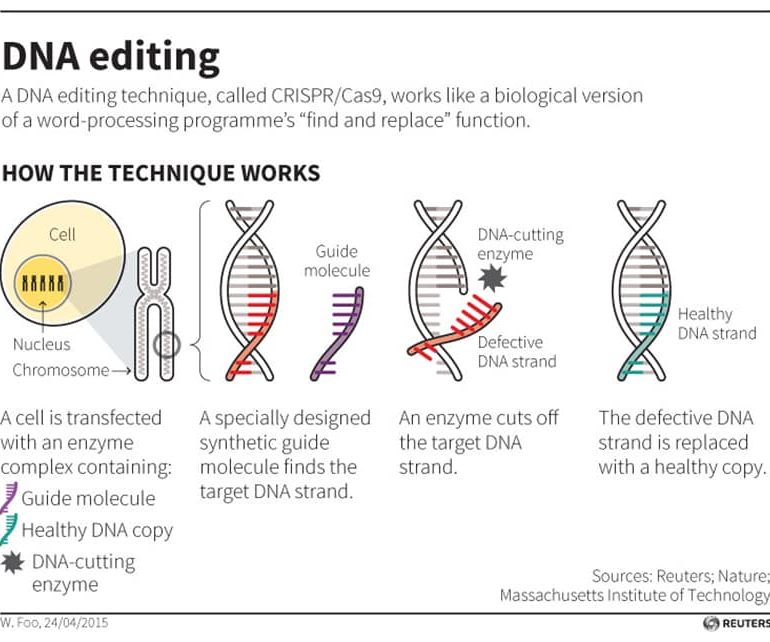
CRISPR is a technique to edit genes. It has been compared to a word processor to edit the genome of any living organism. This capability has the power for breakthrough developments such as biofuels, disease resistant and more nutritious crops, and actually “repairing” a human gene that causes a deadly disease such as sickle cell anemia. But, like nuclear energy, CRISPR can be used for good or bad. Should we “fix” or even “improve” nature? What regulations are called for? Can the genie be put back in the bottle? Jack Fitzgibbons will lead the discussion as we struggle with this promising but challenging technology.

https://dariendma.org/wp-content/uploads/CRISPR-US-Patient.pdf
https://dariendma.org/wp-content/uploads/CRISPR-What-are-the-Ethical-Concerns-of-Genome-Editing.pdf
Discussion leader: John Schlachtenhaufen

Everybody has an opinion – and someone to blame – but in this discussion we’ll dig deep into the data and look for realistic solutions.
Opening commentary:
CONNECTICUT FISCAL STABILITY AND ECONOMIC GROWTH
Connecticut has been amassing unfunded liabilities for decades and the amount today approaches $100 billion, primarily associated with employee and teacher pensions, and associated other post employment benefits (OPEB). Part of today’s problem is driven by an attempt to more fully fund this exposure.
As we try to understand how we got here, 2 years in recent history have had very significant impact, 1991 and 2008. After a bitter battle, CT enacted an income tax in 1991. The top rate was 4.5%, partially offset by a reduction in sales tax from7.5% to 5%. In 1990, the population was 3.29 million and the general fund expenses were $7.1 Billion.
By 2008, the year the deepest and longest recession in memory began, our population had grown about 7% to 3.5 million, and the State budget had doubled to $14.1 billion. A move to raise the top tax rate to 7.5% from 5% was vetoed and the sales tax was increased slightly to try to balance the budget.
In the last decade, the population remained essentially flat at 3.57 million while the proposed budget for 2020 has grown by nearly 50% to $20.9 billion. In the meantime, CT remains the only State to have lost jobs in that period, and only 10,000 jobs were added last year. In this last(lost) decade our Gross State Product (GSP) has declined 7%, while all surrounding States have seen an increase of from 3 to 7%. Connecticut ranks near bottom in terms of business friendliness. (tax & infrastructure)
The no growth problem is exacerbated by a demographic shift as older, wealthier people who do not tax the infrastructure are replaced by relatively younger, less established people who do. (schools, roads and affordable housing)
The bottom line is that expenses have been growing and are likely to continue to grow faster than revenues, given long term State employee commitments and dismal revenue growth prospects. New revenue sources must be tapped or expenses reduced, or preferably both.
GOVERNOR LAMONT’S 2020-2021 BUDGET PROPOSAL
With decisions made by last year’s legislature, CT faces a $1.5 billion deficit in 2020 and a $2 billion deficit in 2021, (the biennium), and that does not include the $400 million earmarked for transportation infrastructure. Gov. Lamont has submitted a budget that closes these gaps. Key elements of his proposal, which requires legislative approval are the following:
- Keep in place those policy items proposed to sunset this year. That produces just under $1 billion in revenue. Key items include maintaining the hospital surcharge and the concomitant Federal reimbursement it brings for a total of almost $800 million. Also, no reduction in corporate income tax, but phase out of gift tax and increased estate tax threshold plan stays.
- “Modernize” the sales tax to include many services not currently taxed. No tax on medical or grocery bills. 2020 impact is $292 million; 2021 impact is $505 million.
- Combine the State and teacher’s retirement funds, change teacher’s fund growth assumption to match State at 6.9%, and refinance these over 30 years, instead of eliminating unfunded liabilities in 12 years, which was the plan. 2020 impact is$365 million; 2021 impact is $467 million.
- Do not transfer $400 million per year out of general fund to the transportation fund, but finance these years from the current surplus. Develop a new revenue source for transportation via tolls on I-95, I-91, I-87 and the Merritt Parkway. Estimated cost for 50 gantries is $5 million each and 5 years before $1 of revenue. Bond this project to level the expense/revenue flows.
Governor Lamont’s proposed budget closes the gap and provides for balance in both years. He has accomplished this without any meaningful expense cuts and with no increase in tax rates, but choosing to tax new elements through broadening the sales tax and tolling major roads. His proposed budget includes a host of items which have minimal financial impact, but which informed citizens should be aware of, including the following:
1) Forced school regionalization to achieve economies of scale. This has been
modified to “encourage voluntary efforts by schools to seek procurement
savings, etc.”
2) A portion of teacher current new pension costs to be charged to Towns, by
formula. 5% of costs for troubled cities; 25% of costs for most Towns;
higher costs for Towns paying teachers over State median wage.
3) State employee and retiree health care prices to be tied to Medicare by
formula; doctors and hospitals to bear cost.
4) State to implement a “debt diet” to limit new bond authorizations.
5) New container deposit. 10 cents per bag; 25 cents per wine/alcohol bottle.
6) Tobacco & e-cig purchase age 21; tax e-cigs for parity with tobacco.
7) Tax of 1.5 cents on sugar sweetened beverages.
8) Increase CT minimum wage in steps to $15/Hr by 1/1/2023.
Unfortunately, with regard to proposed expenses, Connecticut does not employ zero based budgeting. In the governor’s proposal, all adjustments are shown as changes from the prior year, so it is difficult to know where the money is going. Here is the best I can do. Of the $21.2 Billion total, $19.3B is for the General Fund, up $.3B and $1.7 B is for the special transportation fund, up $.4B. The other largest categories are insurance at $105M and the tribal fund at $50M, unchanged.
Within the General Fund, assuming prior year breakout, 33.3%is for personnel, including fringes; 13.5% is for Medicaid grants; 5.5% for teacher’s retirement; 11.5% for education equalization grants; 3% for magnet /pilot schools; 11% for debt service; and 9% for other current expense and equipment. Examined by function, 28% is for education, museums and libraries; 17% is for human services; 10% for health; 8% for correction; 10% for government services, including judicial, protection, conservation and legislative. A very large 26% is for non-functional use.
CONCLUSION/CHALLENGE
Connecticut would have a temporary budget balance for 2020-2021, without trimming expenses or raising tax rates. Instead, new sales taxes on services and highway/congestion tolls would be imposed. However, in future, expenses would continue to rise faster than revenues in all likelihood with current trajectories.
Assuming most session attendees will have read this summary or are otherwise familiar with the issue, I would propose that discussion focus on creative ways to increase revenues, lower expenses and most of all, ways to encourage economic growth.
Lamont’s Budget Proposal: https://dariendma.org//wp-content/uploads/Gov-Lamont-FY20-FY21-Budget-Presentation-2-20-19.pdf
https://ctmirror.org/2017/01/30/a-legacy-of-debt-connecticut-standing-on-its-own-fiscal-cliff/
https://ctmirror.org/2017/01/31/a-legacy-of-debt-squeeze-on-states-priorities-only-getting-tighter/
https://ctmirror.org/2017/02/03/a-legacy-of-debt-when-fiscal-reality-meets-political-spin/
https://ctmirror.org/2018/11/30/can-efficiency-save-state-government-1-billion-per-year/
The Commission on Fiscal Stability and Economic Growth produced a bleak assessment of Connecticut’s fiscal health for the incoming governor and General Assembly https://ctmirror.org/2018/11/28/second-effort-sound-fiscal-alarm-connecticut/
https://ctmirror.org/2018/12/13/advocates-warn-fiscal-caps-tighten-social-services-local-aid/
https://ctmirror.org/2018/12/04/lamont-taps-hartford-budget-chief-solve-cts-fiscal-crisis/
https://ctmirror.org/2018/12/17/millionaire-suitcase-man-myth/
CT’S LEGACY OF DEBT WAS MALLOY’S ULTIMATE CHALLENGE: https://ctmirror.org/2018/12/26/cts-legacy-debt-malloys-ultimate-challenge/?utm_source=Connecticut+Mirror+Mailing+List&utm_campaign=c751074ff2-DAILY_BRIEFING_AFTERNOON&utm_medium=email&utm_term=0_571d22f8e4-c751074ff2-68155097
Another article about the wealthy leaving. This from the Yankee Institute: http://www.yankeeinstitute.org/2018/12/packed-up-and-ready-to-go-those-who-can-that-is/
Connecticut Commission on Fiscal Stability
Report 1.0
Report 2.0
Click on this URL GROWING JOBS AND CONNECTICUT’S TRANSPORTATION CRISIS to view the following documents:
- THE GEOGRAPHY OF JOBS NYC Metro Region Economic Snapshot
- Overview of the Business Council of Fairfield County
- Special Transportation Fund (STF) 2018-R-0088
- Assessment of Reason Foundation’s National Transportation Reports
Click on this URL NEW CANAAN BRANCH LINE – PROPOSED CTDOT ENHANCEMENTS to view the following documents:
- Connecticut State Rail Plan 2012-2016
- Next Steps on Implementing the proposed CTDOT Enhancements on the New Canaan Branch Line
- New Canaan Study Team Detailed Report on CTDOT Enhancements to the New Canaan Branch Line
Click on this URL HIGHWAY TOLLIING to view the following documents:
- CTDOT Study for Implementing Tolls in Connecticut
- Debunking the Myths about Highway Tolling
- Tolling the Freeway: Congestion Pricing and the Economics of Managing Traffic
- Dynamic Tolls for Congestion Control
Click on the following URL to watch a video of Jim Cameron and Joe McGee talking about how Jobs Growth in Connecticut is linked to significant upgrading of Connecticut’s Transportation Infrastructure: https://vimeo.com/258249483
Connecticut’s Commission on Financial Stability and Economic Growth (FSEG)
Click on this URL CONNECTICUT COMMISSION ON FISCAL RESPONSIBILITY & ECONOMIC GROWTH to view the following documents:
- FSEG Final Report with Appendix March 2018
- Lamont’s Recommended Budget for FY 2020 – FY 2021
- Robert Patricelli’s Observations on Lamont’s Recommended Budget for FY 2020 – FY 2021
- James C. Smith presentation on Stimulating Economic Growth through Private/Public Partnerships
Overview of the Fiscal Stability and Economic Growth (FSEG) Commission
Senate Bill No. 1502 June Special Session, Public Act No. 17-2 Sec.250 established a Commission on Fiscal Stability and Economic Growth which shall develop and recommend policies to achieve state government fiscal stability and promote economic growth and competitiveness within the state. The commission shall study and make recommendations regarding state revenues, tax structures, spending, debt, administrative and organizational actions and related activities, including relevant municipal activities, to (1) achieve consistently balanced and timely budgets that are supportive of the interests of families and businesses and the revitalization of major cities within the state, and (2) materially improve the attractiveness of the state for existing and future businesses and residents.
While the FSEG Commission was disbanded when it submitted their Report on March 1, 2018 it continued to function and on November 28, 2018 a second round of recommendations to curb the state’s multibillion-dollar deficit and jumpstart growth was issued by Patricelli and Smith. They billed the new recommendations as “Report 2.0” at the state Capitol building even though it is no longer operating under the state.
On March 13, 2019 Bob Patricelli and Jim Smith spoke to the Darien Men’s Association about the Connecticut Commission on Fiscal Stability and Economic Growth (FSEG) to the. Bob’s presentation gave his Observations on Governor Lamont’s Budget Proposal and Jim’s presentation gave his ideas on Stimulating Economic Growth through Private/Public Partnership. They also stated that they have been collaborating with Governor Lamont to agree on the best options for addressing Connecticut’s problems.
Click on this URL to view The Presentations of Bob Patricelli and Jim Smith.
Click on this URL BACKGROUND ON THE PENSION CHALLENGES OF CONNECTICUT to view the following documents:
- How Did Connecticut Become a Fiscal “Basket Case”
- SEBAC 2017 Agreement with State of Connecticut
- Stress Testing in Connecticut Shows Reforms Stabilizing State Pension System
- As Pensions Grow, State Struggling to Pay
- Has Connecticut Found A Solution to Underfunded Public Pensions
- Connecticut Pension Sustainability Commission Established
- Connecticut Pension Sustainability Commission Update
Discussion leader: Gary Banks

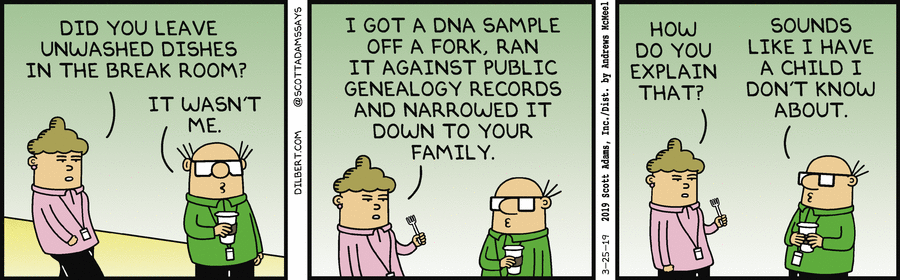
DNA Privacy. It is now inexpensive to at least partially sequence a person’s genome. Companies like Ancestry.com, GEDMatch and 23andMe.com have done it for over 20 million people. There are other databases where people have uploaded their DNA profile insearch of relatives. There are also growing databases, some public, with individual’s DNA gathered from medical testing or crime events. Recently, a cold case of rape/murder was solved by taking DNA from the crime scene and quickly identifying the killer’s cousin that then lead to an arrest. That’s good to solve a horrible crime but there are also risks and concerns.
Certainties:
- Almost all of us have, will shortly have, our DNA profile, or that of a close relative, in an on-line database. It could be from genealogy hobbyists, voluntary samples, medical tests or police actions. There will be incentives and pressure to be profiled, e.g., Stamford Health will need your DNA profile as part of their standard healthcare program – you may have already consented. Babies are being tested at birth. All those routine blood tests could be stored for medical research.
- The massive DNA databases, along with personal medical history will lead to healthcare breakthroughs for both us personally and the public health overall. Personalized medicine – both treatments and prevention is the future.
- The DNA databases can be searched with a court order, but many are open and companies will be building their own databases. It easy to picture an offer for a “free” DNA test (like free email or facebook) if you send them a sample. Police can simply upload a DNA profile and search for relatives.
- The predictive value of your DNA profile will improve – or at least people and organizations will believe it is predictive. Those predictions could involve health, behavior, intelligence, …
- Companies and organizations will figure out a way to monetise and benefit from that data.
I have a bad feeling this is already out of control:
- Companies such as insurance, pharmaceutical, your employer, police, or schools will exploit your DNA profile. Given the experience with google and facebook, any sort of opt-in or consent laws will be ineffective. Think of spam from a pharmaceutical company “Your DNA profile indicates you are at risk of macular degeneration – take our stuff now and save your eyes. ” Or “Your child’s DNA profile indicates they will not succeed in our most demanding academic program.” “Your DNA profile indicates you should not own a gun, have a pilot’s license, or be trusted with children.” Companies would claim they are providing a public service – and say talk to your doctor. Modern day eugenics.
- How about discoveries made from your DNA? Think of Henrietta Lacks – 17,000 patents derived from her cells without compensation. A few people survive deadly things – ebola, HIV, cancer, … Do you deserve compensation if you have some unique and valuable genetic trait that a pharmaceutical company uses? Legal precedent is you don’t have rights over your bio samples.
- Can a dating company require genetic testing to claim they only match people who have compatible genetics? Should you avoid marrying a person who carries the same deadly recessive gene as you?
- Most of us would not volunteer our fingerprints or consent to have our phone tapped. Yet we don’t even have to directly have our DNA sequenced to be visible to the government. It is legal to collect a coffee cup or cigarette butt to get a DNA sample. Police departments are using desktop machines, under less than rigorous laboratory protocols by people with limited training. Seems like fishing is inevitable – e.g. browse for local people who “lack empathy”. Risk of false charges or being brought in for questioning.
- Are we capable of responsibly interpreting the data? The public is not allowed to write their own prescriptions. Could people have their lives ruined – be filled with anxiety, get dangerous or useless medical treatments, fall prey to quacks, even be driven to suicide by not having a medical professional interpret the data? Google “headache” to get a scare.
- Already the DNA testing companies warn people they may be upset by what they find. Your parents and siblings are not biologically who you thought they were. Sperm donors being identified. A sibling you didn’t know you had. There are happy endings for sure – but not always.
- Lack of checks and balances. Without them there will be abuse.
From The Conversation:
Your genome may have already been hacked. https://theconversation.com/your-genome-may-have-already-been-hacked-95763
DNA apps promise deeper insights for consumers – but at what cost? https://theconversation.com/dna-apps-promise-deeper-insights-for-consumers-but-at-what-cost-96257
Americans want a say in what happens to their donated blood and tissue in biobanks Americans want a say in what happens to their donated blood and tissue in biobanks
5 biggest risks of sharing your DNA with consumer genetic-testing companies https://www.cnbc.com/2018/06/16/5-biggest-risks-of-sharing-dna-with-consumer-genetic-testing-companies.html
China Uses DNA to Track Its People, With the Help of American Expertise. The Chinese authorities turned to a Massachusetts company and a prominent Yale researcher as they built an enormous system of surveillance and control.
Genealogists Turn to Cousins’ DNA and Family Trees to Crack Five More Cold Cases https://www.nytimes.com/2018/06/27/science/dna-family-trees-cold-cases.html
A Mother Learns the Identity of Her Child’s Grandmother. A Sperm Bank Threatens to Sue.
https://www.nytimes.com/2019/02/16/health/sperm-donation-dna-testing.html
How your third cousin’s ancestry DNA test could jeopardize your privacy. Public DNA databases can be used to find you — even if you never shared your own DNA. https://www.vox.com/science-and-health/2018/10/12/17957268/science-ancestry-dna-privacy
We will find you: DNA search used to nab Golden State Killer can home in on about 60% of white Americans https://www.sciencemag.org/news/2018/10/we-will-find-you-dna-search-used-nab-golden-state-killer-can-home-about-60-white
How an Unlikely Family History Website Transformed Cold Case Investigations. Fifteen murder and sexual assault cases have been solved since April with a single genealogy website. This is how GEDmatch went from a casual side project to a revolutionary tool. https://www.nytimes.com/2018/10/15/science/gedmatch-genealogy-cold-cases.html
When a DNA Test Reveals Your Daughter Is Not Your Biological Child https://www.theatlantic.com/science/archive/2018/10/dna-test-divorce/571684/
23 and me Privacy Policy. https://www.23andme.com/about/privacy/
Ancestry.com Privacy Statement https://www.ancestry.com/cs/legal/privacystatement
The FBI’s CODIS database: https://www.fbi.gov/services/laboratory/biometric-analysis/codis
Also on CODIS:
An overview of human genetic privacy from the NIH: https://www.ncbi.nlm.nih.gov/pmc/articles/PMC5697154/
Coming Soon to a Police Station Near You: The DNA ‘Magic Box’
https://www.nytimes.com/2019/01/21/science/dna-crime-gene-technology.html
Testing DNA: In her new book, Erin Murphy investigates how the criminal justice system misuses genetic identification
http://www.law.nyu.edu/news/ideas/erin-murphy-forensic-dna
Familial DNA Searches and the Law
https://criminal.findlaw.com/criminal-rights/familial-dna-searches.html
ACLU: The Police Want Your DNA to Prove You’re Innocent. Do You Give it to Them?
FamilyTreeDNA Admits to Sharing Genetic Data With F.B.I.
https://www.nytimes.com/2019/02/04/business/family-tree-dna-fbi.html
Jerry Westrom Threw Away a Napkin Last Month. It Was Used to Charge Him in a 1993 Murder.
https://www.nytimes.com/2019/02/17/us/jerry-westrom-isanti-mn.html
Privacy, Security, and the Legacy of 9/11 – Daniel Klau, UConn Law
https://today.uconn.edu/2015/09/privacy-security-and-the-legacy-of-911/
Electronic Frontier Foundation on Medical Privacy
https://www.eff.org/issues/medical-privacy
Dear Mr. Banks,
Thank you for your inquiry. Generally, and depending on the test ordered by your physician, blood samples are retained anywhere from 3 days to 2 weeks after the testing is performed, after which they are appropriately discarded.
Regards,
Todd M. Lieval
Privacy Analyst
Discussion leader: Bryan Hooper
Opening Notes:
BREXIT: Why should we care?
At a seminar I attended in the UK many years ago each participant was asked to consider the future of their industry or professional group. When it was his turn to make his forecast, a lawyer stood up and declared that “the legal profession has no future, but it has a long and glorious past stretching in front of it.” Some might say the same about the United Kingdom of Great Britain and Northern Ireland as it wrestles with the problems created by the vote in June, 2016, to exit the European Union.
To help answer the question in the title above it might be helpful to have an understanding of some of the history of the UK, the development of the EU, and how the UK came to be in its current situation – if the situation ever becomes clear, that is.
- The United Kingdom (UK)
Great Britain was created by the English annexing Wales in 1535 and 1542 and forming a union with Scotland in 1707. The kingdom of Ireland was added in 1801, and Northern Ireland was formed in 1922 when what became Eire seceded from the kingdom and established an independent country. The combination of Great Britain and Northern Ireland is the United Kingdom. All four countries elect members to the UK parliament that sits in Westminster, London, and, in addition, Wales, Scotland and Northern Ireland each has a separate devolved parliament. The total population of the UK is 66 million, with England at 55.6, Scotland 5.4, Wales 3.1 and Northern Ireland 1.9 million. Gross domestic product of the UK is the fifth largest in the world at an estimated $2.8 trillion in 2018 out of a world total of $84.8 trillion. To put this in perspective, the US GDP was $20.5, China $13.5, Japan $5.1 and Germany $4.0 trillion.
- The European Union (EU)
It is ironic in today’s discombobulated Brexit climate that in 1946 Winston Churchill, a Conservative statesman, was one of the early advocates of a United States of Europe. The EU traces its origin to the formation of the European Coal and Steel Community created during the recovery from World War II by the Treaty of Paris in 1951. The subsequent Treaty of Rome in 1957 led to the establishment of the European Economic Community comprising six countries: West Germany, France, Italy and the Benelux nations. The UK eventually joined the EEC in 1973 having been rebuffed initially by the French in 1963.
In 1975 the UK held its first ever nationwide referendum, and it concerned staying in the EEC. The government recommended the UK should remain in the group, and the electorate voted 67% in favor on a 64% turnout. In 1993 the Maastricht Treaty came into effect for the 12 countries of the EEC. That treaty established the EU together with European citizenship, it ensured the free movement of people, goods, services and capital within the market, and enabled the enaction of legislation covering justice, home affairs and trade policies. It also laid the foundation for the common currency, the euro: the EU now has 28 member countries and 19 of them use the euro. The population of the EU is 513 million and GDP in 2018 was estimated at $18.8 trillion, approximately 22% of the world’s GDP, compared with the US share of 24%.
- The Brexit Referendum
(a) The political timeline
David Cameron, leader of the Conservative Party, won an unexpected victory over the Labour Party in the UK general election in 2010. The Conservatives did not, however, gain sufficient votes to form a clear majority and they allied with the Liberal Democratic Party to form a coalition government with Cameron as Prime Minister.
-2-
Animosity in the UK toward the EU had gradually increased since the terms of the Maastricht Treaty were enforced in 1993, and the Treaty of Lisbon exacerbated the situation when it was implemented in December, 2009. This gave increasing power to the EU parliament and also fueled the anti-immigrant feelings in the UK which had been developing and strengthening as the EU expanded its number of member countries and assigned more power to the European Parliament in Brussels. During and after the world financial crisis in 2008 the resentment intensified with many in the UK objecting to immigrants taking away jobs from the UK population and some allegedly living off the UK by taking advantage of social welfare handouts. Further dislike of the EU was fostered by the crisis in the Eurozone creating economic uncertainty, and the rise of terrorism that was also blamed on immigrant factions. Pressure built up to fix the UK economy and react to the growing power arrogated by the EU.
Cameron called a general election in 2015 during which he promised another referendum on staying in the EU. The conservatives won enough seats this time to form a majority government (over 326) without the assistance of another party. In the table below are shown the seats won in 2015 compared with 2010 and also the percentage of the vote won by the main parties:
|
Party |
Members of Parliament |
Share of MPs (%) |
Share of Votes (%) |
|
|
2010 2015 |
2010 2015 |
2010 2015 |
|
Conservative |
306 330 |
47.1 50.8 |
36.1 36.8 |
|
Labour |
258 232 |
39.7 35.7 |
29.0 30.4 |
|
Scottish National |
6 56 |
0.9 8.6 |
1.7 4.7 |
|
Liberal Democrats |
57 8 |
8.8 1.2 |
23.0 7.9 |
|
Democratic Unionist |
8 8 |
1.2 1.2 |
0.6 0.6 |
|
UK Independence |
0 1 |
0.0 0.2 |
3.1 12.6 |
|
Speaker |
1 1 |
0.2 0.2 |
0.2 0.2 |
|
Other |
14 14 |
2.1 2.1 |
6.3 6.8 |
|
Total |
650 650 |
100.0 100.0 |
100.0 100.0 |
Note in 2015 the growth of the Scottish National Party (SNP), the decline of the Liberal Democrats, and the share of the vote won by the UK Independence Party (UKIP):
- The electorate in Scotland had rejected separating from the UK in a referendum held in September, 2014, voting 55% to stay, with a very high turnout of 85%. However, the whole process of the independence plebiscite stirred nationalist sentiment and that carried over to the UK general election in 2015 as the SNP won 56 of the 59 available seats in Scotland.
- The Liberal Democrats paid the price for being in coalition with the Conservative Party in the last government, losing 49 of the 57 seats they held previously.
- The Democrat Unionist Party (DUP) retained 8 of the 18 seats available in Northern Ireland.
- Labour won 25 of 40 seats in Wales.
- The Conservative Party took 316 of 533 seats in England.
- In 2014 UKIP candidates took 27% of the vote in the UK for the European Parliament, ending up with 24 out of the 73 seats assigned to the UK, and greater than the seats won by either of the two major UK parties. In the 2015 UK general election UKIP picked up only one seat, but their 13% share of the total vote was a signal of what was to come in 2016.
-3-
(b) The fateful vote
Prime Minister David Cameron and his government passed the Enabling Act in February, 2016, authorizing the referendum to be held for remaining or leaving the EU, and announced the date of June 23, 2016, for it to occur.
The government threw its support behind the Remain camp, but Cameron allowed Conservative Party members of parliament (MPs) and members of his Cabinet to make their own decisions on which side to support. Seven cabinet members joined the Leave faction. Boris Johnson, former Mayor of London and an MP, plus Michael Gove, Secretary of State for Justice, together with UKIP leader, Nigel Farage, spearheaded the Leave side. Arguments for Remain were that the UK would risk prosperity, jeopardize national security, lose jobs, delay investment in the UK, and lose influence in world affairs if they left. The Leave group argued that the EU had a deficit of democracy, it undermined national sovereignty and prevented the UK from making better trade deals. Leaving would give control of immigration back to the UK and save billions of pounds in membership fees. The Leave group appeared to take better advantage of social media than the Remain team, spreading the memes that emphasized the potential danger of immigration from Turkey if it became a member, and also trumpeting that leaving the EU would free up £350 million a week ($24 billion annually) to be spent on the UK National Health Service. Neither of these messages were countered effectively by the Remain side.
The results of the referendum surprised everyone – to say the least. The overall vote in the UK to leave the EU was 52% versus 48% to remain, and the turnout was 72% of the electorate (compared with a 64% turnout in 1975 when 67% to remain in the EEC). On a country basis, England voted to leave by 53.4%, and Wales at 52.5% also voted to leave. In England only Greater London voted to remain, while all other regions opted to leave. Scotland at 62.0% and Northern Ireland at 55.8% voted to remain in the EU.
Prime Minister Cameron announced his resignation the next day and Theresa May, the Home Secretary, took over on July 13, 2016. May was one of the ministers who had supported the Remain campaign. On March 29, 2017, the UK government invoked Article 50 of the Treaty on European Union to leave the EU by March 29, 2019, and so began the process of planning and negotiating terms of the withdrawal.
(c) The 2017 election
On April 18, 2017, Theresa May called for a general election in order to strengthen her hand in negotiations with the EU, and set the date for June 8th. Strong support for her government diminished considerably by the time the election occurred, and the Conservative Party lost 13 seats. They ended up 9 short of an overall majority, but continued in power as a minority government with the backing of the 10 votes of the DUP from Northern Ireland.
|
Party |
Members of Parliament |
|
|
2015 2017 |
|
Conservative |
330 317 |
|
Labour |
232 262 |
|
Scottish National |
56 35 |
|
Liberal Democrats |
8 12 |
|
Democratic Unionist |
8 10 |
|
UK Independence |
1 0 |
|
Speaker |
1 1 |
|
Other |
14 13 |
|
Total |
650 650 |
-4-
(d) The draft agreement and the options
May then proceeded to negotiate with the EU with a view to avoid permanent membership of the single market or the customs union and to repeal membership of the EU. In July 2018, the PM’s cabinet agreed to the Chequers plan which outlined the proposals made by the UK government, and in November, 2018, the draft Agreement on the Withdrawal of the United Kingdom from the European Union as developed between the UK and EU was published – all 585 pages.
The proposal allows for the UK to transition out of the EU over the period March 29, 2019 to December 31, 2020. In the interim, it will remain in the customs union, continue to pay into the EU budget and apply EU laws while negotiating further with the EU on new trade deals. The UK will have no representation in making decisions in the EU during the transition. In case no agreement is reached by the end of 2020 there is a backstop agreement that says the UK will remain in a customs union with the EU, thus avoiding the necessity of setting up a hard border with customs checks between Northern Ireland and Eire, which would avert a potential conflict in this previously troubled area. This part of the agreement is difficult for Brexit supporters to accept. They have consistently argued that Britain must be able to exit any UK customs union with the EU as and when it wants so as to be able to pursue free-trade deals around the world. The DUP objects to the backstop since it treats Northern Ireland differently from the rest of the UK and could promote a renewal of talk and action on reunification of Ireland and leaving the UK.
The draft agreement was submitted by the UK government for approval to parliament on January 15, 2019, and went down to defeat by 432 votes to 202, an extraordinary and record margin of 230 for a government loss. Nonetheless, the Prime Minister survived a vote of no confidence the next day by 19 votes. Non-binding amendments were then approved by parliament on January 29 that rejected a no-deal Brexit and authorized the Prime Minister to return for talks with the EU to alter the Irish backstop to allow for alternative arrangements.
The EU negotiators have already stated there will be no changes made to the draft agreement, but meetings are continuing, and Prime Minister May will present revised proposals to parliament later in February.
(e) What will happen?
There are several possibilities:
- The chaotic solution nobody wants is that a hard Brexit occurs on 3/29/19 with no agreement in place.
- The UK and EU come to a new arrangement over the Irish backstop, and a more amicable divorce is agreed between the two participants.
- The UK decides to have another referendum if parliament votes for it. Additionally, Scotland has the right to vote for independence in a second referendum once Brexit terms are decided, and might subsequently apply for membership of the EU.
- The decision is deferred for a few months, although that could create problems since there are elections in May for the EU parliament and the UK theoretically would still have to vote to fill their EU seats.
- Why should we care?
An open question, and one for discussion at our meeting on February 21, 2019.
To get everyone started on their reading of the subject of Brexit I would suggest the article on the Conversation website: https://theconversation.com/whats-the-deal-or-no-deal-with-brexit-heres-everything-explained-110024
Another excellent source is the BBC news website: https://www.bbc.com/news
to find “All you need to know about Brexit.” Enter Brexit in the search box to see a summary of the situation and links to give you greater insight into several subjects.
For those of you interested in delving into more background go into Wikipedia and search for the individual articles on the United Kingdom, the European Union, and Brexit. More data regarding the EU can be found on their website, Europa.eu
The Malign Incompetence of the British Ruling Class
https://www.nytimes.com/2019/01/17/opinion/sunday/brexit-ireland-empire.html
Discussion leader: Jim Phillips
Intelligence Squared Debate https://www.intelligencesquaredus.org/debates/social-media-good-democracy-0
Hard Questions: What Effect Does Social Media Have on Democracy?https://newsroom.fb.com/news/2018/01/effect-social-media-democracy/
Facebook Says Social Media Can Be Negative For Democracy https://www.npr.org/sections/thetwo-way/2018/01/22/579732762/facebook-says-social-media-can-be-negative-for-democracy
Guest Post: Is Social Media Good or Bad for Democracy?https://newsroom.fb.com/news/2018/01/vromen-democracy/
Without Transparency, Democracy Dies In The Darkness Of Social Media https://www.forbes.com/sites/kalevleetaru/2018/01/25/without-transparency-democracy-dies-in-the-darkness-of-social-media/#41017c4a7221
Why social media may not be so good for democracyhttps://theconversation.com/why-social-media-may-not-be-so-good-for-democracy-86285
Discussion leader: Charlie Goodyear
Summary :
SINGLE PAYER HEALTHCARE SYSTEMS
USA Healthcare System
-17% of GDP (was 7% in 1971) vs. 9% Canada,10% UK, 10% Germany
-Coverage :
+50% Employer (155 million people, cost $20,000/family, employee pays
$5000)
+14% Medicare (+/- 55 million people)
+12% Medicaid, Veterans, Native Americans (+/- 50 million people)
+ 7% ACA purchased (+/- 20 million people)
+ 8% Emergency Room, Other
+ 9% Uninsured (+/- 30 million people)- 80% US citizens
-Drug costs : $1000/per person/year vs. OECD $500
-Estimated 100-130 million people have “pre-exsisting conditions”
-Life expectancy below OECD countries, Infant mortality higher
-Reasons for higher costs vs OECD countries :
+ Technology and drugs ( eg more MRIs per capita, no drug price controls)
+ Obesity (35% vs 19% OECD) and chronic illnesses (32% of Medicare costs
cover the last two years of life)
+ Much higher administrative costs (4% of GDP), double the staffing vs Canada
-Healthcare costs a major factor in personal bankruptsy( !0 million have bills they can’t
pay )
Canada Healthcare System
-Single payer system covering 100% of the population -no co-pays or deductables
-Doctors and hospitals privately owned and managed within system rules
-Managed by Provincial governments who pay all doctor and hospital charges
-System funded 50/50 with Federal government
-Provinces set prices and proceedures that comply with Federal requirements
-No private insurance allowed except for drugs and dental not covered by System
-Heavy involvement in drug pricing and approval, cost benefit analysis
-Essentially no US type media drug advertising
-Doctors earn about 2/3 of what US doctors earn/year
-Lower availability of medical devices (eg. 75% fewer MRIs per capita than US)
-Open heart and transplant surgery restricted
– Major problems: waiting times for referral to specialists (+/- 16 weeks ), doctor
choice limited, long delays for elective surgery
United Kingdom Healthcare System
-Single payer system covering 100% of the population-no co-pays or deductables
-Doctors are government employees and hospitals are government owned
-Managed by major regional authorities (ie Britain, Wales,Scotland, etc)
-Drug prices controlled by the government, strict cost/benefit analysis. No US
type media drug advertising
-Drug prescriptions cost about $12/ each, free for children.
– No dental coverage for adults
– Doctors earn about 2/3 of what US doctors earn
– Individuals may purchase insurance coverage with doctors in private practice
– Major problems: Long wait times (+/- 10 weeks for general surgery), limited availabiliy
of new(expensive) or experimental treatments, cost/benefit analysis, lack of mental
health services, very long delays for elective surgery
-Per capita costs $4K/year vs US $10K/year
-Many say “Underfunded but not broken “
Germany Healthcare System ( An alternative to “single payer” ??)
-An insurance based system with non profit and for profit insurers
-Covers 90% of population- required participation for all but highest earners
-Funded by 50/50 contribution by employers and employees -15% of earnings
up to about $70K/year (2014 data)
-Private doctors and hospitals but highly regulated
-No deductables and low co-pays -children are free
-Managed by regional authorities via “sickness funds” that are used to control
total costs
– Drug prices are controlled, cost/benefit analysis, no US type public advertising
– Doctors earn about 2/3 of US doctors/year
– Per capita costs less than 1/2 of US
– Surveys indicate significantly higher public satisfaction with the system vs US,
Canada or UK
( The relationship between the insurance companies, doctors, hospitals ,employers,
employees individuals and the regional government bodies is unclear and needs
further analysis and understanding)
Comparisons of Health Care Systems in the United States, Germany and Canada
https://theconversation.com/why-market-competition-has-not-brought-down-health-care-costs-78971
https://theconversation.com/medicare-for-all-could-be-cheaper-than-you-think-81883
The article below on drug cost shows how complicated healthcare is to understand, much less manage. Factors such as age of population, availability of new drugs, the number of insured, etc. all interact.
The False Promise of ‘Medicare for All’
Cost is only part of the problem. Single-payer systems create long waits and delays on new drugs.
Discussion leader:Jack Neafsey
Discussion outline:
Global Warming
What we probably agree on by Bob Baker:
Atmospheric CO2 levels are now at the highest of the past million years. This has occurred while CO2 emissions have risen since the start of the industrial revolution.
Current atmospheric level of 410 ppm compares to 280 ppm at start of industrial revolution
For the past 4-5 years CO2 emissions have leveled off at about 100 million tons per day.
This compares with about 60 million tons per day in 1990, when temperatures were rising.
Global temperatures have an erratic yr. to yr. change but have risen since 1950 by about .7 degree C at sea level and about 1 degree C at land surface.
In 1990, the temp. increases were at about their midpoint, such that if CO2 emissions were to drop to the 1990 level, we would not expect any decline in the rate of temperature increase.
The growth in CO2 emissions from fossil fuels has resulted from the consumer choice for consuming these fuels vs alternatives. The added cost for alternatives is not known.
What is at issue is the target in the “Paris Accords” to limit global temperature rise to 2.0 degrees C (but with a preferred target of a 1.5degree rise) in some target year. No agreed level of global emissions has been set; any reduction of atmospheric CO2 will need “CO2 capture and containment” which has not been demonstrated as feasible on a large scale. Lowering CO2 emissions does not lower atmospheric CO2 levels.
Estimated costs for meaningful reductions in fossil fuel use are huge, with the assumption that these will offset future costs of higher world temperatures.
About a billion persons do not have access to a reliable supply of electricity. What is the optimum method/cost for meeting this demand?
Several humanitarian uses for large expenditures can be identified which can yield with near-term results. (Between and one and two million persons die each year: lack of clean water, malaria, HIV and malnutrition).
What is the best use of huge mandated expenditures?
What’s with this wild weather? Blame an ‘extreme’ jet stream pattern.
The Washington Post
“Even veteran meteorologists with decades of experience are astounded,” said Capital Weather Gang’s severe weather expert.
https://www.washingtonpost.com/news/capital-weather-gang/wp/2018/07/25/extreme-jet-stream-pattern-has-spurred-a-week-of-wild-weather-in-u-s/?noredirect=on&utm_term=.36353023b7f0
WSJ – Economics of Climate Change
Major Trump administration climate report says damages are ‘intensifying across the country’ – The Washington Post
California’s Death Valley Will Have the Hottest Month Ever Recorded on Earth
Gizmodo
July has been one for extreme heat around the world, but every locale pales in comparison to what’s going on at Death Valley in California. Already one of the hottest places on the Earth, the heat has gone into overdrive this July. Death Valley is in line to set a record for the hottest month ever recorded on Earth.
https://earther.gizmodo.com/californias-death-valley-will-have-the-hottest-month-ev-1828001766
Startling new research suggests even faster rate of global warming
The Washington Post
More than 90 percent of global warming ends up in the oceans.
The Climate Won’t Crash the Economy
A worst-case scenario projects annual GDP growth will be slower by 0.05 percentage point. WSJ 11/27/18
Climate Change Is Affordable
A new assessment allows us to think about good policy without panicking.
https://www.wsj.com/articles/climate-change-is-affordable-1543362461?mod=searchresults&page=1&pos=6
You should read this.note the comment that U S emissions are declining and are now 14% versus China’s 27%. China’s are growing rapidly.how does the pact deal with China and India? https://www.nytimes.com/2018/12/05/climate/greenhouse-gas-emissions-2018.html
![]()
Discussion leaders: David Mace & Charlie Goodyear
Opening summary: Immigration Opening Comments
Migrants Are on the Rise Around the World, and Myths About Them Are Shaping Attitudes – The New York Times
Migrants Around the World
Key facts about U.S. immigration policies and proposed changes | Pew Research Center
http://www.pewresearch.org/fact-tank/2018/02/26/key-facts-about-u-s-immigration-policies-and-proposed-changes/
Companies Say Trump Is Hurting Business by Limiting Legal Immigration – The New York Times
https://www.wola.org/analysis/fact-sheet-united-states-immigration-central-american-asylum-seekers/
https://www.epi.org/publication/immigration-facts/
Discussion leader: Harris Hester
International Trade – It’s complicated
Foreign Affairs. Three Cheers for Trump’s Foreign Policy: What the establishment misses by Randy Schweller
China’s Small Share of an iphone
This is a brief fact check on the relationship between the federal deficit and the trade deficit.
http://www.crfb.org/blogs/did-trade-deficit-cause-20-trillion-debt
This is a more in depth analysis of the same thing.
https://www.cato.org/publications/commentary/us-trade-deficit-not-debt-repay
41-Straight-Years-Of-Trade-Deficits-Yet-America-Still-Stands-Strong
8:15 Lilian Gade room
Discussion Leader: Charles Salmans
Gun Control
Interpreting The Second Amendment – The Right to Bear Arms
A well regulated militia being necessary to the security of a free state, the right of the people to keep and bear arms shall not be infringed.
The historical debate over the language of this amendment, as to whether this is an individual right or a right in conjunction with service in “a well regulated militia”, has antecedents before the amendment was drafted. John Adams wrote that Congress should not prevent peaceable citizens from keeping their own arms. James Madison, in Federalist Paper 46, wrote about the right to bear arms within state militias as a means to keep in check a federal army.
In a 2008 Supreme Court ruling, District of Columbia vs. Heller, Justice Scalia, writing for the majority, argued that the right to bear arms was a “right of the whole people, an individual right.” Justice Stevens disagreed in a minority opinion, arguing that this was a right in conjunction with service in a well-regulated militia.
The following Wikipedia entry summarizes interpretations and rulings over the years:
https://en.wikipedia.org/wiki/Second_Amendment_to_the_United_States_Constitution
Legal restrictions on weapons ownership that comply with the Second Amendment
The right to bear arms does not guarantee the right to buy or possess any weapon. Wikipedia on Federal Gun Control Laws
https://en.wikipedia.org/wiki/Gun_law_in_the_United_States
In 1939, in US vs. Miller, the Supreme Court upheld the law banning the right to buy, sell or possess a sawed-off shotgun.
From 1994-2004, there was a Federal ban on assault weapons, but that lapsed when Congress refused to renew it under pressure from the NRA. See https://en.wikipedia.org/wiki/Federal_Assault_Weapons_Ban for definition of “assault weapons” under the law.
In the 2008 Heller decision, Justice Scalia wrote that the right to bear arms had boundaries. “Like most rights, the Second Amendment right is not unlimited. It is not a right to keep and carry any weapon whatsoever in any manner whatsoever and for whatever purpose.” For example he cited laws that prohibit the possession of firearms by felons and the mentally ill, or that forbid them in places such as schools and government buildings, or impose conditions on their sale. In other words, gun enthusiasts are wrong when they claim that any limitation on firearms is unconstitutional.
President Trump has called for a ban on “bump stocks” that effectively turn a semi-automatic weapon into a full automatic weapon, but although this has been filed as a proposed rule change by the Justice Department, it has not yet been implemented by the Justice Department and will be challenged.
https://www.huffingtonpost.com/entry/bump-stock-ban-trump_us_5ab92cf5e4b0decad04cb02a
There are also concerns that it will be hard to enforce, as some 500,000 are in circulation.
https://www.wsj.com/articles/proposed-bump-stock-ban-would-be-tough-to-enforce-1523185201
The President has also called for the age limit for purchase of a firearm be raised to 21. That proposal is opposed by the NRA and has not been implemented as yet. http://abcnews.go.com/Politics/president-trump-vows-care-bump-stocks-executive-action/story?id=53421961
CDC and other Data on Gun Deaths
Gun death statistics kept by the CDC (Center for Disease Control) counted 38,658 deaths in 2016 (including suicides). Data collected by Gun Violence Archive, a nonprofit organization that tracks media and law enforcement reports of shootings estimated that
3,964 children and teenagers were shot in 2017 including fatal and nonfatal shootings (CDC: 6,400 children and teens have been shot each year)
Incidents of defensive gun use were 2,030 in 2017 (the majority of gun owners cite self defense as their primary reason for owning a gun.
Unintentional shootings dropped by 9%. Only four states have some form of law requiring gun owners to safely store their guns when not in use, a practice linked to lower rates of accidental shootings.
A trauma surgeon describes high velocity wounds, such as from an AR-15 or an AK-47, that are much more destructive than those from a low velocity weapon. The bullet destroys whole areas of the body and shatters bone into hundreds of microscopic pieces.
When a Bullet Enters a Body: Gun Violence as Seen by a Trauma Surgeon
Correlation between rate of gun ownership and gun violence, effect of Background Checks on gun deaths and suicide rates
Among US states and among countries, there is a correlation between the rate of gun ownership and gun violence.
https://www.vox.com/policy-and-politics/2017/10/2/16399418/us-gun-violence-statistics-maps-charts
Gun ownership correlates with gun deaths. Connecticut and other New England states rank low in gun ownership and gun deaths.
Developed countries with more guns have more gun deaths.
America has six times as many firearm homicides as Canada, 16 times as many as Germany.
The US has 4.4% of the world’s population, but nearly half of all civilian-owed guns around the world.
There have been more than 1,600 mass shootings since Sandy Hook (defined as four or more people shot in an incident) but these are a tiny percentage of firearm deaths.
States with Universal Background Checks had fewer gun deaths and those with stricter gun provisions had fewer suicide deaths.
Federal law requires background checks for anyone purchasing a firearm through a licensed dealer, but says nothing about private sales or transactions at gun shows. Many buyers slip through this loophole. A survey of 1,613 gun-owners published in 2017 found that 42% had acquired their most recent weapon without a background check. The internet has made sales even harder to police. A probe by private investigators hired by New York City in 2011 found that 62% of online private sellers agreed to sell guns to people who stated they “probably could not pass a background check”.
Proposals to further restrict gun ownership
Constitutional Amendment or Supreme Court ruling that departs from the 2008 District of Columbia vs. Heller ruling and links the “right to bear arms” to militia (National Guard?) membership.
Both these seem unlikely.
Proposals by the Parkland Students.
https://www.theguardian.com/us-news/commentisfree/2018/mar/23/parkland-students-manifesto-americas-gun-laws?utm_source=esp&utm_medium=Email&utm_campaign=GU+Today+USA+-+Collections+2017&utm_term=268684&subid=13072209&CMP=GT_US_collection
Ban semi-automatic weapons that fire high velocity rounds.
Ban accessories that simulate automatic weapons such as bump stocks.
Establish a database of gun sales and universal background checks paired with data on individuals’ infringement of gun laws, criminal offenses, and mental records.
Change privacy laws to allow healthcare providers to communicate with law enforcement.
Close gun show and secondhand sales loopholes.
Allow the CDC to make recommendations for gun reform.
Raise the firearm purchase age to 21.
Dedicate more funds to mental health.
Increase funding for school security.
Other proposals:
“Red Flag Laws” – Extreme risk protection orders allowing the police to take away guns from people deemed by a judge to be dangerous, often after a family member or acquaintance raises concerns. Connecticut was the first state, in 1999, to pass such a law.
https://www.nytimes.com/2018/02/23/us/red-flag-laws-guns.html
Require gun-buyers to apply for permits or licenses and to pass safety training. Twelve states and Washington, DC have such laws, several of which require would-be handgun-buyers to pass safety training. Canada has such a requirement. Some require people to turn up at their local sheriff’s office or police department. This may deter so-called “straw purchases”, in which someone stands in for a debarred buyer.
The Australian Solution. Make it illegal to own an unregistered firearm and then have periodic amnesties to allow people to turn over firearms without prosecution. To date, some 700,000 firearms have been surrendered to authorities in Australia.
http://www.bbc.com/news/world-australia-43236421
“The good guy with a gun” proposal.
Australia had a serious problem with gun violence. Here’s what happened after the country tried gun control
Allow teachers and officials to carry guns in K-12 schools. Case history of an Ohio school where unnamed teachers have received training and have secured access to firearms.
https://www.nytimes.com/2018/03/01/us/armed-teachers-guns-schools.html
Allow concealed carry without a permit and in more places. Concealed carry reciprocity would allow citizens who live in a state that allows concealed carry to legally carry in states that do not have concealed carry.
https://en.wikipedia.org/wiki/Concealed_carry_in_the_United_States
Problem of Overhang of Guns already in Private Possession
If new controls were imposed upon the sale and/or possession of firearms of various types, there still would be the problem of the weapons already in circulation. Presuming that the US attitude toward guns is different than in Australia, it’s unlikely that a high percentage of guns in private ownership would be turned in. Arguably, those that remained would command a high price on the black market (and bid on by those with nefarious purposes).
Of the roughly 300 million firearms owned by Americans, an estimated 8.5 million to 15 million are AR-15 and similar assault style rifles according to the NRA
http://www.mcclatchydc.com/news/nation-world/national/article201882739.html
Even if the ban on “bump stocks” was imposed today, there are some 500,000 in circulation.
I was unable to find an estimate of the number of high capacity magazines in circulation.
American Gun Violence and Culture
It is not more difficult to buy guns or ammunition in Canada than the US, but the rate of homicide by guns is much less. Homicides in Canada are 5.1 per 100,000 vs 29.7 in the US. Virtually every gun used in an American mass shooting is legally available for purchase in Canada.
One difference: nobody legally buys a gun in Canada without first taking the Canadian Firearms Safety Course. Then they have to submit an application for a license where they are screened for risk factors such as criminal history and mental health. Unlike the US, where gun ownership is closely correlated with self defense, according to surveys most Canadians believe the only reason for owning a gun is to kill animals or to shoot at paper targets.
Most guns in school shootings come from home.
https://www.wsj.com/articles/in-school-shootings-most-guns-come-from-home-1522920600?mod=searchresults&page=1&pos=1
NYT’s Opinion – How to Reduce Shootings
https://www.nytimes.com/interactive/2017/11/06/opinion/how-to-reduce-shootings.html?action=click&pgtype=Homepage&clickSource=story-heading&module=opinion-c-col-left-region®ion=opinion-c-col-left-region&WT.nav=opinion-c-col-left-region
NBC News: Rural America is mad about proposed gun laws. So they’re creating ‘gun sanctuaries.’
https://www.nbcnews.com/news/us-news/rural-america-mad-about-proposed-gun-laws-so-they-re-n877481
Active Shooter Video Game
https://www.nytimes.com/2018/05/29/us/parkland-shooter-video-game.html
We don’t have much that discounts the importance of gun control relative to psychology/sociology. I was listening to The New Yorker Radio Hour on NPR this morning and there was an 11 minute segment by Malcolm Gladwell that argued that there are too many guns already in circulation to make gun control an effective way of stopping school shootings. (He also pointed out that there were plenty of guns out there before school shootings became commonplace.
The segment cites a study that showed that incidents once regarded as so rare as to be almost unique motivate copycats as the second, then third, then fourth…incidents take place. In effect, school shooters have become part of a self-perpetuating subculture.
https://www.newyorker.com/podcast/the-new-yorker-radio-hour/malcolm-gladwell-on-school-shootings-and-the-return-of-paul-schrader
Women Should Be at Vanguard of the Gun-Control Movement –
Murders by firearms by husbands, boyfriends and other male partners surpass the number of victims of mass shootings.
https://www.bloomberg.com/view/articles/2018-05-30/women-should-be-leading-the-fight-for-stricter-gun-laws