Coordinator: Alex Gibbons
Category: Activities (Page 12 of 50)
Activities are gatherings that occur on a regular schedule, usually weekly, to enjoy a specific pastime.
 “China’s economy has been booming for decades now. Keyu Jin, an economist who was born in China and educated in the United States, brings her fluency in Eastern and Western cultures together to offer an explanation of how China became such a successful economic story. This book is a guide to the Chinese economy as it has shifted from being based primarily on state-owned enterprise to being based on entrepreneurship and participation in the global economy”–
Wednesday, April 17, 2024, at 6:30 p.m.
The DMA will present an evening of jazz music with five members of the Norwalk Symphony Orchestra at the Annex Building of St. Luke’s church in Darien. Prior to the concert we will provide wine, beverages and delicious hors d’oeuvres prepared by the well-known caterer, Carolyn Eddie. The music will begin at 7:30 p.m. These talented members of the Norwalk Symphony Orchestra are looking forward to entertaining our members and guests with great selections of Jazz music. The cost is $35 per person for this delightful evening, and checks should be made out to DMA.
We have a maximum capacity of 100 people, but still have some openings, so please bring a check and sign up at the meeting, or contact Bob McGroarty at rgmcg@me.com. Jerry Crowley and Chet Cobb have kindly volunteered to help out for the evening.
HIKING MIANUS RIVER PARK
STAMFORD, CT
APRIL 22, 2024
10:00 AM
Mianus River Park is a 391 acre nature preserve on the
Stamford/Greenwich border. The park, one of a series of green areas in the Mianus River Watershed, features a two mile stretch of the beautiful Mianus River, forest lands, vernal pools, glacial outcroppings, varied wildlife and rolling hills. The trails are good but feature the usual rocks and roots and some elevation change but anything steep is in short spurts.
We rate this hike of about 3.5 miles as easy to moderate and it should take us about 2 hours to complete. Dogs on a leash are welcome (there are many dog walkers here!) and, of course, bring a spouse or friend to enjoy this hike.
There will be an optional lunch after the hike at Zody’s 19th Hole Restaurant at the E Gaynor Brennan Golf Course near the Park and Stamford Hospital.
DIRECTIONS:
We will meet at the Merriebrook Road entrance to the Park in Stamford. Both Waze and Google Maps respond to “Mianus River Park”. There is parking on the right before the bridge over the river. Do not park on the roads in the area which are marked and patrolled.
Write Up:
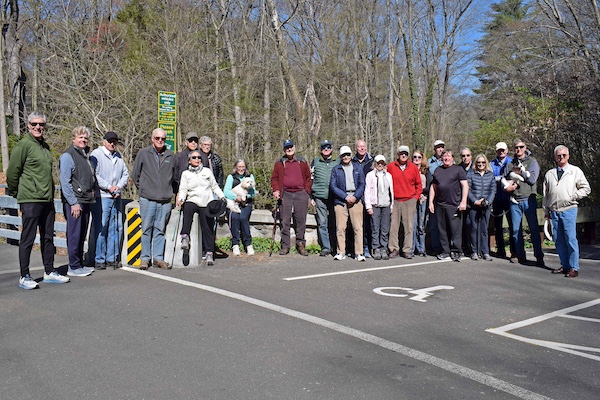
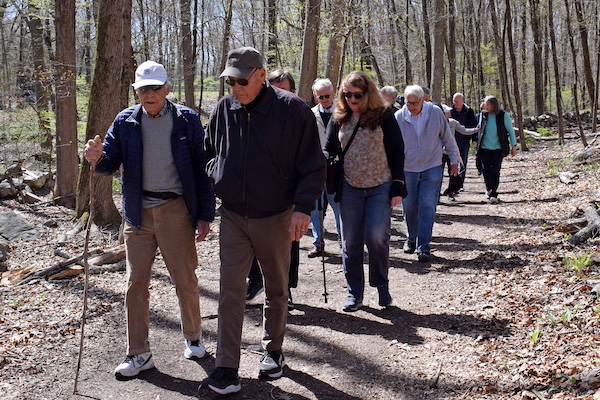
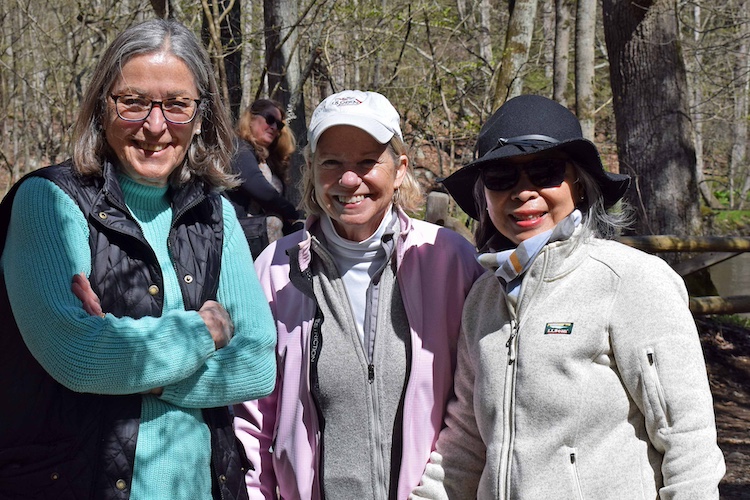
A cloudless sky, 54 degree temperature and Earth Day to boot made for a memorable 2 hour hike through the spectacular Mianus River Park! A total of 21 DMAers, spouses and two dogs spent the first half hour walking upstream along the river which was full and moving rapidly. Two of the party retraced that section back to parking but the rest continued on over the inland portion of the trail, which is hillier and more rugged, through scenic views of rocks and trees. This is a park that is well used by the public and it is easy to see why!
We encourage hikers who would like a shorter hike to come with us. There is almost always an intermediate point where it is an option to return to the start. So long as there are at least 2 for that option, we can offer it on most hikes.
After the hike a smaller group ate lunch at Zody’s 19th Hole Restaurant at the E Gaynor Brennan Gold course. Lunch there, by the way, is excellent and well priced!
Dave McCollum
Robert Plunkett
HIKING – SHERWOOD ISLAND STATE PARK
WESTPORT, CT
MARCH 14, 2024
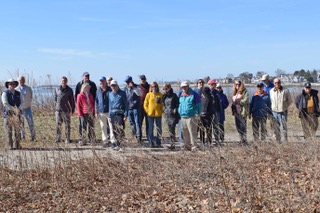
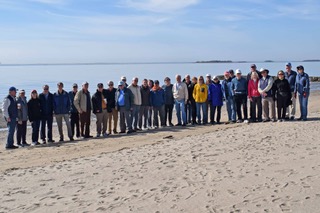
We finally had some beautiful weather with mild temperatures and sunny skies for our hike today at Sherwood Island. A total of 32 hikers came out to enjoy the day. Our walk of just over three miles included a stroll on the beach followed by a hike in the woods on a loop trail and then onto various paths nearby and along another part of the beach. We also spent some time reflecting at the meaningful 9/11 memorial. Following the hike, 12 of us enjoyed lunch at The Little Barn in Westport.
Robert Plunkett
 Alexander von Humboldt (1769-1859) was an intrepid explorer and the most famous scientist of his age. His restless life was packed with adventure and discovery, whether climbing the highest volcanoes in the world or racing through anthrax-infested Siberia. He came up with a radical vision of nature, that it was a complex and interconnected global force and did not exist for man’s use alone. Ironically, his ideas have become so accepted and widespread that he has been nearly forgotten.
Now Andrea Wulf brings the man and his achievements back into focus: his investigation of wild environments around the world; his discoveries of similarities between climate zones on different continents; his prediction of human-induced climate change; his remarkable ability to fashion poetic narrative out of scientific observation; and his relationships with iconic figures such as Simón Bolívar and Thomas Jefferson. Wulf examines how his writings inspired other naturalists and poets such as Wordsworth, Darwin, and Goethe, and she makes the compelling case that it was Humboldt’s influence on John Muir that led him to his ideas of preservation and that shaped Thoreau’s Walden.
Humboldt was the most interdisciplinary of scientists and is the forgotten father of environmentalism. With this brilliantly researched and compellingly written audiobook, she makes clear the myriad, fundamental ways that Humboldt created our understanding of the natural world.
 “An epic account of the decades-long battle to control what has emerged as the world’s most critical resource–microchip technology–with the United States and China increasingly in conflict. You may be surprised to learn that microchips are the new oil–the scarce resource on which the modern world depends. Today, military, economic, and geopolitical power are built on a foundation of computer chips. Virtually everything–from missiles to microwaves, smartphones to the stock market–runs on chips. Until recently, America designed and built the fastest chips and maintained its lead as the #1 superpower. Now, America’s edge is slipping, undermined by competitors in Taiwan, Korea, Europe, and, above all, China. Today, as Chip War reveals, China, which spends more money each year importing chips than it spends importing oil, is pouring billions into a chip-building initiative to catch up to the US. At stake is America’s military superiority and economic prosperity. Economic historian Chris Miller explains how the semiconductor came to play a critical role in modern life and how the U.S. become dominant in chip design and manufacturing and applied this technology to military systems. America’s victory in the Cold War and its global military dominance stems from its ability to harness computing power more effectively than any other power. But here, too, China is catching up, with its chip-building ambitions and military modernization going hand in hand. America has let key components of the chip-building process slip out of its grasp, contributing not only to a worldwide chip shortage but also a new Cold War with a superpower adversary that is desperate to bridge the gap. Illuminating, timely, and fascinating, Chip War shows that, to make sense of the current state of politics, economics, and technology, we must first understand the vital role played by chips”–Amazon.
URBAN HIKE
NORWALK RIVER VALLEY TRAIL
NORWALK, CT
FEBRUARY 22, 2024
10:00 AM
The Norwalk River Valley Trail will eventually run from Calf Pasture Beach in Norwalk to Danbury. We hiked one finished section in Wilton last November. The trail is either paved or packed stone, is well marked and has limited ups and downs. The section of the trail we will be hiking on 2/15 runs for 3 miles north from the Maritime Museum in South Norwalk. This is an out and back hike so, depending on the weather and how we feel, we can turn around at any point and return to the start. We will probably hike for 4-5 miles in total which should take us 2 hours or less.
From the start at the front door of the Maritime Museum the trail takes us along the Norwalk River behind the SONO Mall, along the Metro North tracks, past the Norwalk Transfer Station and into the Pine Island Cemetery which dates from 1708 where the oldest surviving headstone dates from 1723. On north past the Lockwood-Mathews Mansion, through Union Park and along the river again up past Riverside Cemetery to the end at Kellogg Pond. On the return we will pass through Oyster Shell Park which has a commanding view over the river out to the sound. We will have an optional lunch at Mamma Bella Cucina near the museum.
DIRECTIONS: Park in the Maritime Center Garage on N. Water Street which is directly across from the Center. The restaurant is in the garage building. Bring friends and family and dogs on a leash are allowed.
CONTACT: Dave McCollum
Recap:
 A group of 22 DMA hikers and friends braved a chilly but pleasant day traversing a completed section of the future trail from Norwalk to Danbury that begins at the Maritime Aquarium and runs north for 3 miles to Broad Street. Our group only went up as far as Riverside Cemetery, a distance of 2.2 miles, before returning back along the same path to the Aquarium. We were joined by Tanner Thompson, a Norwalk resident who is planning a new trail from Norwalk to Greenwich. Tanner is also involved in Norwalk affairs and was able to provide interesting commentary on many aspects of the history and state of the NRVT.
This section of the NRVT runs along the Norwalk River and passes through Pine Island Cemetery, which dates from 1708, past the Lockwood-Matthews Mansion and on up past Union Park to Riverside Cemetery. 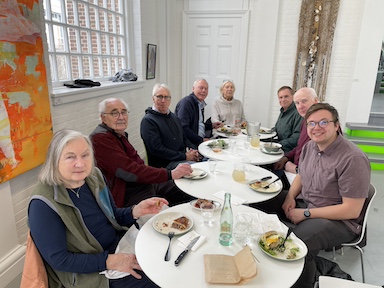
Because it was an out and back hike, some hikers turned around at various points and headed back to the Aquarium, tailoring their hike to the distance that was comfortable for them. Fourteen of us made the entire trip and eight stopped for lunch on the way back at The Norwalk Art Space Café at 455 West Avenue for lunch. We were joined by one non-hiker who came to lunch. The Art Space is in a repurposed church and features local art in addition to delicious food. After lunch, we resumed our hike back to the Aquarium.
This trail is an amazing amenity for all of Fairfield County to enjoy.
Dave McCollum
Robert Plunkett
“HIKING” SHERWOOD ISLAND STATE PARK
SHERWOOD ISLAND CONNECTOR
WESTPORT, CT
JANUARY 18, 2024
We will be walking about 3 miles through Sherwood Island State Park on mostly hard and gravel paths. Very little up and down. We will meet in the Pavilion parking lot at 10:30 AM. The Park hugs the Sound shoreline and is often quite windy. Dogs are permitted on a leash and, as always, bring anyone with you who would enjoy a one hour plus walk in a beautiful setting. We will have an optional lunch after at the Little Barn in Westport.
HISTORY
Sherwood Island State Park is the oldest state park in Connecticut dating to 1914. The island itself was first settled by Daniel Sherwood in1787 where he built a grist mill. Over the next 70 years the land was farmed by many others but around 1860 the property became known as “Sherwood’s Island”
After the Connecticut State Park Commission was formed in 1911 the search for suitable shorefront property to buy was on. The first piece of the existing park was purchased in 1914 making this the oldest state park. The park officially opened in 1932 but not until 1950 did the Army Corps of Engineers build the jetties and extend the beaches. The Pavilion opened in 1959 and a 911 Memorial was added in 2002.
DIRECTIONS
This one is easy! Take Exit 18 off I-95 (Sherwood Island connector) and turn right towards the Sound. The road goes directly into the Park. Keep straight onto the wide roundabout and take the exit marked “Pavilion Parking”. We’ll meet at the front of that lot up towards the Pavilion.
Mike Wheeler and Bob Baker will moderate a discussion of Affordable Housing on March 7th at 2 pm at the DCA and on Zoom.
What is the status of Affordable Housing in Darien? What is the Darien Affordable Housing Plan of 2022? What is happening at the state level? What would a Fair Share requirement mean to Darien? Should Darien be funding its Affordable Housing Fund? Among the experts joining us are DMA and P&Z member George Reilly and Joe Warren of the Darien Housing Authority
Articles of Interest
“HIKING” GREENWICH POINT PARK
7 TOD’S DRIFTWAY, GREENWICH
THURSDAY DECEMBER 7, 2023
10:30
We will be walking around Greenwich Point starting at 10:30 am.
NOTE THAT THIS START TIME IS LATER THAN OTHER HIKES. We will be walking about 3 miles over flat, mostly paved or packed gravel paths, which should take us about an hour and a half.
Greenwich Point is a 147 acre property owned by the Town of Greenwich which bought the property in 1945. The peninsula, surrounded on three sides by water, was the private estate of J. Kennedy Tod who purchased the property in the 1880s. Greenwich Point offers spectacular views of Manhattan and the Greenwich shoreline. It is a beautiful place to walk and only available to non-Greenwich residents (without a substantial fee) during the months of December-April.
We will assemble in the first parking lot on the right after you pass the gatehouse. Greenwich Point can be windy and cold so layer up! Dogs on a leash are permitted and, as always, bring guests.
We will have an optional lunch at Lugano in Old Greenwich.
Contacts:
Dave McCollum dgmccollum63@gmail.com and 203-858-5688
Robert Plunkett rgplunkett1@gmail.com and 203-246-2898
HIKING GREENWICH POINT
DECEMBER 7, 2023
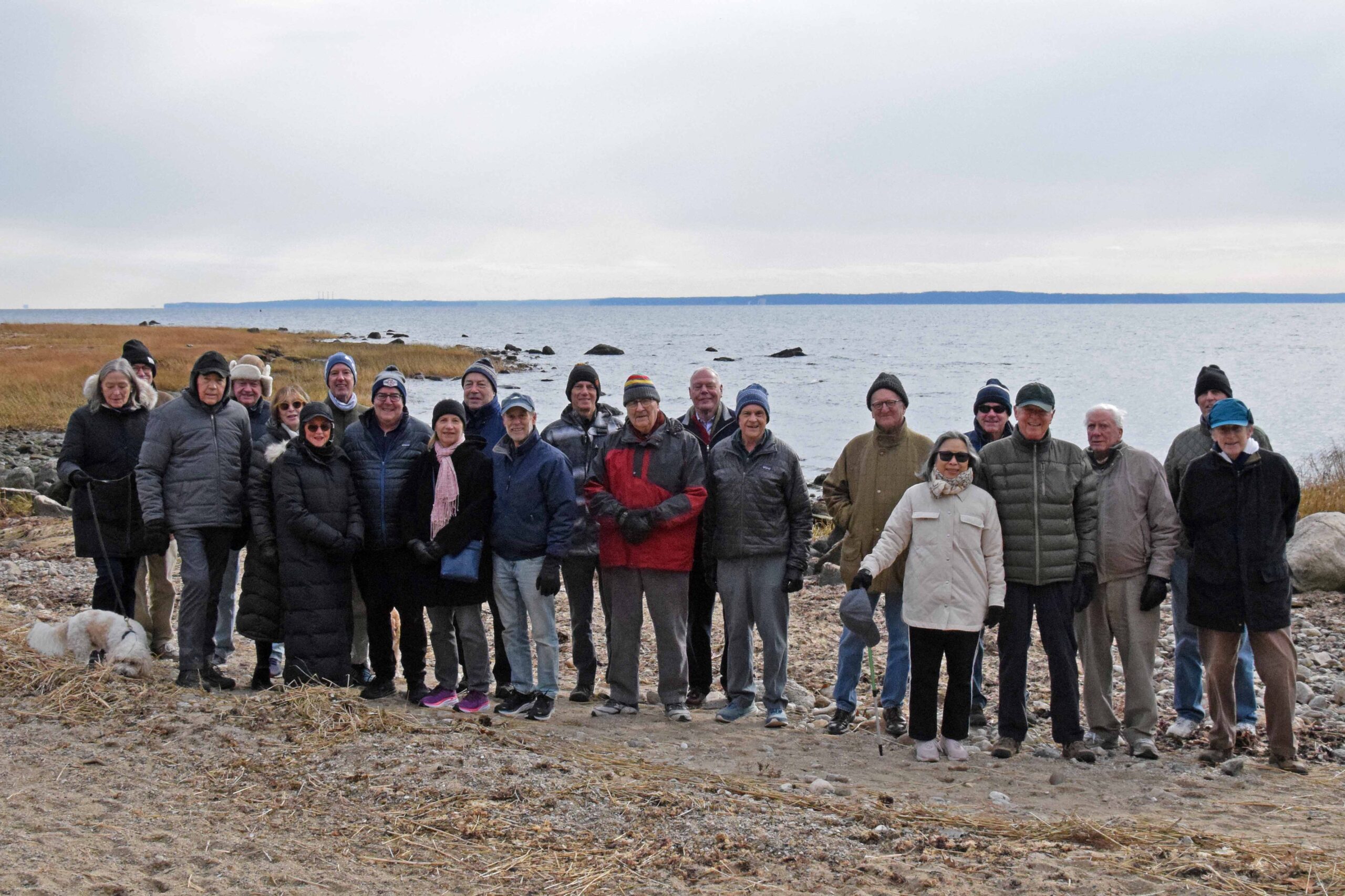 The scenery at Greenwich Point never disappoints. Even on a cold and cloudy day, there is so much to look at along the shore and inside the park itself. A hearty group of 23 DMAers and guests (plus two dogs) walked about 3 miles in an hour and a half. Some of the group were first timers to the site and were impressed with its size and beauty, not to mention the history of the Tod family’s ownership and the remains of the original mansion. Marilyn Parker’s superb photographs capture the day perfectly!
The ingenuity of DMA members was on display again at lunch after the hike. Out of the original 23, 16 opted to join the lunch at Lugano restaurant in Old Greenwich. An addition 3 skipped the hike and just came to lunch! Apparently the post hike lunches have become an attraction in themselves!
Dave McCollum
Robert Plunkett