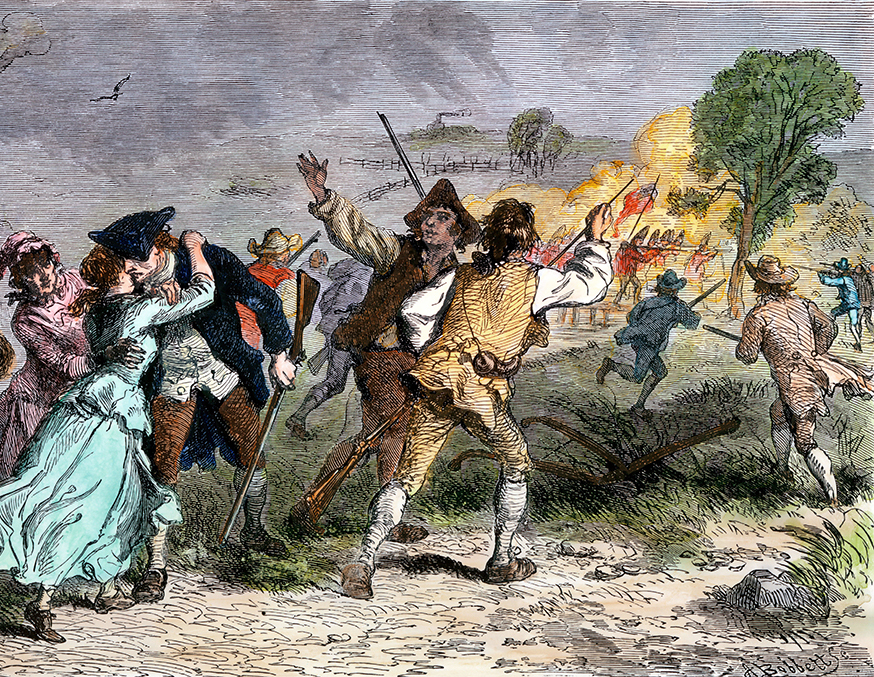
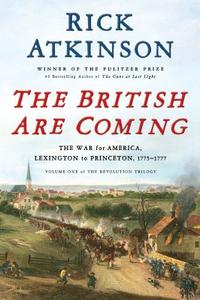
Rick Atkinson, author of the Pulitzer Prize-winning An Army at Dawn and two other masterly books about World War II, has long been admired for his unparalleled ability to write deeply researched, stunningly vivid narrative history. Now he turns his attention to a new war, and in the initial volume of the Revolution Trilogy he tells the story of the first twenty months of the bloody struggle to shake free of King George’s shackles. From the battles at Lexington and Concord in spring 1775 to those at Trenton and Princeton in winter 1777, the ragtag Continental Army takes on the world’s most formidable fighting force and gradually finds the will and the way to win. It is a riveting saga populated by singular characters: Henry Knox, the former bookseller with an uncanny understanding of how best to deploy artillery; Nathaniel Greene, the blue-eyed bumpkin who becomes one of America’s greatest battle captains; Benjamin Franklin, the self-made man who proves himself the nation’s greatest diplomat; George Washington, the commander-in-chief who learns the difficult art of leadership amid the fire and smoke of the battlefield. And the British are here, too: we see the war through their eyes and their gunsights, and as a consequence the mortal conflict between the redcoats and the rebels is all the more compelling. Full of fresh details and untold stories, The British Are Coming gives stirring new life to the first act of our country’s creation drama. It is a tale of heroes and knaves, of sacrifice and blunder, of redemption and profound suffering. But once begun, the war for independence can have only one of two outcomes: death or victory.
Category: Activities (Page 25 of 49)
Activities are gatherings that occur on a regular schedule, usually weekly, to enjoy a specific pastime.
Our second 2020 outing is at Oak Hills Park, Norwalk, Tuesday,
15 September, starting at 10:00 AM.
To sign up, email Peter Carnes, picarnes@gmail.com.
Provide your handicap to facilitate pairing.
Tee times will be announced once registration is complete.
Fee is estimated to be $50 (includes cart) payable when you arrive.
Members of Oak Hills pay a discounted price.
Confirmation and coordination will be via email during the week prior to play.
For directions to Oak Hills, go to. https://www.oakhillsgc.com/
Gents,
We have some times reserved for a golf outing at Sterling Farms. The date is Tuesday 25 August at 11am. Cost will be $51 with a cart (single occupant). Before fully securing this reservation, I want to get a sense for the number of you who are likely to play.
If you are interested, please respond to me directly: picarnes@gmail.com. This is just an indication for planning purposes. Once we reach a critical mass, I will contact you again with an official invitation.
Peter Carnes
Your Host: Bob Baker
Discussion Leader: David Mace
Our current affairs group will talk about income inequality in America and what we should do about it.
The Black-White Wage Gap Is as Big as It Was in 1950
https://www.nytimes.com/2020/06/25/opinion/sunday/race-wage-gap.html?referringSource=articleShare
https://en.wikipedia.org/wiki/List_of_countries_by_income_equality
Racism’s Hidden Toll
How does income inequality affect our lives
Video recording of the discussion: https://youtu.be/8x4ej7hyeA4
Sept 9, 2020, 12:00
THE GREAT INFLUENZA
THE EPIC STORY OF THE DEADLIEST PLAGUE IN HISTORY
BY JOHN M. BARRY
A keen recounting of the 1918–20 pandemic.
This deadly global flu outbreak has gotten hazy in the public memory, and its origins and character were unclear from the beginning, writes popular historian Barry (Rising Tide, 1997, etc.). But influenza tore apart the world’s social fabric for two long years, and it would be a mistake to forget its lessons. (It also tore apart the American medical establishment—but that was for the good.) With the same terrorizing flair of Richard Preston’s Hot Zone, the author follows the disease in the way he might shadow a mugger, presenting us with the vivid aftereffects as if from Weegee’s camera: “Influenza killed more people in a year than the Black Death of the Middle Ages killed in a century; it killed more people in twenty-four weeks than AIDS has killed in twenty-four years.” But Barry is not interested simply in hugely disturbing numbers. He charts how the pandemic brought a measure of scientific maturity to the medical world and profiles such important personalities as Paul Lewis and William Henry Welch, institutions like Johns Hopkins, the Rockefeller Institute, and the Red Cross. He covers with an easy touch the evolution in our understanding of viral disease and the strides that have been made to counter its effects, such as vaccines. He watches the flu spread until there aren’t enough coffins to house the bodies, and he watches as the military fails to alert the general public because the brass feared it would hurt wartime morale. Influenza appears to have spread like a prairie fire from a military base in Kansas throughout the world, thanks to WWI troop deployment and the disease’s highly contagious nature. There was nowhere to hide, Barry chillingly explains: “It now seemed as if there had never been life before the epidemic. The disease informed every action of every person.” Emerging viruses, including new strains of flu, will likely visit us again.
Majestic, spellbinding treatment of a mass killer.
Host: Bob Baker
Discussion Leader: Charles Salmans
Main topics are:
Covid infection and death rates
Latest data and possibility of “waves” this fall and next year, as in 1918
Tradeoff between economy and quarantines
Unemployment rates and issues of income replacement
Especially hard hit — hospitality and travel, small business
K-12 Schools, colleges and universities
Only the Federal government can print money; constraints on state and local budgets
Nations (and states) that have tightened after loosening (Australia, New Zealand, California, Florida)
Challenge of testing and contract tracing
Vaccine timetable
Vaccines under development
Challenge of final approvals
Manufacturing challenge to meet worldwide demand
Vaccine roll-out and priorities?
– Health care workers
– Elderly/Nursing Homes
– Other priority job categories (Police/fire, Food industry workers, Teachers)
Articles:
Covid treatment
Covid Discussion Links Aug 2020 copy
Wall Street Journal: Lockdowns punish the economy. Months into the Covid-19 pandemic, evidence points to ways to slow the spread of the coronavirus at much lower economic cost.
Host: Charlie Goodyear
Discussion Leader: Art Baron
DISCUSSION OUTLINE ON INNOVATION
Current Affairs, June 18, 2020
AGENDA:
- The Science of Innovation
- The Digital Age . . . a Multi-Decade Transformation
- Winners and Losers . . . Lessons Learned . . . Market Considerations
- COVID . . . a Present Day Catalyst
- Potential Future Industry Disruptions
=====================================================================
- The Science of Innovation
Innovation: The process of translating an idea or invention into a product, service, or business model that creates value for which customers will pay.
Peter Drucker: “The Discipline of Innovation” HBR, August 2002 https://hbr.org/2002/08/the-discipline-of-innovation Areas of Opportunity: Unexpected Occurrences, Incongruities, Process Needs, Industry & Market Changes, Demographic Changes, Changes in Perception, New Knowledge
Clayton Christensen: theory of “disruptive innovation”, first introduced in his 1997 book The Innovator’s Dilemma. Key insights: S-curve, market-creating innovations drive growth, (vs sustaining or efficiency innovations), innovations often come from outside the established incumbents.
Henry Ford: “If I had asked people what they wanted, they would have said faster horses.” Steve Jobs: “You can’t just ask customers what they want and then try to give that to them.
“Inspiring Innovation”, HBR August 2002 https://hbr.org/2002/08/inspiring-innovation
Other Key Enablers: Simplicity, Focus, Diversity, Cross-discipline, Innovation Culture, Risk Acceptance . . . overcoming resistance to change
- The Digital Age . . . a Multi-Decade Transformation
- Dramatic transformation fueled by, (among other things), Moore’s Law, Metcalfe’s Law
- “The Consumerization of IT”
○ Increasingly, employees had more capabilities at home than at work
○ Trickle down from consumer market to enterprise market, (much like prior generation trickle down from Military and NASA to private sector)
- Adoption rates of digital products accelerating virally. Many digital products have near zero marginal cost.
○ Time to reach 50 million users
■ Automobiles, 62 years
■ Telephone, 50 years
■ Credit Card, 28 years
■ Mobile Phones, 12 years
■ Facebook, 3 years
■ PokemonGo, 19 days
- Brand new product categories, e.g. Streaming content, Smart phones, Virtual Assistants, AI, Social Media
- Increasingly Mobile First as the Innovation platform
- New Business Models are Transforming Industries
○ SaaS, Cloud . . . new players, e.g. SalesForce.com, Workday
○ Sharing Economy . . . Uber, Lyft, Airbnb
- Crisis driven change and leadership, e.g. Estonia, cyberattacks, 2007
- Winners and Losers . . . Lessons Learned . . . Market Considerations
- Top valued companies as of 3/31/20: Microsoft, Apple, Amazon, Alphabet, Facebook.
○ Leadership with brand new product & services categories
- Why did Microsoft miss the Internet in the mid-90’s, but recover and thrive, while Digital Equipment missed the microcomputer in the 80’s and didn’t
- Blackberry vs iPhone . . . dynamics in the marketplace
- Industry evolution:. Visacalc and the PC, then Lotus 123, and then Microsoft Excel
- Early internet successes, (AOL and Yahoo), superseded by newer ones, (Google and Facebook).
○ As consumers became more proficient with the Internet, the access advantages of AOL and Yahoo gave way to the continuous innovation of companies like Google and Facebook.
- Xerox Parc, (GUI and Mouse), vs Apple
- A 19th Century Example: Steel industry leadership shift from U.K. to U.S. with Carnegie Steel’s adoption of Bessemer Steel Process.
- Fast Company: The World’s Most Innovative Companies, 2020 and 2019
https://www.fastcompany.com/most-innovative-companies/2020
https://www.fastcompany.com/most-innovative-companies/2019
- COVID . . . a Present Day Catalyst
- Medical: Vaccines, Therapies, Ventilators, PPE,…
- Telehealth: technology available for years, but limited adoption due to business model, (insurance, provider fees) —> current urgency now driving coverage and deployment. Many post-COVID benefits.
- Online services
○ Collaboration and Work from Home
■ Zoom Video, simplicity vs competition, 20 million to 200m users, fierce competition: Microsoft Teams, Google Meet, Facebook, Apple,…
■ Consumer apps, e.g. Caribu
○ eCommerce Delivery, e.g. Amazon, Walmart
○ Food delivery services, Restaurant services, Supermarket delivery, Instacart
○ Location services enabling individual tracking, social distancing compliance, temperatures, etc.
○ Behavior change, e.g. increase in digital banking across populations, Gucci, reducing runway fashion shows
- Potential Future Industry Disruptions
- Healthcare
- Education, new cost dynamics, pathway for greater equality and opportunity
- CyberSecurity
- Food Supply, risks, (global hunger, climate change, drought, income security), reduce waste, (e.g. Apeel Sciences), new sources, (e.g. Beyond Meat, milk substitutes), new processes, (e.g. precision agriculture, restaurants delivery, kits, home cooking)
- Environment, Efficiency, Energy Transition, Pollution, Advanced Manufacturing, Circular Economy, Hydrogen, EVs
- Social/News Trust and Accountability, beginning to see some take action, (Twitter, Zoom), but others resist. Much more is needed given the harmful power of digital media.
- Resilience, Markets, Supply Chain, Transportation, Financial Systems, Global/Deglobalization Balance, . . . .
Host: Charlie Goodyear.
Speaker Mike Critelli. Bio Critelli, Mike
Outline of the electric grid. OUTLINE OF ELECTRIC POWER GRID
The #1 New York Times bestselling author of The Devil in the White City and Dead Wake delivers a fresh and compelling portrait of Winston Churchill and London during the Blitz On Winston Churchill’s first day as prime minister, Hitler invaded Holland and Belgium. Poland and Czechoslovakia had already fallen, and the Dunkirk evacuation was just two weeks away. For the next twelve months, Hitler would wage a relentless bombing campaign, killing 45,000 Britons. It was up to Churchill to hold the country together and persuade President Franklin Roosevelt that Britain was a worthy ally-and willing to fight to the end. In The Splendid and the Vile, Erik Larson shows, in cinematic detail, how Churchill taught the British people “the art of being fearless.” It is a story of political brinkmanship, but it’s also an intimate domestic drama set against the backdrop of Churchill’s prime-ministerial country home, Chequers; his wartime retreat, Ditchley, where he and his entourage go when the moon is brightest and the bombing threat is highest; and of course 10 Downing Street in London. Drawing on diaries, original archival documents, and once-secret intelligence reports-some released only recently-Larson provides a new lens on London’s darkest year through the day-to-day experience of Churchill and his family: his wife, Clementine; their youngest daughter, Mary, who chafes against her parents’ wartime protectiveness; their son, Randolph, and his beautiful, unhappy wife, Pamela; Pamela’s illicit lover, a dashing American emissary; and the cadre of close advisers who comprised Churchill’s “Secret Circle,” including his lovestruck private secretary, John Colville; newspaper baron Lord Beaverbrook; and the Rasputin-like Frederick Lindemann. The Splendid and the Vile takes readers out of today’s political dysfunction and back to a time of true leadership, when-in the face of unrelenting horror-Churchill’s eloquence, courage, and perseverance bound a country, and a family, together.
As you can imagine, for someone who has been wearing prison greens for years, proper civilian clothing is a must and is sorely needed. (New York, which is not atypical, gives a released inmate only $40 and a bus ticket home.) This year’s drive will take place on Wednesday, March 18, 2020 before our regular meeting.
Just bring those gently worn items (suits, ties, shirts, pants, sweaters, coats, etc.) that’s been clogging up your closet to the DCA parking lot before our meeting on May 4. A Hudson Link van will be waiting to take it to the Hudson Link office in Ossining, where it will be Ossining office where it will change someone’s life. It will be much appreciated!
It costs $60,000/yr to incarcerate a person. The NY the recidivism rate is 43% – a stunning waste of money and lives. However, Hudson Link, through counseling, education, and help with reentry, has a recidivism rate of just 2%. Part of the help with reentry is a professional wardrobe that can help land a job and find housing.
Last year the clothing drive was a huge success. Let’s make it happen again.
Arranged by Pete Wells
Hudson Link has spoken at DMA twice:
Damian Rossney and Billy Seales,Hudson Link for Higher Education in Prison,Wednesday, April 18, 2018
To find out more see: www.hudsonlink.org