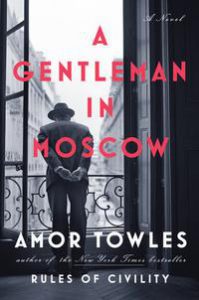
 A New York Times bestseller “The same gorgeous, layered richness that marked Towles’ debut, Rules of Civility, shapes [A Gentleman in Moscow]” – Entertainment Weekly “Elegant… as lavishly filigreed as a Fabergé egg” – O, the Oprah Magazine He can’t leave his hotel. You won’t want to. From the New York Times bestselling author of Rules of Civility—a transporting novel about a man who is ordered to spend the rest of his life inside a luxury hotel In 1922, Count Alexander Rostov is deemed an unrepentant aristocrat by a Bolshevik tribunal, and is sentenced to house arrest in the Metropol, a grand hotel across the street from the Kremlin. Rostov, an indomitable man of erudition and wit, has never worked a day in his life, and must now live in an attic room while some of the most tumultuous decades in Russian history are unfolding outside the hotel’s doors. Unexpectedly, his reduced circumstances provide him entry into a much larger world of emotional discovery. Brimming with humor, a glittering cast of characters, and one beautifully rendered scene after another, this singular novel casts a spell as it relates the count’s endeavor to gain a deeper understanding of what it means to be a man of purpose. “And the intrigue! … [A Gentleman in Moscow] is laced with sparkling threads (they will tie up) and tokens (they will matter): special keys, secret compartments, gold coins, vials of coveted liquid, old-fashioned pistols, duels and scars, hidden assignations (discreet and smoky), stolen passports, a ruby necklace, mysterious letters on elegant hotel stationery… a luscious stage set, backdrop for a downright Casablanca-like drama.” – The San Francisco Chronicle From the Hardcover edition
Here is a video tour of the Hotel Metropol (courtesy of Charles Salmans)
https://www.youtube.com/watch?v=NPkLFmUiTjo
An interview with the author by the WSJ:
https://www.youtube.com/watch?v=mUXlagGIH18
Amor Towles’ website has some interesting discussion:
http://www.amortowles.com/
Latvian Stew: Mentioned on page 97
The author points to this recipe (there are others).
PORK STEW WITH DRIED APRICOTS AND PRUNES
(Svinina v Kislo-Sladkom Souse)
SERVES 6 — 8
As the apricots and prunes cook, some of them will fall apart and thicken the sauce. Serve this stew accompanied by boiled potatoes, buttered and garnished with chopped parsley, if you like.
3 lbs. boneless pork shoulder,
trimmed and cut into 1″ pieces
Salt and freshly ground black pepper
6 tbsp. vegetable oil
6 carrots, peeled, trimmed, and
sliced crosswise
4 tbsp. tomato paste
1 cup dried apricots
1 lb. white boiling onions, peeled,
each cut into 6 wedges
1 cup pitted prunes
1. Season pork with salt and pepper. Heat 3 tbsp. of the oil in a large heavy-bottomed pot over medium-high heat. Add pork and cook, stirring occasionally, until meat releases its juices and is no longer pink all over, about 5 minutes. Add carrots and cook until slightly tender, about 5 minutes. Stir in tomato paste and 5 cups of water, then add apricots. Bring to a boil, reduce heat to medium-low, and gently simmer, uncovered, for 45 minutes.
Another recipe that looks good from Epicurious:
https://www.epicurious.com/recipes/food/views/pork-stew-with-apricots-and-prunes-2559
nbsp;
On page 133 The Count quickly notes that a number, 1,173 is not prime by using the Divisibility by 3 Theorem. That is if the sum of the digits of a number are divisible by 3 (or 9) then the number is divisible by three (or 9), hence, not prime. The book’s example: 1+1+7+3 =12 is divisible by 3 so, according to the theorem, 1,173 is divisible by 3.
Here is an informal proof.
Suppose that you have a four-digit number N that is written abcd. and a+b+c+d is divisible by 3. Then
N=1000a+100b+10c+d=(999+1)a+(99+1)b+(9+1)c+d=(999a+99b+9c)+(a+b+c+d)=3(333a+33b+3c)+(a+b+c+d)
so when you divide N by 3, you’ll get
333a+33b+3c+(a+b+c+d) /3. But since a+b+c+d was divisible by 3, the 3 in the denominator cancels out and the remainder is an integer.. Hence N is divisible by 3 and not prime.



 Thursday November 9th we will be check the lights on the holiday wreaths. We will be meet at
 Taylor Strubinger reports that the Happy Wanderers will explore Central Park on Tuesday, October 17, 2017.
 The hike will last about 2-2 ½ hours and will give us ample opportunity to bathe in the forest air. I mention this because the Japanese believe hiking is good for one’s health, not just because of the exercise involved, but also because it gives one the opportunity to breathe the forest air which is swirling with healthful compounds released by the trees.
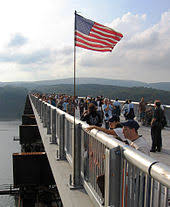 Happy Wanderers — Walkway Over the Hudson River – 21 September, 2017
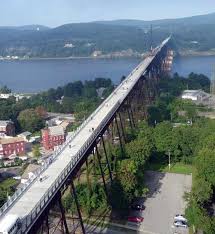 Driving directions will be provided for each car. For GPS users, the address of the parking area for the Walkway is 61 Parker Avenue, Poughkeepsie, NY, 12601.

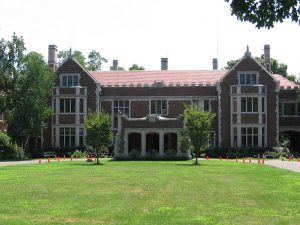 Following this hike we will take a short drive to the second property,the 80 acre Waveney Park, which is owned by the Town of New Canaan. Here the trail loop is about 1.5 miles and serenely beautiful.
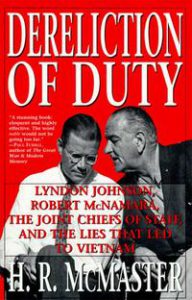 From respected Lieutenant General and Trump Administration National Security Adviser H. R. McMaster, an authoritative, highly critical analysis of the arrogance, deception, and controversial decisions at the highest level of government that led to America’s involvement in the Vietnam War. “The war in Vietnam was not lost in the field, nor was it lost on the front pages of the New York Times or the college campuses. It was lost in Washington, D.C.” —H. R. McMaster (from the Conclusion) Dereliction Of Duty is a stunning analysis of how and why the United States became involved in an all-out and disastrous war in Southeast Asia. Fully and convincingly researched, based on transcripts and personal accounts of crucial meetings, confrontations and decisions, it is the only book that fully re-creates what happened and why. McMaster pinpoints the policies and decisions that got the United States into the morass and reveals who made these decisions and the motives behind them, disproving the published theories of other historians and excuses of the participants. A page-turning narrative, Dereliction Of Duty focuses on a fascinating cast of characters: President Lyndon Johnson, Robert McNamara, General Maxwell Taylor, McGeorge Bundy and other top aides who deliberately deceived the Joint Chiefs of Staff, the U.S. Congress and the American public. McMaster’s only book, Dereliction of Duty is an explosive and authoritative new look at the controversy concerning the United States involvement in Vietnam