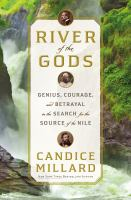
 NEW YORK TIMES BESTSELLER • The harrowing story of one of the great feats of exploration of all time and its complicated legacy—from the New York Times bestselling author of The River of Doubt and Destiny of the Republic
For millennia the location of the Nile River’s headwaters was shrouded in mystery. In the 19th century, there was a frenzy of interest in ancient Egypt. At the same time, European powers sent off waves of explorations intended to map the unknown corners of the globe – and extend their colonial empires.
Richard Burton and John Hanning Speke were sent by the Royal Geographical Society to claim the prize for England. Burton spoke twenty-nine languages, and was a decorated soldier. He was also mercurial, subtle, and an iconoclastic atheist. Speke was a young aristocrat and Army officer determined to make his mark, passionate about hunting, Burton’s opposite in temperament and beliefs.
From the start the two men clashed. They would endure tremendous hardships, illness, and constant setbacks. Two years in, deep in the African interior, Burton became too sick to press on, but Speke did, and claimed he found the source in a great lake that he christened Lake Victoria. When they returned to England, Speke rushed to take credit, disparaging Burton. Burton disputed his claim, and Speke launched another expedition to Africa to prove it. The two became venomous enemies, with the public siding with the more charismatic Burton, to Speke’s great envy. The day before they were to publicly debate,Speke shot himself.
Yet there was a third man on both expeditions, his name obscured by imperial annals, whose exploits were even more extraordinary. This was Sidi Mubarak Bombay, who was enslaved and shipped from his home village in East Africa to India. When the man who purchased him died, he made his way into the local Sultan’s army, and eventually traveled back to Africa, where he used his resourcefulness, linguistic prowess and raw courage to forge a living as a guide. Without Bombay and men like him, who led, carried, and protected the expedition, neither Englishman would have come close to the headwaters of the Nile, or perhaps even survived.
In River of the Gods Candice Millard has written another peerless story of courage and adventure, set against the backdrop of the race to exploit Africa by the colonial powers.





 Dwight Lee Chapin will speak to us about his new book The President’s Man | The Memoirs of Nixon’s Trusted Aide (William Morrow). Dwight will share the background on the book and why he wrote it, provide an overview of his relationship with President Nixon, and describe first-hand accounts of the historic and fascinating events and happenings of the Nixon era of which he was an eyewitness.
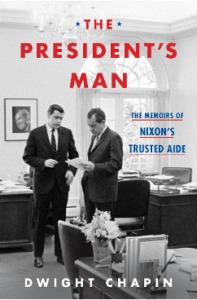 From Richard Nixon’s “You-won’t-have-Nixon-to-kick-around-anymore” 1962 gubernatorial campaign through his world-changing trips to China and the Soviet Union and epic downfall, Dwight was by his side. As his Personal Aide and then Deputy Assistant in the White House, Dwight was with him in his most private and most public moments. He traveled with him, assisted, advised, strategized, campaigned and learned from one of America’s most controversial presidents. As Bob Haldeman’s protege, Dwight worked with Henry Kissinger in opening China—then eventually went to prison in the aftermath of Watergate although he had no involvement in it.
 Alexandra “Ali” Ramsteck, the Director of the Department of Human Services in Darien, will lead a discussion on the vital role that the Department plays in our community. In particular, the Department provides a wide variety of services, including supportive counseling, assessments for benefits and program eligibility, as well as case management for any Darien resident. In addition, the organization provides crisis intervention, assistance with mental health, substance abuse and domestic violence issues, and emergency financial assistance.
 Dr. C. Griffith Mann will present a talk entitled “Unicorns and Heroes: John D. Rockefeller, Jr. and Tapestries at The Met Cloisters,” an in-depth look at the Unicorn Tapestries and the Heroes Tapestries. The Unicorn Tapestries are among the most beautiful and complex works of art from the late Middle Ages that survive. Luxuriously woven in fine wool and silk with silver and gilded threads, the tapestries vividly depict scenes associated with a hunt for the elusive, magical unicorn. The Heroes Tapestries, representing the Hebrew heroes (Joshua and David), the Christian hero (King Arthur), and the pagan heroes (Alexander the Great and Julius Caesar), are thought to have been made around 1400. Once part of a larger ensemble featuring Nine Heroes, these remarkable tapestries are among the earliest large-scale tapestries to survive from a moment when these ensembles were part of princely collections, and are currently being conserved at the Met.