Author: Webmaster (Page 68 of 96)

Philip Vitiello, White Star Line’s Olympic Class Ships, February 6, 2019

Philip Vitiello will speak on the White Star Line’s Olympic Class Ships, Olympic, Titanic and Britannic. Almost everyone knows the story of the Titanic, which, while on her maiden voyage to New York in 1912, hit an iceberg and sank, causing the loss of 1,500 passengers and crew.  However, few people realize that the Titanic actually was the second of three super ships built in the Olympic Class for the White Star Line to compete for the Atlantic-crossing passenger trade.  At the time, these three ships were claimed to be the largest ever built. This PowerPoint presentation tells the incredible and tragic story of these three historical ships and what eventually happened to them. Included in the story is the amazing life of Violet Constance Jessop, who, ironically, sailed on all three of these ships as a stewardess and then as a nurse during World War I. Philip is the director of operations of Northeast Food Marketing in Stamford. Hehas been a Civil War historian and re-enactor for more than 40 years and the vice president of the Civil War Round Table of South Central Connecticut. He is a member of the Titanic Historical Society, as well as The International Group for Historic Aircraft Recovery. He previously delivered two other DMA presentations on Joshua Chamberlain, the Civil War general and on the Hunley, a Civil War submarine.

Arranged by Andre Guilbert


Presentation video: https://www.youtube.com/watch?v=AP0HiP2J7qw&t=5s

Steven Roach, China: Trade War to Cold War, January 30, 2019

Steve Roach will speak on China: Trade War to Cold War. He is a senior fellow at Yale’s Jackson Institute of Global Affairs and a senior lecturer at Yale’s School of Management. He formerly was chairman of Morgan Stanley Asia and the firm’s chief economist for the bulk of his 30-year career at Morgan Stanley, heading up a highly regarded team of economists around the world and currently focusing on the impact of Asia on the broader global economy. He has introduced courses on “The Next China” and “The Lessons of Japan.” His writing and research address globalization, trade policy, the post-crisis policy architecture and the capital markets implications of global imbalances. Steve has long been one of Wall Street’s most influential economists, and his opinions on the global economy have been known to shape the policy debate from Beijing to Washington, D.C. His new book, Unbalanced: The Codependency of America and China, examines the risks and opportunities of what is likely to be the world’s most important economic relationship of the 21st century. Steve served on the research staff of the Federal Reserve Board and also was a research fellow at the Brookings Institution. He holds a Ph.D. in economics from New York University. He is a member of the Council on Foreign Relations, the Investment Committee of the Metropolitan Museum of Art, the China Advisory Board of the Environmental Defense Fund and the Economics Advisory Board of the University of Wisconsin.

Arranged by Sunil Saksena


Video of presentation: https://www.youtube.com/watch?v=el6EfQ3h768

Flemming Heilmann, Odyssey Uncharted, January 23, 2019

Flemming Heilmann discusses Odyssey Uncharted, a memoir of his World War II childhood and education on four continents. His is a coming-of-age story against a backdrop of historical events and is shaped by immersion in the cultures of Southeast Asia, Australia, Denmark and England. Flemming was born in 1936 of Danish parents in what then was known as Malaya. Spending his early childhood there, he was forced by the Japanese invasion to evacuate to Australia in 1941. The family spent the war as refugees. When the war ended in Europe, and prior to Japanese capitulation, the family traveled home to Denmark on a troopship, evading kamikaze attacks in the Pacific. Flemming’s education spanned Australia, Denmark and the United Kingdom, where he spent four years at Gresham, a boarding school where he instigated a successful mutiny against a tyrannical headmaster, resulting in his being ousted. Vacations were spent in Malaya surviving terrorist attacks, meeting the King of Swaziland and confronting apartheid in South Africa. He graduated from Cambridge with a law degree. The memoir covers his life through his first job at age 22. After a 40-year career as an international business executive, Flemming now is retired and lives with his wife Judy in Rowayton. They have four sons, a daughter and nine grandsons.

Arranged by Sunil Saksena

Odyssey Uncharted – a World War II Childhood Adventure and Education Wrapped in mid-20th Century History by [Heilmann, Flemming]

A yarn about Flemming’s itinerant World War II childhood and education in British colonial Malaya. The book leaps into a roiled global environment, which forces risky decisions and navigation of uncharted waters, sink or swim.

Imminent Japanese invasion plucks the frail five-year-old Flemming out of his environment within the bosom of benign Muslim culture on a Malayan rubber plantation, where his father is in charge of a Danish owned group of properties. Abdul Rahman is his Malay mentor, whose daughter, Fatima, is his beloved playmate. Alongside his brother, John, and mother, Hedde, he waves his father a fearful, tearful farewell in a monsoon deluge as an evacuation vessel inches sideways from its Singapore dock through the gloom. They are refugees headed for unknown Australia, while his father, known as PB, stays at his job managing the plantations until he too must flee. Eventually, PB escapes with newfound friends on a river steamer stolen in Singapore Harbor, to reach Perth via the Indonesian archipelago after months of naked peril. The family is reassembled for years of refugee life assuaged by generous Australians.

Peace in Europe prompts another perilous odyssey, evading kamikaze attacks in the Pacific, and returns the family to Europe before the Japanese capitulate. As Hedde returns to Malaya to join PB, her religious conviction consigns Flemming to an evangelical school in otherwise secular Denmark. Beyond reach of missionaries, he sinks roots into Danish culture, observing its socialist embrace of Janteloven – a Nordic egalitarian dogma, which scorns individualism and personal achievement. Upon a return visit to his parents in Malaya, he survives a communist insurgent attack on the plantation homestead, and then soaks up the eclectic folklore, colors, sounds and smells of the country. PB’s pragmatic leadership and grasp of risk make a deep impression.

In England, Flemming at last spent four years at Gresham’s School after attending nine different schools in eight years of frenetic change. He embraces western democracy with a dash of Danish egalitarianism and a heavier dose of market economics gleaned from his teacher and mentor, Eric Kelly. Sports become a priority. He gets to appreciate America’s role in the post-war global recovery and sees its economic engine driving social and technological progress. A long vacation exposes him to South Africa’s early apartheid and an encounter with Swaziland’s King Sobhuza, resplendent in leopard skins and eagle feathers. Back at school in England he leads a precocious mutiny, unseating the perverse headmaster.

Years in the academic cocoon that is Cambridge University are stimulating, yet sometimes frivolous. Preconceptions are reversed, religion rejected, government intervention in personal choice is confronted. Policies of entitlement, and the dependence they foster, are questioned as Flemming focuses on opportunity and self help. New career aspirations are hatched. The sway of teaching masterminds on this unexceptional student inevitably molds a solid intellectual footing. Life is replete with social events and rugby. The traditions, scenery and architecture of this ancient crucible of learning are soaked up. Finally, two years of hands-on training in the grimy industrial heartland of Britain help prepare Flemming for the real world. The yarn concludes as he disembarks in Cape Town to plunge into an uncharted career in the African hinterland beyond Table Mountain’s purple silhouette. There he will either sink or swim.

An epilogue visits lessons learned from an itinerant childhood and realities encountered. They pertain to issues like religion, sociopolitical dogma, family structure, waste and the role of risk in mankind’s progress – issues given short shrift in today’s classrooms, where preconceptions, risk aversion and instant gratification displace the recognition of opportunity.

Video of presentation: https://www.youtube.com/watch?v=ciPh0SNBz-I

Andrew Wilk, Live from Lincoln Center, January 16, 2019


Andrew Wilk,executive producer and director of the PBS series “Live from Lincoln Center,” will talk about his long career in broadcast entertainment, with particular focus on the last seven years with the Lincoln Center series. Andrew is an experienced television and media executive with a history of creating innovative, award-winning programming. His work has earned five personal Emmy Awards with 15 nominations. He also is an acclaimed playwright, director and accomplished symphony conductor. He was chief creative officer at Sony Music Entertainment, overseeing visual content for Sony’s label groups and leading Sony’s digital music expansion. He was instrumental in the launching of the worldwide National Geographic channel and developed its initial programming. In 2011, Andrew became the second executive producer and director in the 44-year history of “Live from Lincoln Center” and “Lincoln Center at the Movies.” Andrew holds a bachelor’s degree from Tisch School of the Arts at New York University. He and his family live in Westport.

Arranged by Bud Bain

Bill Rycek, History of Football, January 9, 2019

Bill Rycek will talk about the history of semipro and pro football in Connecticut. This narrative of minor league football teams in Connecticut in the 1960s and 1970s is based on extensive newspaper and periodical research and interviews with nearly 70 former players, broadcasters and journalists. Only a few players – like Marv Hubbard, Lou Piccone and Bob Tucker – made it to the NFL, but many more played for as little as $25 per game in their quest to make it big or just have fun. Wealthy men like Pete Savin and Frank D’Addario owned teams in Hartford and Bridgeport. In the days before cable television saturated the media with live sports, small town fans turned out to support their local heroes, often men who worked on construction crews during the week and stopped by the diner Sunday morning to talk football. Now in their 60s, 70s and 80s, these men share their stories of a simpler era: the good times, like the Hartford Knights’ 1968 ACFL championship season and the long bus rides and missed paydays that were as much a part of minor league ball as first downs and interceptions. Bill is a finance professional from Wallingford who has written eight books on sports history, including a trilogy on 19th century baseball, three books on baseball during the 1960s and two books on professional football in the 1960s. His work has earned a number of awards, and he has edited and contributed to other books and publications on the history of sports.

Arranged by Gehr Brown

Video of presentation: https://www.youtube.com/watch?v=8xC5cOIW_oY

Mark Albertson, The Rise of Hitler, January 2, 2019

Mark Albertson will speak on “The Rise of Hitler.” Mark is an exciting speaker who has spoken to us before on historical topics. 
He is the historical research editor at ArmyAviation magazine and is a long-time member of the United States Naval Institute. 
In addition, Mark teaches history at Norwalk Community College. His courses include World War I and Iraq; Creation of Colonialism; A History of Vietnam; A History of World War I; the Turning Points of World War II; the Great Patriotic War, the Titanic Clash between Nazi Germany and the Soviet Union; and American Empire, Grand Republic to Corporate State. 
In May 2005, Mark was presented with a General Assembly Citation by both houses of the state legislature in Hartford for his effort in commemorating the centennial of the battleship Connecticut.


Video of presentation: https://www.youtube.com/watch?v=A5KjWz3aoPw


Current Affairs: CT’s Fiscal Problems, April 18, 2019

Discussion leader: John Schlachtenhaufen

Everybody has an opinion – and someone to blame – but in this discussion we’ll dig deep into the data and look for realistic solutions. 


You’re gonna need these …


Opening commentary:

                   CONNECTICUT FISCAL STABILITY AND ECONOMIC GROWTH

Connecticut has been amassing unfunded liabilities for decades and the amount today approaches $100 billion, primarily associated with employee and teacher pensions, and associated other post employment benefits (OPEB). Part of today’s problem is driven by an attempt to more fully fund this exposure.

As we try to understand how we got here, 2 years in recent history have had very significant impact, 1991 and 2008. After a bitter battle, CT enacted an income tax in 1991. The top rate was 4.5%, partially offset by a reduction in sales tax from7.5% to 5%. In 1990, the population was 3.29 million and the general fund expenses were $7.1 Billion.

By 2008, the year the deepest and longest recession in memory began, our population had grown about 7% to 3.5 million, and the State budget had doubled to $14.1 billion. A move to raise the top tax rate to 7.5% from 5% was vetoed and the sales tax was increased slightly to try to balance the budget.

In the last decade, the population remained essentially flat at 3.57 million while the proposed budget for 2020 has grown by nearly 50% to $20.9 billion. In the meantime, CT remains the only State to have lost jobs in that period, and only 10,000 jobs were added last year. In this last(lost) decade our Gross State Product (GSP) has declined 7%, while all surrounding States have seen an increase of from 3 to 7%. Connecticut ranks near bottom in terms of business friendliness. (tax & infrastructure)

The no growth problem is exacerbated by a demographic shift as older, wealthier people who do not tax the infrastructure are replaced by relatively younger, less established people who do. (schools, roads and affordable housing)

The bottom line is that expenses have been growing and are likely to continue to grow faster than revenues, given long term State employee commitments and dismal revenue growth prospects. New revenue sources must be tapped or expenses reduced, or preferably both.

GOVERNOR LAMONT’S 2020-2021 BUDGET PROPOSAL

With decisions made by last year’s legislature, CT faces a $1.5 billion deficit in 2020 and a $2 billion deficit in 2021, (the biennium), and that does not include the $400 million earmarked for transportation infrastructure. Gov. Lamont has submitted a budget that closes these gaps. Key elements of his proposal, which requires legislative approval are the following:

  • Keep in place those policy items proposed to sunset this year. That produces just under $1 billion in revenue. Key items include maintaining the hospital surcharge and the concomitant Federal reimbursement it brings for a total of almost $800 million. Also, no reduction in corporate income tax, but phase out of gift tax and increased estate tax threshold plan stays.
  •  “Modernize” the sales tax to include many services not currently taxed. No  tax on medical or grocery bills. 2020 impact is $292 million; 2021 impact is $505 million.
  • Combine the State and teacher’s retirement funds, change teacher’s fund growth assumption to match State at 6.9%, and refinance these over 30 years, instead of eliminating unfunded liabilities in 12 years, which was the plan. 2020 impact is$365 million; 2021 impact is $467 million.
  • Do not transfer $400 million per year out of general fund to the transportation fund, but finance these years from the current surplus. Develop a new revenue source for transportation via tolls on I-95, I-91, I-87 and the Merritt Parkway. Estimated cost for 50 gantries is $5 million each and 5 years before $1 of revenue. Bond this project to level the expense/revenue flows.

Governor Lamont’s proposed budget closes the gap and provides for balance in both years. He has accomplished this without any meaningful expense cuts and with no increase in tax rates, but choosing to tax new elements through broadening the sales tax and tolling major roads. His proposed budget includes a host of items which have minimal financial impact, but which informed citizens should be aware of, including the following:

         1) Forced school regionalization to achieve economies of scale. This has been

              modified to “encourage voluntary efforts by schools to seek procurement    

              savings, etc.”

         2) A portion of teacher current new pension costs to be charged to Towns, by

              formula. 5% of costs for troubled cities; 25% of costs for most Towns;

              higher costs for Towns paying teachers over State median wage.

         3) State employee and retiree health care prices to be tied to Medicare by       

              formula; doctors and hospitals to bear cost.

         4) State to implement a “debt diet” to limit new bond authorizations.

         5) New container deposit. 10 cents per bag; 25 cents per wine/alcohol bottle.

         6) Tobacco & e-cig purchase age 21; tax e-cigs for parity with tobacco.

         7) Tax of 1.5 cents on sugar sweetened beverages.

         8) Increase CT minimum wage in steps to $15/Hr by 1/1/2023.

Unfortunately, with regard to proposed expenses, Connecticut does not employ zero based budgeting. In the governor’s proposal, all adjustments are shown as changes from the prior year, so it is difficult to know where the money is going. Here is the best I can do. Of the $21.2 Billion total, $19.3B  is for the General Fund, up $.3B and $1.7 B is for the special transportation fund, up $.4B. The other largest categories are insurance at $105M and the tribal fund at $50M, unchanged.

Within the General Fund, assuming prior year breakout, 33.3%is for personnel, including fringes; 13.5% is for Medicaid grants; 5.5% for teacher’s retirement; 11.5% for education equalization grants; 3% for magnet /pilot schools; 11% for debt service; and 9% for other current expense and equipment. Examined by function, 28% is for education, museums and libraries; 17% is for human services; 10% for health; 8% for correction; 10% for government  services, including judicial, protection, conservation and legislative. A very large 26% is for non-functional use.

CONCLUSION/CHALLENGE

Connecticut would have a temporary budget balance for 2020-2021, without trimming expenses or raising tax rates. Instead, new sales taxes on services and highway/congestion tolls would be imposed. However, in future, expenses would continue to rise faster than revenues in all likelihood with current trajectories.

Assuming most session attendees will have read this summary or are otherwise familiar with the issue, I would propose that discussion focus on creative ways to increase revenues, lower expenses and most of all, ways to encourage economic growth.


Lamont’s Budget Proposal:  https://dariendma.org//wp-content/uploads/Gov-Lamont-FY20-FY21-Budget-Presentation-2-20-19.pdf

https://ctmirror.org/2017/01/30/a-legacy-of-debt-connecticut-standing-on-its-own-fiscal-cliff/

https://ctmirror.org/2017/01/31/a-legacy-of-debt-squeeze-on-states-priorities-only-getting-tighter/

 https://ctmirror.org/2017/02/01/a-legacy-of-debt-whether-taxing-or-cutting-ct-faces-painful-contentious-fiscal-future/

 https://ctmirror.org/2017/02/02/a-legacy-of-debt-as-cuts-get-ugly-legislators-forfeit-power-transparency/

 https://ctmirror.org/2017/02/03/a-legacy-of-debt-when-fiscal-reality-meets-political-spin/

https://ctmirror.org/2018/11/30/can-efficiency-save-state-government-1-billion-per-year/

The Commission on Fiscal Stability and Economic Growth produced a bleak assessment of Connecticut’s fiscal health for the incoming governor and General Assembly  https://ctmirror.org/2018/11/28/second-effort-sound-fiscal-alarm-connecticut/

 https://ctmirror.org/2018/12/13/advocates-warn-fiscal-caps-tighten-social-services-local-aid/

 https://ctmirror.org/2018/12/04/lamont-taps-hartford-budget-chief-solve-cts-fiscal-crisis/

 https://ctmirror.org/2018/12/17/millionaire-suitcase-man-myth/

CT’S LEGACY OF DEBT WAS MALLOY’S ULTIMATE CHALLENGE: https://ctmirror.org/2018/12/26/cts-legacy-debt-malloys-ultimate-challenge/?utm_source=Connecticut+Mirror+Mailing+List&utm_campaign=c751074ff2-DAILY_BRIEFING_AFTERNOON&utm_medium=email&utm_term=0_571d22f8e4-c751074ff2-68155097

Another article about the wealthy leaving.  This from the Yankee Institute: http://www.yankeeinstitute.org/2018/12/packed-up-and-ready-to-go-those-who-can-that-is/

Connecticut Commission on Fiscal Stability 

Report 1.0

https://www.cga.ct.gov/fin/tfs/20171205_Commission%20on%20Fiscal%20Stability%20and%20Economic%20Growth/20180301/Final%20Report%20with%20Appendix.pdf

Report 2.0

https://www.cga.ct.gov/fin/tfs/20171205_Commission%20on%20Fiscal%20Stability%20and%20Economic%20Growth/20181128/Report%202.0%2011.26.18.pdf

Click on this URL GROWING JOBS AND CONNECTICUT’S TRANSPORTATION CRISIS to view the following documents:

  1. THE GEOGRAPHY OF JOBS NYC Metro Region Economic Snapshot
  2. Overview of the Business Council of Fairfield County
  3. Special Transportation Fund (STF) 2018-R-0088
  4. Assessment of Reason Foundation’s National Transportation Reports

Click on this URL NEW CANAAN BRANCH LINE – PROPOSED CTDOT ENHANCEMENTS to view the following documents:

  1. Connecticut State Rail Plan 2012-2016
  2. Next Steps on Implementing the proposed CTDOT Enhancements on the New Canaan Branch Line
  3. New Canaan Study Team Detailed Report on CTDOT Enhancements to the New Canaan Branch Line

Click on this URL HIGHWAY TOLLIING to view the following documents:

  1. CTDOT Study for Implementing Tolls in Connecticut
  2. Debunking the Myths about Highway Tolling
  3. Tolling the Freeway: Congestion Pricing and the Economics of Managing Traffic
  4. Dynamic Tolls for Congestion Control

Click on the following URL to watch a video of Jim Cameron and Joe McGee talking about how Jobs Growth in Connecticut is linked to significant upgrading of Connecticut’s Transportation Infrastructure: https://vimeo.com/258249483


Connecticut’s Commission on Financial Stability and Economic Growth (FSEG)

Click on this URL CONNECTICUT COMMISSION ON FISCAL RESPONSIBILITY & ECONOMIC GROWTH to view the following documents:

  1. FSEG Final Report with Appendix March 2018
  2. Lamont’s Recommended Budget for FY 2020 – FY 2021
  3. Robert Patricelli’s Observations on Lamont’s Recommended Budget for FY 2020 – FY 2021
  4. James C. Smith presentation on Stimulating Economic Growth through Private/Public Partnerships

Overview of the Fiscal Stability and Economic Growth (FSEG) Commission

Senate Bill No. 1502 June Special Session, Public Act No. 17-2 Sec.250 established a Commission on Fiscal Stability and Economic Growth which shall develop and recommend policies to achieve state government fiscal stability and promote economic growth and competitiveness within the state. The commission shall study and make recommendations regarding state revenues, tax structures, spending, debt, administrative and organizational actions and related activities, including relevant municipal activities, to (1) achieve consistently balanced and timely budgets that are supportive of the interests of families and businesses and the revitalization of major cities within the state, and (2) materially improve the attractiveness of the state for existing and future businesses and residents.

While the FSEG Commission was disbanded when it submitted their Report on March 1, 2018 it continued to function and on November 28, 2018 a second round of recommendations to curb the state’s multibillion-dollar deficit and jumpstart growth was issued by Patricelli and Smith. They billed the new recommendations as “Report 2.0” at the state Capitol building even though it is no longer operating under the state.

On March 13, 2019 Bob Patricelli and Jim Smith spoke to the Darien Men’s Association about the Connecticut Commission on Fiscal Stability and Economic Growth (FSEG) to the. Bob’s presentation gave his Observations on Governor Lamont’s Budget Proposal and Jim’s presentation gave his ideas on Stimulating Economic Growth through Private/Public Partnership. They also stated that they have been collaborating with Governor Lamont to agree on the best options for addressing Connecticut’s problems.

Click on this URL to view The Presentations of Bob Patricelli and Jim Smith.

Click on this URL BACKGROUND ON THE PENSION CHALLENGES OF CONNECTICUT to view the following documents:

  1. How Did Connecticut Become a Fiscal “Basket Case”
  2. SEBAC 2017 Agreement with State of Connecticut
  3. Stress Testing in Connecticut Shows Reforms Stabilizing State Pension System
  4. As Pensions Grow, State Struggling to Pay
  5. Has Connecticut Found A Solution to Underfunded Public Pensions
  6. Connecticut Pension Sustainability Commission Established
  7. Connecticut Pension Sustainability Commission Update


Current Affairs. DNA Privacy. March 21, 2019

Discussion leader: Gary Banks

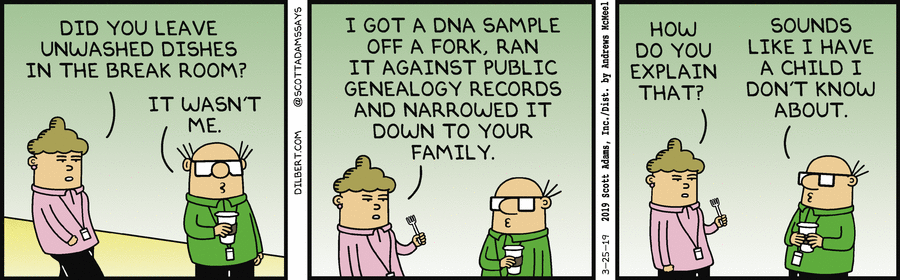
DNA Privacy.  It is now inexpensive to at least partially sequence a person’s genome.  Companies like Ancestry.com, GEDMatch and 23andMe.com have done it for over 20 million people.  There are other databases where people have uploaded their DNA profile insearch of relatives.  There are also growing databases, some public, with individual’s DNA gathered from medical testing or crime events.  Recently, a cold case of rape/murder was solved by taking DNA from the crime scene and quickly identifying the killer’s cousin that then lead to an arrest.  That’s good to solve a horrible crime but there are also risks and concerns.

Certainties:

  1. Almost all of us have, will shortly have, our DNA profile, or that of a close relative, in an on-line database.  It could be from genealogy hobbyists, voluntary samples, medical tests or police actions.  There will be incentives and pressure to be profiled, e.g., Stamford Health will need your DNA profile as part of their standard healthcare program – you may have already consented.  Babies are being tested at  birth.   All those routine blood tests could be stored for medical research.  
  2. The massive DNA databases, along with personal medical history will lead to healthcare breakthroughs for both us personally and the public health overall.    Personalized medicine – both treatments and prevention is the future.
  3. The DNA databases can be searched with a court order, but many are open and companies will be building their own databases.  It easy to picture an offer for a “free” DNA test (like free email or facebook) if you send them a sample.  Police can simply upload a DNA profile and search for relatives.
  4. The predictive value of your DNA profile will improve – or at least people and organizations will believe it is predictive.  Those predictions could involve health,  behavior, intelligence, …
  5. Companies and organizations will figure out a way to monetise and benefit from that data.  

I have a bad feeling this is already out of control:

  1. Companies such as insurance, pharmaceutical, your employer,  police, or schools will exploit your DNA profile.  Given the experience with google and facebook, any sort of opt-in or consent laws will be ineffective.   Think of spam from a pharmaceutical company “Your DNA profile indicates you are at risk of macular degeneration – take our stuff now and save your eyes. ”  Or “Your child’s DNA profile indicates they will not succeed in our most demanding academic program.”  “Your DNA profile indicates you should not own a gun, have a pilot’s license, or be trusted with children.”  Companies would claim they are providing a public service – and say talk to your doctor.  Modern day eugenics.
  2. How about discoveries made from your DNA?  Think of Henrietta Lacks – 17,000 patents derived from her cells without compensation.  A few people survive deadly things – ebola, HIV, cancer, …  Do you deserve compensation if you have some unique and valuable genetic trait that a pharmaceutical company uses?  Legal precedent is you don’t have rights over your bio samples.
  3. Can a dating company require genetic testing to claim they only match people who have compatible genetics?  Should you avoid marrying a person who carries the same deadly recessive gene as you?   
  4. Most of us would not volunteer our fingerprints or consent to have our phone tapped.   Yet we don’t even have to directly have our DNA sequenced to be visible to the government.  It is legal to collect a coffee cup or cigarette butt to get a DNA sample.  Police departments are using desktop machines, under less than rigorous laboratory protocols by people with limited training.   Seems like fishing is inevitable – e.g. browse for local people who “lack empathy”.  Risk of false charges or being brought in for questioning.
  5. Are we capable of responsibly interpreting the data?  The public is not allowed to write their own prescriptions.  Could people have their lives ruined – be filled with anxiety, get dangerous or useless medical treatments, fall prey to quacks, even be driven to suicide by not having a medical professional interpret the data?  Google “headache” to get a scare.   
  6. Already the DNA testing companies warn people they may be upset by what they find.  Your parents and siblings are not biologically who you thought they were.  Sperm donors being identified.  A sibling you didn’t know you had.  There are happy endings for sure – but not always.
  7. Lack of checks and balances.  Without them there will be abuse.    


From The Conversation:

Your genome may have already been hacked. https://theconversation.com/your-genome-may-have-already-been-hacked-95763 

DNA apps promise deeper insights for consumers – but at what cost? https://theconversation.com/dna-apps-promise-deeper-insights-for-consumers-but-at-what-cost-96257

Americans want a say in what happens to their donated blood and tissue in biobanks  Americans want a say in what happens to their donated blood and tissue in biobanks


5 biggest risks of sharing your DNA with consumer genetic-testing companies https://www.cnbc.com/2018/06/16/5-biggest-risks-of-sharing-dna-with-consumer-genetic-testing-companies.html

https://www.nytimes.com/2019/02/21/business/china-xinjiang-uighur-dna-thermo-fisher.html?emc=edit_na_20190221&nl=breaking-news&nlid=57463667ing-news&ref=headline

Genealogists Turn to Cousins’ DNA and Family Trees to Crack Five More Cold Cases https://www.nytimes.com/2018/06/27/science/dna-family-trees-cold-cases.html

https://www.nytimes.com/2019/02/16/health/sperm-donation-dna-testing.html

How your third cousin’s ancestry DNA test could jeopardize your privacy. Public DNA databases can be used to find you — even if you never shared your own DNA. https://www.vox.com/science-and-health/2018/10/12/17957268/science-ancestry-dna-privacy

We will find you: DNA search used to nab Golden State Killer can home in on about 60% of white Americans https://www.sciencemag.org/news/2018/10/we-will-find-you-dna-search-used-nab-golden-state-killer-can-home-about-60-white

How an Unlikely Family History Website Transformed Cold Case Investigations. Fifteen murder and sexual assault cases have been solved since April with a single genealogy website. This is how GEDmatch went from a casual side project to a revolutionary tool. https://www.nytimes.com/2018/10/15/science/gedmatch-genealogy-cold-cases.html

When a DNA Test Reveals Your Daughter Is Not Your Biological Child https://www.theatlantic.com/science/archive/2018/10/dna-test-divorce/571684/

23 and me Privacy Policy. https://www.23andme.com/about/privacy/

Ancestry.com Privacy Statement https://www.ancestry.com/cs/legal/privacystatement

The FBI’s CODIS database: https://www.fbi.gov/services/laboratory/biometric-analysis/codis

Also on CODIS:

An overview of human genetic privacy from the NIH: https://www.ncbi.nlm.nih.gov/pmc/articles/PMC5697154/

https://www.nytimes.com/2019/01/21/science/dna-crime-gene-technology.html

Testing DNA: In her new book, Erin Murphy investigates how the criminal justice system misuses genetic identification

http://www.law.nyu.edu/news/ideas/erin-murphy-forensic-dna

Familial DNA Searches and the Law

https://criminal.findlaw.com/criminal-rights/familial-dna-searches.html

ACLU: The Police Want Your DNA to Prove You’re Innocent. Do You Give it to Them?

https://www.aclu.org/blog/privacy-technology/medical-and-genetic-privacy/police-want-your-dna-prove-youre-innocent-do-you

https://www.nytimes.com/2019/02/04/business/family-tree-dna-fbi.html

https://www.nytimes.com/2019/02/17/us/jerry-westrom-isanti-mn.html

Privacy, Security, and the Legacy of 9/11  – Daniel Klau, UConn Law

https://today.uconn.edu/2015/09/privacy-security-and-the-legacy-of-911/

Electronic Frontier Foundation on Medical Privacy

https://www.eff.org/issues/medical-privacy

Dear Mr. Banks,

Thank you for your inquiry.  Generally, and depending on the test ordered by your physician, blood samples are retained anywhere from 3 days to 2 weeks after the testing is performed, after which they are appropriately discarded.  

Regards,

Todd M. Lieval

Privacy Analyst


Current Affairs. Brexit. February 21, 2019

Discussion leader: Bryan Hooper
Opening Notes:

BREXIT: Why should we care?


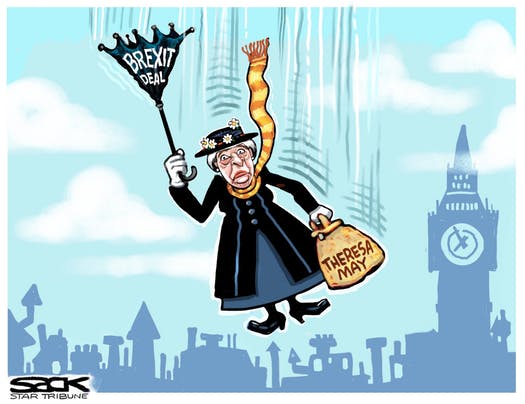
At a seminar I attended in the UK many years ago each participant was asked to consider the future of their industry or professional group.  When it was his turn to make his forecast, a lawyer stood up and declared that “the legal profession has no future, but it has a long and glorious past stretching in front of it.”  Some might say the same about the United Kingdom of Great Britain and Northern Ireland as it wrestles with the problems created by the vote in June, 2016, to exit the European Union. 


To help answer the question in the title above it might be helpful to have an understanding of some of the history of the UK, the development of the EU, and how the UK came to be in its current situation – if the situation ever becomes clear, that is.


  1. The United Kingdom (UK)


Great Britain was created by the English annexing Wales in 1535 and 1542 and forming a union with Scotland in 1707.  The kingdom of Ireland was added in 1801, and Northern Ireland was formed in 1922 when what became Eire seceded from the kingdom and established an independent country.  The combination of Great Britain and Northern Ireland is the United Kingdom.  All four countries elect members to the UK parliament that sits in Westminster, London, and, in addition, Wales, Scotland and Northern Ireland each has a separate devolved parliament.  The total population of the UK is 66 million, with England at 55.6, Scotland 5.4, Wales 3.1 and Northern Ireland 1.9 million.  Gross domestic product of the UK is the fifth largest in the world at an estimated $2.8 trillion in 2018 out of a world total of $84.8 trillion.  To put this in perspective, the US GDP was $20.5, China $13.5, Japan $5.1 and Germany $4.0 trillion.


  1. The European Union (EU)


It is ironic in today’s discombobulated Brexit climate that in 1946 Winston Churchill, a Conservative statesman, was one of the early advocates of a United States of Europe.  The EU traces its origin to the formation of the European Coal and Steel Community created during the recovery from World War II by the Treaty of Paris in 1951.  The subsequent Treaty of Rome in 1957 led to the establishment of the European Economic Community comprising six countries: West Germany, France, Italy and the Benelux nations.  The UK eventually joined the EEC in 1973 having been rebuffed initially by the French in 1963. 

In 1975 the UK held its first ever nationwide referendum, and it concerned staying in the EEC.  The government recommended the UK should remain in the group, and the electorate voted 67% in favor on a 64% turnout.  In 1993 the Maastricht Treaty came into effect for the 12 countries of the EEC.  That treaty established the EU together with European citizenship, it ensured the free movement of people, goods, services and capital within the market, and enabled the enaction of legislation covering justice, home affairs and trade policies.  It also laid the foundation for the common currency, the euro: the EU now has 28 member countries and 19 of them use the euro.  The population of the EU is 513 million and GDP in 2018 was estimated at $18.8 trillion, approximately 22% of the world’s GDP, compared with the US share of 24%.


  1. The Brexit Referendum


(a) The political timeline

David Cameron, leader of the Conservative Party, won an unexpected victory over the Labour Party in the UK general election in 2010.  The Conservatives did not, however, gain sufficient votes to form a clear majority and they allied with the Liberal Democratic Party to form a coalition government with Cameron as Prime Minister.

-2-


Animosity in the UK toward the EU had gradually increased since the terms of the Maastricht Treaty were enforced in 1993, and the Treaty of Lisbon exacerbated the situation when it was implemented in December, 2009.  This gave increasing power to the EU parliament and also fueled the anti-immigrant feelings in the UK which had been developing and strengthening as the EU expanded its number of member countries and assigned more power to the European Parliament in Brussels.  During and after the world financial crisis in 2008 the resentment intensified with many in the UK objecting to immigrants taking away jobs from the UK population and some allegedly living off the UK by taking advantage of social welfare handouts.  Further dislike of the EU was fostered by the crisis in the Eurozone creating economic uncertainty, and the rise of terrorism that was also blamed on immigrant factions.  Pressure built up to fix the UK economy and react to the growing power arrogated by the EU.  

Cameron called a general election in 2015 during which he promised another referendum on staying in the EU.  The conservatives won enough seats this time to form a majority government (over 326) without the assistance of another party.  In the table below are shown the seats won in 2015 compared with 2010 and also the percentage of the vote won by the main parties:


Party

Members of

Parliament

Share of MPs

(%)

Share of Votes

(%)


2010                        2015

 2010                           2015

 2010                             2015

Conservative

 306                          330

  47.1                            50.8

  36.1                              36.8

Labour

 258                          232

  39.7                            35.7

  29.0                              30.4

Scottish National

     6                            56

    0.9                              8.6

    1.7                                4.7

Liberal Democrats

   57                              8

    8.8                              1.2

  23.0                                7.9

Democratic Unionist

     8                              8

    1.2                              1.2

    0.6                                0.6

UK Independence

     0                              1

    0.0                              0.2

    3.1                              12.6

Speaker

     1                              1

    0.2                              0.2

    0.2                                0.2

Other

   14                           14

    2.1                              2.1

    6.3                                6.8

Total

 650                         650

100.0                         100.0

100.0                           100.0


Note in 2015 the growth of the Scottish National Party (SNP), the decline of the Liberal Democrats, and the share of the vote won by the UK Independence Party (UKIP): 

  • The electorate in Scotland had rejected separating from the UK in a referendum held in September, 2014, voting 55% to stay, with a very high turnout of 85%. However, the whole process of the independence plebiscite stirred nationalist sentiment and that carried over to the UK general election in 2015 as the SNP won 56 of the 59 available seats in Scotland.
  • The Liberal Democrats paid the price for being in coalition with the Conservative Party in the last government, losing 49 of the 57 seats they held previously.
  • The Democrat Unionist Party (DUP) retained 8 of the 18 seats available in Northern Ireland.
  • Labour won 25 of 40 seats in Wales.
  • The Conservative Party took 316 of 533 seats in England.
  • In 2014 UKIP candidates took 27% of the vote in the UK for the European Parliament, ending up with 24 out of the 73 seats assigned to the UK, and greater than the seats won by either of the two major UK parties. In the 2015 UK general election UKIP picked up only one seat, but their 13% share of the total vote was a signal of what was to come in 2016.


-3-


(b) The fateful vote

Prime Minister David Cameron and his government passed the Enabling Act in February, 2016, authorizing the referendum to be held for remaining or leaving the EU, and announced the date of June 23, 2016, for it to occur. 

The government threw its support behind the Remain camp, but Cameron allowed Conservative Party members of parliament (MPs) and members of his Cabinet to make their own decisions on which side to support.  Seven cabinet members joined the Leave faction.  Boris Johnson, former Mayor of London and an MP, plus Michael Gove, Secretary of State for Justice, together with UKIP leader, Nigel Farage, spearheaded the Leave side.  Arguments for Remain were that the UK would risk prosperity, jeopardize national security, lose jobs, delay investment in the UK, and lose influence in world affairs if they left.  The Leave group argued that the EU had a deficit of democracy, it undermined national sovereignty and prevented the UK from making better trade deals.  Leaving would give control of immigration back to the UK and save billions of pounds in membership fees.  The Leave group appeared to take better advantage of social media than the Remain team, spreading the memes that emphasized the potential danger of immigration from Turkey if it became a member, and also trumpeting that leaving the EU would free up £350 million a week ($24 billion annually) to be spent on the UK National Health Service.  Neither of these messages were countered effectively by the Remain side.

The results of the referendum surprised everyone – to say the least.  The overall vote in the UK to leave the EU was 52% versus 48% to remain, and the turnout was 72% of the electorate (compared with a 64% turnout in 1975 when 67% to remain in the EEC).  On a country basis, England voted to leave by 53.4%, and Wales at 52.5% also voted to leave.  In England only Greater London voted to remain, while all other regions opted to leave.  Scotland at 62.0% and Northern Ireland at 55.8% voted to remain in the EU.

Prime Minister Cameron announced his resignation the next day and Theresa May, the Home Secretary, took over on July 13, 2016.  May was one of the ministers who had supported the Remain campaign.  On March 29, 2017, the UK government invoked Article 50 of the Treaty on European Union to leave the EU by March 29, 2019, and so began the process of planning and negotiating terms of the withdrawal.


(c) The 2017 election

On April 18, 2017, Theresa May called for a general election in order to strengthen her hand in negotiations with the EU, and set the date for June 8th.  Strong support for her government diminished considerably by the time the election occurred, and the Conservative Party lost 13 seats. They ended up 9 short of an overall majority, but continued in power as a minority government with the backing of the 10 votes of the DUP from Northern Ireland.


Party

Members of

Parliament


2015                        2017

Conservative

 330                           317                         

Labour

 232                           262                         

Scottish National

   56                             35

Liberal Democrats

     8                             12

Democratic Unionist

     8                             10

UK Independence

     1                               0

Speaker

     1                               1

Other

   14                             13

Total

 650                           650


-4-


 (d) The draft agreement and the options

May then proceeded to negotiate with the EU with a view to avoid permanent membership of the single market or the customs union and to repeal membership of the EU.  In July 2018, the PM’s cabinet agreed to the Chequers plan which outlined the proposals made by the UK government, and in November, 2018, the draft Agreement on the Withdrawal of the United Kingdom from the European Union as developed between the UK and EU was published – all 585 pages.

The proposal allows for the UK to transition out of the EU over the period March 29, 2019 to December 31, 2020.  In the interim, it will remain in the customs union, continue to pay into the EU budget and apply EU laws while negotiating further with the EU on new trade deals.  The UK will have no representation in making decisions in the EU during the transition.  In case no agreement is reached by the end of 2020 there is a backstop agreement that says the UK will remain in a customs union with the EU, thus avoiding the necessity of setting up a hard border with customs checks between Northern Ireland and Eire, which would avert a potential conflict in this previously troubled area.  This part of the agreement is difficult for Brexit supporters to accept. They have consistently argued that Britain must be able to exit any UK customs union with the EU as and when it wants so as to be able to pursue free-trade deals around the world.  The DUP objects to the backstop since it treats Northern Ireland differently from the rest of the UK and could promote a renewal of talk and action on reunification of Ireland and leaving the UK.

The draft agreement was submitted by the UK government for approval to parliament on January 15, 2019, and went down to defeat by 432 votes to 202, an extraordinary and record margin of 230 for a government loss.  Nonetheless, the Prime Minister survived a vote of no confidence the next day by 19 votes.  Non-binding amendments were then approved by parliament on January 29 that rejected a no-deal Brexit and authorized the Prime Minister to return for talks with the EU to alter the Irish backstop to allow for alternative arrangements. 

The EU negotiators have already stated there will be no changes made to the draft agreement, but meetings are continuing, and Prime Minister May will present revised proposals to parliament later in February.


(e) What will happen?

There are several possibilities:

  • The chaotic solution nobody wants is that a hard Brexit occurs on 3/29/19 with no agreement in place.
  • The UK and EU come to a new arrangement over the Irish backstop, and a more amicable divorce is agreed between the two participants.
  • The UK decides to have another referendum if parliament votes for it. Additionally, Scotland has the right to vote for independence in a second referendum once Brexit terms are decided, and might subsequently apply for membership of the EU.
  • The decision is deferred for a few months, although that could create problems since there are elections in May for the EU parliament and the UK theoretically would still have to vote to fill their EU seats.


  1. Why should we care?


An open question, and one for discussion at our meeting on February 21, 2019.

To get everyone started on their reading of the subject of Brexit I would suggest the article on the Conversation website:  https://theconversation.com/whats-the-deal-or-no-deal-with-brexit-heres-everything-explained-110024

Another excellent source is the BBC news website: https://www.bbc.com/news  

to find “All you need to know about Brexit.”  Enter Brexit in the search box to see a summary of the situation and links to give you greater insight into several subjects.

For those of you interested in delving into more background go into Wikipedia and search for the individual articles on the United Kingdom, the European Union, and Brexit.  More data regarding the EU can be found on their website, Europa.eu 

https://www.nytimes.com/2019/01/17/opinion/sunday/brexit-ireland-empire.html

 

Ed Mulock passes away Dec 3, 2018

Edwin McCord Mulock, III of Darien, died at home December 3, 2018. Born April 14, 1938 in Detroit, Michigan, he was the son of Edwin McCord Mulock Jr. and Harriett (Knight) Mulock.

Ed is survived by his wife of fifty-four years Neville Rodgers Mulock, his children Lyndsay Drew and Luke Mulock and two grandchildren. He is also survived by his brother Bruce Mulock.

As a resident of Darien since 1973, Ed was active in the community. Starting out as a co-president of the Hindley School Parents Association and Sunday school teacher at St. Luke’s Parish, he also served as President of the Board of the Noroton Bay Property Owners Association, and enjoyed his stint as “King of the Bay” in their opening day parade.

He developed the first computer system for Person-to-Person and served there as a Van Man. He continued to move furniture in and out of clients’ and donors’ homes until he was 80. He became a member of the Darien Men’s Association and served on the Social Committee, offered to be their Computer Activity representative at the Darien Senior Center and partook in their Happy Wanderers outings.

Ed attended Hackley School in Tarrytown. He went on to Princeton University and attended reunions, football games and P-rades the rest of his life. He spent a summer at UC Berkeley studying German and attended the University of Virginia for graduate school. Rather than beginning his career as an economist as planned, Ed began with three days of training from IBM at Avon Products and spent his entire career in computer systems development and information services management. Ed also received an MBA from Adelphi University after three years while commuting with a professor on Metro-North. He became a founding member of the Advanced Technology Group at Bristol-Myers Squibb in New York where he was employed for over thirty years. After retirement, he became a consultant for Hoffman-La Roche Pharmaceuticals.

Ed loved to travel. He met his wife in the lobby of a hotel in Miami while getting ready to embark on a windjammer cruise to the Bahamas in 1963. His more adventurous travels included camping trips navigating Volkswagon Pop Top campers through Holland, Belgium, Germany, and Austria when his children were young.

He was an avid sailor and loved sailing more than any other activity. He was lucky and grateful to his many friends at Noroton Yacht Club who asked him to be their foredeck man for decades. He also discovered he liked having others skipper cruises in the Caribbean, Europe and Africa and across the Atlantic. He loved jumping from the pilings at Noroton Bay at high tide and body surfing wherever the surf swelled enough.

He was a true music enthusiast with his tastes ranging from atonal Charles Ives to zydeco, to Norah Jones to jazz to classical. His favorite, however, always remained Bach for whom he forever tweaked his speakers to find just the right acoustics. He will be remembered by all who knew him for his big smile.

A memorial service will be held at Saint Luke’s Parish. In lieu of flowers, donations may be made in Ed’s memory to Person-to-Person, 1864 Post Road, Darien, CT 06820 or a charity special to the donor. Edward Lawrence Funeral Home, 2119 Post Road, Darien, handled arrangements.

A service will be held Friday, December 28th, 2:00 p.m., St Luke’s.

« Older posts Newer posts »