
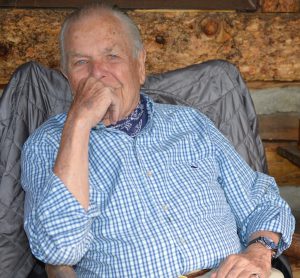
 George Blackwell Cammann, son of Katharine Blackwell and Frederic Almy Cammann, died peacefully on Tuesday, August 15th at home.
George was born on January 27, 1926 in New York City. After attending St. Marks School, he served as a Navy corpsman during WWII, and graduated from Cornell University (BMA’50). George spent the majority of his career at Pan American World Airways and a decade at Northwest Airlines. Upon retirement, he volunteered at IESC and Norwalk Hospital.
He actively served in the life of Noroton Presbyterian Church, including singing with his strong tenor voice in the choir in his later years. A member of the Tokeneke Club in Darien for 55 years, George was an enthusiastic competitor in his Sunfish on Long Island Sound or on the tennis courts. Equally at ease on alpine or nordic skis, George was noted for his skilled horsemanship at Elkhorn Ranch South in Arizona and Elkhorn Ranch Montana. His greatest pleasure came with good friends and tight lines fly fishing at Megantic, Potatuck, and on the Gallatin, Madison and Yellowstone Rivers.
George is survived by his wife of 64 years, Nancy Colway Cammann; his daughter Amy Cammann Cholnoky and her husband John of Darien, CT and Big Sky, MT; son Thomas Rhody Cammann and his wife Bonnie of Huntington Beach, CA; grandchildren JB, Kari, and Robbie Cholnoky, and Matthew (Andrea) and Sarah Cammann; and his brother Frederic Gallatin Cammann.
A memorial service will be held on Friday, September 1 at 11am, Noroton Presbyterian Church, Darien, CT. Contributions in George’s memory may be sent to Bennett Cancer Center, Stamford, CT or The Open Door Shelter, Norwalk, CT.
To send flowers or a remembrance gift to the family of George Cammann, please visit our Tribute Store.
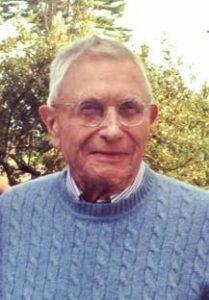 Daniel Russell Cooney, 92, of Darien and Waldoboro, Maine, died on June 24. Born in Brooklyn on Dec. 12, 1924, he was the son of Mae Bossert and Russell S. Cooney. He grew up in Plandome, Long Island and in Waldoboro, attended Exeter Academy, and served in the U.S. Army in World War II in the European Theater. After the war, he entered Yale University and graduated in 1950. He worked as a securities analyst for Lord Abbett & Co. in New York City, and in 1973, he became portfolio manager of the newly established Lord Abbett Developing Growth Fund, one of the earliest funds to focus specifically on the over-the-counter market. After his retirement in 1987, he served as Trustee of Robertson Stephens Emerging Growth Fund.
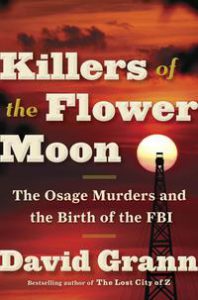 From New Yorker staff writer David Grann, #1 New York Times best-selling author of The Lost City of Z, a twisting, haunting true-life murder mystery about one of the most monstrous crimes in American history In the 1920s, the richest people per capita in the world were members of the Osage Indian nation in Oklahoma. After oil was discovered beneath their land, they rode in chauffeured automobiles, built mansions, and sent their children to study in Europe. Then, one by one, the Osage began to be killed off. The family of an Osage woman, Mollie Burkhart, became a prime target. Her relatives were shot and poisoned. And it was just the beginning, as more and more members of the tribe began to die under mysterious circumstances. In this last remnant of the Wild West—where oilmen like J. P. Getty made their fortunes and where desperadoes like Al Spencer, the “Phantom Terror,” roamed—many of those who dared to investigate the killings were themselves murdered. As the death toll climbed to more than twenty-four, the FBI took up the case. It was one of the organization’s first major homicide investigations and the bureau badly bungled the case. In desperation, the young director, J. Edgar Hoover, turned to a former Texas Ranger named Tom White to unravel the mystery. White put together an undercover team, including one of the only American Indian agents in the bureau. The agents infiltrated the region, struggling to adopt the latest techniques of detection. Together with the Osage they began to expose one of the most chilling conspiracies in American history. In Killers of the Flower Moon, David Grann revisits a shocking series of crimes in which dozens of people were murdered in cold blood. Based on years of research and startling new evidence, the book is a masterpiece of narrative nonfiction, as each step in the investigation reveals a series of sinister secrets and reversals. But more than that, it is a searing indictment of the callousness and prejudice toward American Indians that allowed the murderers to operate with impunity for so long. Killers of the Flower Moon is utterly compelling, but also emotionally devastating.
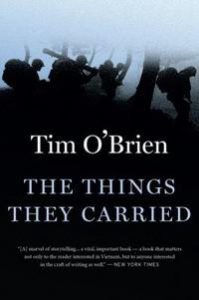 A classic work of American literature that has not stopped changing minds and lives since it burst onto the literary scene, The Things They Carriedis a ground-breaking meditation on war, memory, imagination, and the redemptive power of storytelling. The Things They Carrieddepicts the men of Alpha Company: Jimmy Cross, Henry Dobbins, Rat Kiley, Mitchell Sanders, Norman Bowker, Kiowa, and the character Tim O’Brien, who has survived his tour in Vietnam to become a father and writer at the age of forty-three. Taught everywhere from high school classrooms to graduate seminars in creative writing it has become required reading for any American and continues to challenge readers in their perceptions of fact and fiction, war and peace, courage and fear and longing. The Things They Carried won France’s prestigious Prix du Meilleur Livre Etranger and the Chicago Tribune Heartland Prize; it was also a finalist for the Pulitzer Prize and the National Book Critics Circle Award., A classic, life-changing meditation on war, memory, imagination, and the redemptive power of storytelling, with more than two-million copies in print Depicting the men of Alpha Company-Jimmy Cross, Henry Dobbins, Rat Kiley, Mitchell Sanders, Norman Bowker, Kiowa, and the character Tim O’Brien, who survived his tour in Vietnam to become a father and writer at the age of forty-three-the stories in The Things They Carried opened our eyes to the nature of war in a way we will never forget. It is taught everywhere, from high school classrooms to graduate seminars in creative writing, and in the decades since its publication it has never failed to challenge our perceptions of fact and fiction, war and peace, and courage, longing, and fear., Tim O’Brien’s modern classic that reset our understanding of fiction, nonfiction, and the way they can work together, as well as our understanding of the Vietnam war and its consequences.
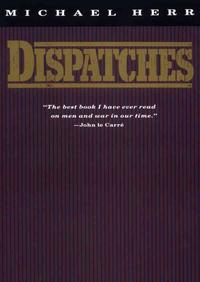 “Dispatches” by Michael Herr. According to John Wolcott, who served in Viet Nam, this accurately captures the life of a grunt. One of the greatest examples of war journalism ever written, Michael Herr’s clearheaded yet unsparing retellings of the day-to-day events in Vietnam take on the force of poetry, finding clarity in one of the most incomprehensible events in our modern era. A National Book Critics Circle finalist and highly acclaimed upon its publication, Dispatches still retains its resonance as America finds itself amidst another military quagmire.
 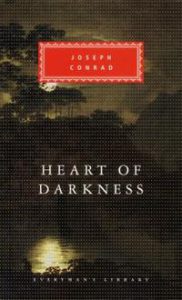 “Heart of Darkness” by Joseph Conrad. Charles Marlow is a steamboat captain on the River Thames near Gravesend England. He and his crew work for an ivory trading company. One day he recounts to his fellow crew the story of his life and how he became a captain for the steam boat company. The focus of his story involves the journey Marlow undertook to the outer reaches of the company’s operations. Here he tells of his wild encounters with Mr. Kurtz, a man with a great reputation for bringing in the most ivory for the company. Kurtz is widely respected by the natives, yet Marlow has some differing opinions as he struggles to understand Kurtz’s way of life, while uncovering secrets about the strange way Kurtz conducts his business.

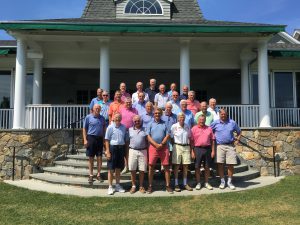
 The next DMA golf outing is at the Woodway Country Club,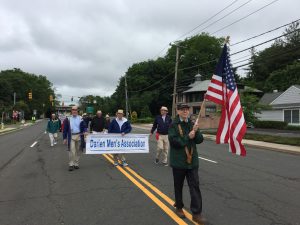
 The first outing this year is at Sterling Farms Golf Course in Stamford, Tuesday, June 20, 2017, 10 a.m.