
l to r: Marc Thorne, Alex Garnett, Bob Baker Jack Fitzgibbons, Taylor Strubinger, Pete Kenyon, Steve Graveraux, Tom Gildersleeve, Kevin Monahan, and Tom Taylor
Activities are gatherings that occur on a regular schedule, usually weekly, to enjoy a specific pastime.
l to r: Marc Thorne, Alex Garnett, Bob Baker Jack Fitzgibbons, Taylor Strubinger, Pete Kenyon, Steve Graveraux, Tom Gildersleeve, Kevin Monahan, and Tom Taylor

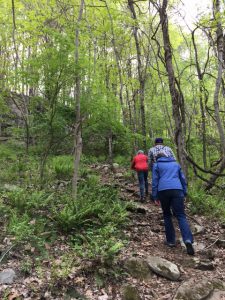
The newly organized Hiking Group led by Scott Hutchason had their initial outing on Oct.25 with a hike on the Mianus River Gorge Trail.
Sixteen people came for the first outing in ideal weather. The group hiked the entire trail to the final point with a view of the Mianus Reservoir. Side trips to see the old Hobby Hill quarry site, the gorge overlook, and the Havemeyer Falls (without water) amounted to a total distance traveled of about five miles. No laggards and no injuries from tripping over rocks and tree roots in the trail.
Before parting, the group went to lunch together at the Lakeside Diner.
Another hike is planned for November. Watch for time and place to be announced.

Thanks to Katie Lawrence for these Photos! [camera slideshow=”2013-fdr-excursion”]
 Benefits of being out in Nature
Aristotle believed that the outdoors clarified the mind. Darwin and Einstein claimed that a walk in the woods helped them think. John Muir felt that we should fight the tendency to become “ tired, nerve-shaken, over-civilized people of the city”, and Walt Whitman warned of the city’s “pestiferous little gratifications in the absence of nature.” And now neuroscientists are showing that nature makes us happier, healthier and more creative.
It is the mission of the hiking group to help you derive not only these benefits but to also have fun doing so and develop lasting friendships with your fellow DMA members.
Hikes are usually between 3-5 miles, last 2-3 hours and are followed by lunch at a nearby restaurant. The lunch has become as important an activity as the hike itself. Spouses and significant others are welcome and some have become regulars.
We select trails which are no more than 30-35 minutes driving distance from Darien and they vary in difficulty from what could be described as a walk in the park to more challenging trails.
Hikes will be announced two weeks in advance at the regular DMA meetings on Wednesday. Details will be posted on our website under “Hiking Posts” and, during the week of the hike, will also be included in the weekly eblast entitled “ This Week at the DMA” which goes out on Mondays.
Trail Masters: Dave McCollum and Bob Plunkett
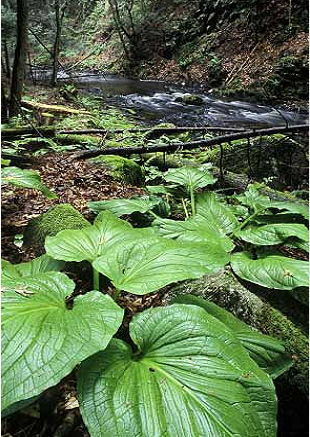 We will have our first hike Friday, October 25, at the Mianus River Gorge. The Gorge is a 750-acre preserve of old-growth forest that was established sixty years ago as the first land project of The Nature Conservancy.
The trails roughly parallel the river at a higher elevation. Among the interesting features is an abandoned quarry where mica, quartz, and feldspar were mined in the 19th century. For more details see www.mianus.org/visit-the-gorge/planning-your-visit/.
The Mianus River Gorge is located nearby in Bedford, NY, not far from the Stamford border. To reach it:
View Larger Map
Be cautious! It is easy to miss Miller’s Mill Road. Check your odometer when you exit the Merritt so you will know when you have traveled 7.5 miles. A helpful landmark on the right is Twin Lakes Drive, which comes just before Miller’s Mill Road.
The hike is about 4½ miles, and will take us 2½ – 3 hours to walk it.
We will meet at the Gorge parking lot at 9:50 and begin the hike at 10:00. Afterwards there will be an optional lunch at the Lakeside Diner in Stamford.
For more information contact Scott Hutchason at 203-322-5025 or shutchason@sbcglobal.net.
| Morning – Eleanor Roosevelt National Historic Site, Val-Kill Cottage |
 Val-Kill, the retreat about two miles from the “big house” at Franklin D. Roosevelt’s Hyde Park, was the only place that Eleanor Roosevelt ever could call her own. |
| Lunch at Bocuse Restaurant |
 The exciting new student-staffed Bocuse Restaurant at the Culinary Institute of America provides a dining experience that is inspired by traditional French regional cuisine, re-envisioned through the lens of modern techniques. The menu includes creative new interpretations of classics selected from the bistros of the French countryside as well as the sophisticated restaurants of Paris. |
| Afternoon — Home of Franklin D. Roosevelt |
 “All that is within me cries out to go back to my home on the Hudson River” FDR This quote captures FDR’s connection to Springwood, the estate that he loved & the place he considered home. The first US Presidential Library was started by FDR here. Visit the Home of FDR and Presidential Library & Museum to learn about the only President elected to four terms. |
The price is $70 per person.
Bus departs from the parking lot of the Christian Science Church located at 2331 Post Road. (Salt Box Lane is the cross street.) at 7:30am SHARP, boarding starts at 7:15am.
DO NOT GO TO 1904 POST ROAD WHICH IS THE READING ROOM OF THE CHURCH.
To make your reservations, please contact Mel Klugman, 914-417-1568, or melklugman@yahoo.com
Thanks to Frank Johnson and Bob Smith for theses photos! Bob reports that the fellowship, weather and sunset were outstanding. [camera slideshow=”2013-dma-picnic”]
The second annual golf tournament between DMA and the Senior Men’s Club of New Canaan (SMNC) was held at the Silvermine Golf Club on Wednesday, June 26th. I am pleased to inform you that DMA atoned for our loss last year and emerged with an 18.5 – 11.5 victory. The Silvermine Cup will now be domiciled in its rightful home at DMA for the next year. Our own Terry Brewer won the Long Drive contest, and hit an amazing shot to also win the Closest to the Pin contest (1’6”).
[camera slideshow=”2013-golf”]
We would not have won the tournament without the active participation of our better golfers. I am particularly grateful to the following members of the 2013 DMA Golf Team:
Special thanks are due to Alex Garnett and Tom Lom for their invaluable assistance in helping me recruit and organize the DMA Golf Team.
Here are pictures of the DMA Golf Team

and the DMA and SMNC Golf Teams together.

The series now stands at one victory for each team. I fully expect SMNC to field a stronger team next year in an attempt to win back the Silvermine Cup. As a result, we will need all of our best players to answer the call in 2014. The trophy and team members will be introduced at the first DMA meeting in September.
Enjoy the remainder of the summer!
Best regards,
Denny Devere
203-353-1758
The DMA Annual Summer Picnic will be celebrated on August 15, 2013 from 5 pm to 8:30 pm at the Weed Beach picnic area. DMA will provide beer, wine, and soft drinks, as well as eating utensils, plates and cups. Although this event is free, it is a potluck dinner, so please bring one of the following foods:
| Last name begins with | Please bring servings for 8 of |
| A — G | Dessert |
| H — M | Salad, pasta, vegetables, etc. |
| N — Z | Casserole or meat platter |
Please be sure to bring suitable serving pieces for your food dish. For your comfort, bring folding chairs, tables, and insect repellent!
IMPORTANT! Absolutely no glass containers or bottles should be brought. Darien resident attendees should have a valid beach sticker of their vehicles. Non-resident attendees should check-in at the Gate House and advise the guard that they are attending the annual DMA Picnic. Reservations are not required, but are appreciated! Contact Scott Huchason, 203-322-5025 or shutchason@sbcglobal.net to reserve.
 [From Amazon.com]
Her name was Henrietta Lacks, but scientists know her as HeLa. She was a poor Southern tobacco farmer who worked the same land as her slave ancestors, yet her cells—taken without her knowledge—became one of the most important tools in medicine. The first “immortal” human cells grown in culture, they are still alive today, though she has been dead for more than sixty years. If you could pile all HeLa cells ever grown onto a scale, they’d weigh more than 50 million metric tons—as much as a hundred Empire State Buildings. HeLa cells were vital for developing the polio vaccine; uncovered secrets of cancer, viruses, and the atom bomb’s effects; helped lead to important advances like in vitro fertilization, cloning, and gene mapping; and have been bought and sold by the billions.
Yet Henrietta Lacks remains virtually unknown, buried in an unmarked grave.
Now Rebecca Skloot takes us on an extraordinary journey, from the “colored” ward of Johns Hopkins Hospital in the 1950s to stark white laboratories with freezers full of HeLa cells; from Henrietta’s small, dying hometown of Clover, Virginia—a land of wooden slave quarters, faith healings, and voodoo—to East Baltimore today, where her children and grandchildren live and struggle with the legacy of her cells.
Henrietta’s family did not learn of her “immortality” until more than twenty years after her death, when scientists investigating HeLa began using her husband and children in research without informed consent. And though the cells had launched a multimillion-dollar industry that sells human biological materials, her family never saw any of the profits. As Rebecca Skloot so brilliantly shows, the story of the Lacks family—past and present—is inextricably connected to the dark history of experimentation on African Americans, the birth of bioethics, and the legal battles over whether we control the stuff we are made of.
Over the decade it took to uncover this story, Rebecca became enmeshed in the lives of the Lacks family—especially Henrietta’s daughter Deborah, who was devastated to learn about her mother’s cells. She was consumed with questions: Had scientists cloned her mother? Did it hurt her when researchers infected her cells with viruses and shot them into space? What happened to her sister, Elsie, who died in a mental institution at the age of fifteen? And if her mother was so important to medicine, why couldn’t her children afford health insurance?
Intimate in feeling, astonishing in scope, and impossible to put down, The Immortal Life of Henrietta Lacks captures the beauty and drama of scientific discovery, as well as its human consequences.
Thanks to Frank Johnson and Bob Smith for these photos!
[camera slideshow=”2013-memorialday”]

Theme by Anders Noren — Up ↑