Month: October 2016

November 16, 2016
Frederic Chiu
Renowned Concert Pianist

Frederic Chiu

Frederic Chiu

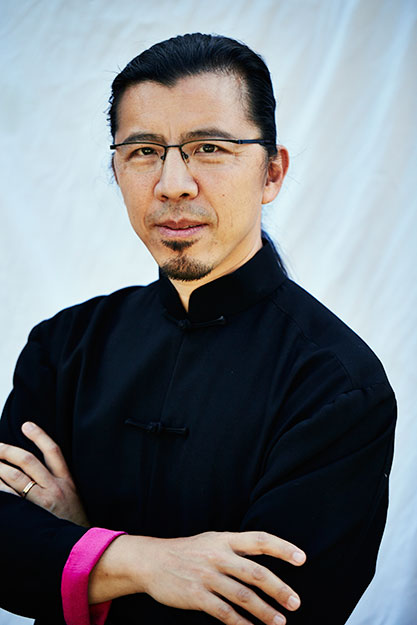
Frederic Chiu will talk about his life as a pianist. His intriguing piano-playing and teaching springs from a diverse set of experiences and interests that include his Asian/American/European background and his musical training that he has combined with an early and ongoing exploration of artificial intelligences and human psychology, especially the body-mind-hearts connection.

With over 25 CDs, his repertoire includes the complete works of Prokofiev and popular classics of Chopin, Liszt, Mendelssohn and Rossini. His work has been recognized by Stereo Review, The New Yorker, The Wall Street Journal and The New York Times.

Chiu has toured Europe and the United States appearing with world renowned orchestras in prestigious halls such as the Lincoln Center, the Kennedy Center, and the Koi and Suntory Halls in Tokyo.

His most recent releases are entitled “Distant Voices” and “Hymns & Dervishes.” On his 50th birthday he hopes to have completed performances in 50 of the United States.

Arranged by Tom Lom

A brief video of Chiu playing the piano can be seen by clicking on the image below.

chiu-play


November 9, 2016
Dr. Arash Salardini
Assistant Professor of Neurology
Yale Medical School

Dr. Arash Salardini

Dr. Arash Salardini

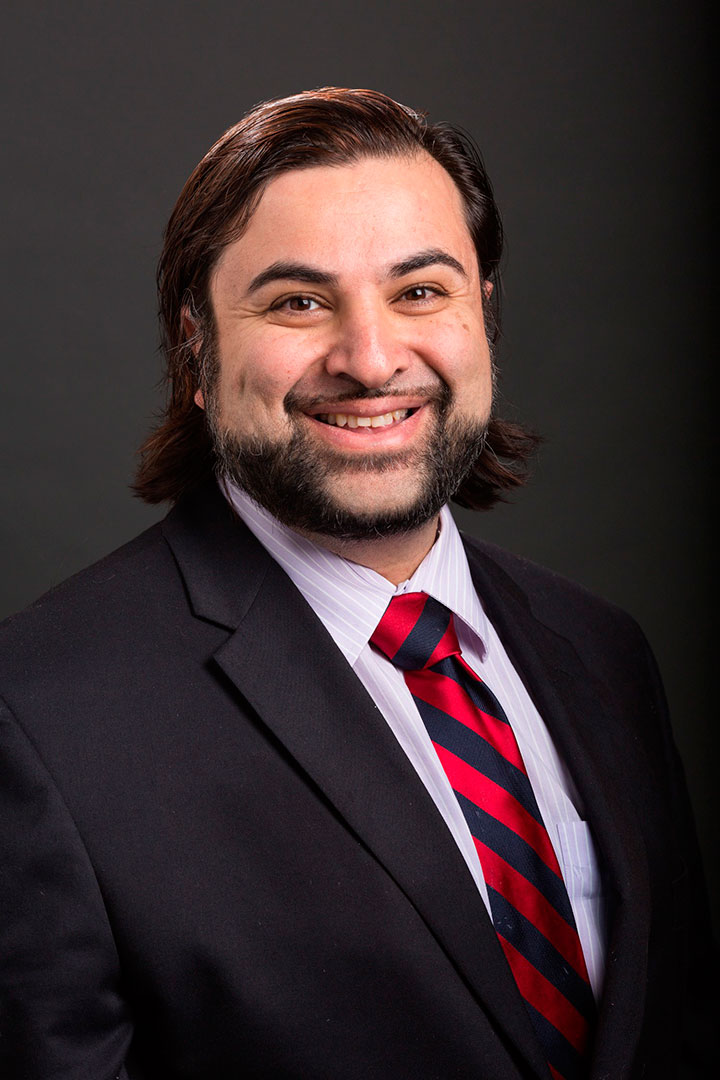
Dr. Arash Salardini, Assistant Professor Of Neurology, Yale Medical School and co-director, Yale Memory Clinic, will talk about dementia, the degree to which it is preventable or reversible, and the results of the latest Alzheimer’s research, including the use of brain imaging to study the disease.

He is currently the associate leader of the clinical core of the Alzheimer Disease Research Center at Yale where he sees patients who have problems with thinking, understanding, learning and remembering due to neurodegenerative and other neurological causes. His work has been widely published both in the United States and internationally. He is editor of the text book The Hospital Neurology Book to be published this year by McGraw-Hill.

Dr. Salardini received his medical degree in 1999 from the University of New South Wales in Sydney, Australia where he developed his interest in neurology. In 2007, he began a two year fellowship in movement disorder at Yale, and then completed a residency at the University of Florida under the noted neurologist Dr. Kenneth Heilman. He returned to Yale to complete a two year fellowship in behavioral neurology and neuropsychiatry under the nationally prominent research neurologist Dr. Stephen Strittmatter.

Hiking the Zofnass Family Preserve
Westchester Wilderness Walk Thursday
November 3, 2016, 9:30 AM

Join us Thursday October 27 November 3 as we hike a portion of the Westchester Wilderness Walk at the 150-acre Zofnass Family Preserve in Pound Ridge, NY  ―  near the North Stamford border. We’ll be at Zofnass during height of the changing leaves in an undeveloped area noted for its beautiful rock outcroppings, upland forests, wetlands and ancient stone walls. We’ll hike about 3 ½ miles of the preserve’s 8 miles of trails.

And after the hike we’ll reward ourselves with lunch at the nearby Long Ridge Tavern on Long Ridge Road in North Stamford.

Invite your wife or significant other to join us both for this special hike ― and for lunch.

Because parking is extremely limited at the Zofnass Preserve we’ll meet at the Long Ridge Tavern at 9:30 a.m. and car pool the five minute drive to trail head.

Directions to Long Ridge Tavern, 2635 Long Ridge Road, Stamford, CT  06903.

― Merritt Parkway, exit 34, Long Ridge Road (CT 104)

― Drive north on Long Ridge Road (CT 104) 3.8 miles to Long Ridge Tavern

― Long Ridge Tavern will be on the right

― Meet in the parking lot

Cell service in Zofnass is limited, so if you need to contact hike leader Rich Sabreen the day of the hike try 917-951-8267 before we leave the Tavern about 9:30 a.m.

Book Club: Hillbilly Elegy by J.D.Vance, January 11, 2017

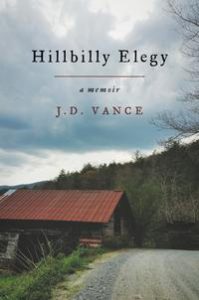
hillbillyFrom a former marine and Yale Law School graduate, a powerful account of growing up in a poor Rust Belt town that offers a broader, probing look at the struggles of America’s white working class Hillbilly Elegy is a passionate and personal analysis of a culture in crisis—that of white working-class Americans. The decline of this group, a demographic of our country that has been slowly disintegrating over forty years, has been reported on with growing frequency and alarm, but has never before been written about as searingly from the inside. J. D. Vance tells the true story of what a social, regional, and class decline feels like when you were born with it hung around your neck. The Vance family story begins hopefully in postwar America. J. D.’s grandparents were “dirt poor and in love,” and moved north from Kentucky’s Appalachia region to Ohio in the hopes of escaping the dreadful poverty around them. They raised a middle-class family, and eventually their grandchild (the author) would graduate from Yale Law School, a conventional marker of their success in achieving generational upward mobility. But as the family saga of Hillbilly Elegy plays out, we learn that this is only the short, superficial version. Vance’s grandparents, aunt, uncle, sister, and, most of all, his mother, struggled profoundly with the demands of their new middle-class life, and were never able to fully escape the legacy of abuse, alcoholism, poverty, and trauma so characteristic of their part of America. Vance piercingly shows how he himself still carries around the demons of their chaotic family history. A deeply moving memoir with its share of humor and vividly colorful figures, Hillbilly Elegy is the story of how upward mobility really feels. And it is an urgent and troubling meditation on the loss of the American dream for a large segment of this country.

Discussion leader: John Wolcott

Gentlemen–Hillbilly Elegy is an extremely important book, perhaps more because so many pundits are liberally quoting it than might truly be the case–and therein lies an intriguing paradox. However, Elegy is extraordinarily well-written (the pages fly by) and relates an absorbing, disturbing, yet at times uplifting story set in Appalachia, referred to by politicians, some sympathetically, others, condescendingly, as the Rust Belt. Our discussion will be both lively and provocative.

Once you’ve put the book down (but not before), please read the attached book review from The New Yorker. I’ve read a number of others, and none comes close. It’s so good that you could almost skip the book, but again, the book is so well crafted that you shouldn’t miss it. The article also refers to several other sources that might be worth a look.

New Yorker – Hillbilly Elegy

See you all January 11. In the meantime, Happy Holidays and a Wonderful New Year, speaking of which, make reading Hillbilly Elegy your first New Year’s Resolution!

–John
Book Club: The Last Hurrah by Edwin O’Connor, December 14, 2016

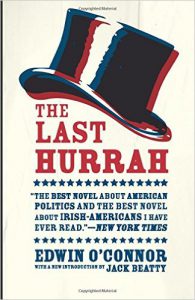
last-hurrah“We’re living in a sensitive age, Cuke, and I’m not altogether sure you’re fully attuned to it.” So says Irish-American politician Frank Skeffington—a cynical, corrupt 1950s mayor, and also an old-school gentleman who looks after the constituents of his New England city and enjoys their unwavering loyalty in return. But in our age of dynasties, mercurial social sensitivities, and politicians making love to the camera, Skeffington might as well be talking to us.
Not quite a roman á clef of notorious Boston mayor James Michael Curley, The Last Hurrahtells the story of Skeffington’s final campaign as witnessed through the eyes of his nephew, who learns a great deal about politics as he follows his uncle to fundraisers, wakes, and into smoke-filled rooms, ultimately coming—almost against his will—to admire the man. Adapted into a 1958 film starring Spencer Tracy and directed by John Ford (and which Curley tried to keep from being made), Edwin O’Connor’s opus reveals politics as it really is, and big cities as they really were. An expansive, humorous novel offering deep insight into the Irish-American experience and the ever-changing nature of the political machine, The Last Hurrah reveals political truths still true today: what the cameras capture is just the smiling face of the sometimes sordid business of giving the people what they want.

Discussion Leader: David Mace

An appreciation
of the United States
by DMA member Sunil Saksena

I recently celebrated a personal milestone which I feel compelled to share … September 23, 2016 marked the 50th anniversary of my arrival in the United States. It was cause not only for celebration but also for reflection and thanks.

Fifty years ago, in September 1966, a young man from India boarded a Pan Am flight from New Delhi, India bound for San Francisco, Cal. I was coming to the University of California at Berkeley to pursue a graduate degree in engineering. My plan was to obtain the degree, work for two or three years and then head back home. Little did I know…

Within weeks of my arrival in Berkeley, I had inhaled the fresh air of freedom and, this being Berkeley in the sixties, it wasn’t just freedom, it was freedom plus. At that time India wasn’t the rollicking democracy it is today. It was run on socialist lines where the government controlled all major sectors of the economy, and personal freedoms, while enshrined in the country’s constitution, were, in practice, hugely circumscribed. So for me to taste this freedom in Berkeley, was a heady experience: it was intoxicating, it was liberating and it became addictive. It felt like a new birth, in fact, “a new birth of freedom,” to quote that immortal phrase from Abraham Lincoln’s Gettysburg Address. Once having tasted this freedom, it was hard to untaste it; once the mind has been unshackled, it is hard to allow it to be shackled again. I decided to abandon my plan to return to India and to make America my new home.

Now, 50 years later, the fact that I am a resident of the prosperous town of Darien is not so much a testament to anything special that I accomplished. Rather, it is a testament to this country that it can take a young man of perhaps modest ability and intelligence, and mold and motivate him to be the best that he can be. This is the true genius of America and that’s what makes this country great.

As I reflected, I realized that I, an immigrant, have lived in this country longer than three-quarters of native born Americans living today, because they are less than 50 years old. Just think about that. It is truly astonishing and could happen in no other country. And that, too, is what makes America great.

And so I say to America: Thank you for a great 50 years!

Sunil Saksena

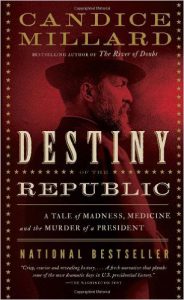
Book Club: Destiny of the Republic: Madness, Medicine & the Murder of a President by Candice Millard, November 9, 2016

destinyoftherepublicThe extraordinary New York Times bestselling account of James Garfield’s rise from poverty to the American presidency, and the dramatic history of his assassination and legacy, from bestselling author of The River of Doubt, Candice Millard.
James Abram Garfield was one of the most extraordinary men ever elected president. Born into abject poverty, he rose to become a wunderkind scholar, a Civil War hero, a renowned congressman, and a reluctant presidential candidate who took on the nation’s corrupt political establishment. But four months after Garfield’s inauguration in 1881, he was shot in the back by a deranged office-seeker named Charles Guiteau. Garfield survived the attack, but become the object of bitter, behind-the-scenes struggles for power—over his administration, over the nation’s future, and, hauntingly, over his medical care. Meticulously researched, epic in scope, and pulsating with an intimate human focus and high-velocity narrative drive, The Destiny of the Republic brings alive a forgotten chapter of U.S. history.

Discussion leader: Joe Spain

November 2, 2016
Tom Molito, Author
Mickey Mantle: Inside and Outside the Lines

tom-molito

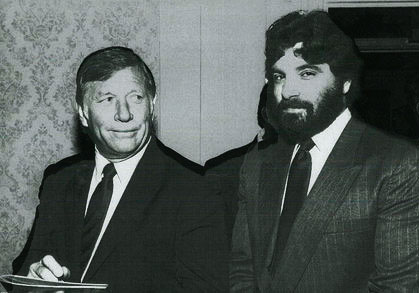
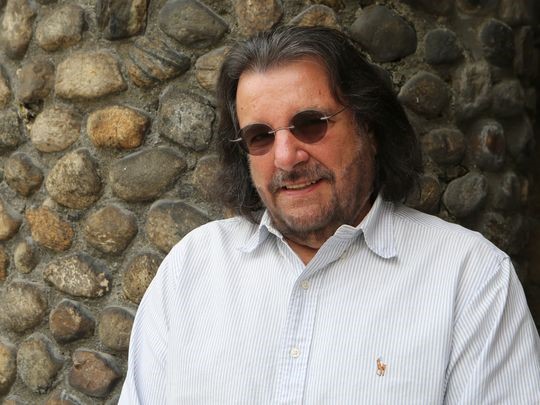
Tom Molito will talk about his book, Mickey Mantle: Inside and Outside the Lines, that was written for baseball lovers and Mantle fans. Archival newspaper articles, websites and more than 35 books on Mantle are used to weave the most complete, unique look at an American icon. The book recalls never-before-told stories: from Park Avenue to Las Vegas to Cooperstown; from television shoots to concerts and Mickey’s restaurant on Central Park West.

This year is the 60th anniversary of Mantle’s Triple Crown season, which many baseball experts consider one of the best seasons ever for a ball player. Although baseball fans who experienced that season are decreasing in number, Mickey Mantle is more popular than ever. The value of his memorabilia is second to none. He remains respected and admired for the redemptive quality of his life.

Mickey Mantle and Tom Molito

Mickey Mantle and Tom Molito

Molito collaborated with the highly respected baseball historian Harold “Doc” Friend. The late Mr. Friend wrote for Bleacher Report (CBS) and uncovered previously unknown facts about Mantle’s career – such as Mickey hitting the facade in Yankee Stadium three times, not the reported twice. An entire chapter updates Mantle’s career with present-day statistical measures and comes to the indisputable conclusion that “Mickey Mantle was even better than we thought!”

Tom lives in New Canaan with his wife Kathleen. They have three adult children, four grandchildren and will soon celebrate their 40th wedding anniversary. A graduate of Iona College and a U.S. Army veteran, Tom served in senior marketing positions at both Nestle and UST Inc. where he founded and was president of a wholly owned subsidiary, Cabin Fever Entertainment. He met Mickey Mantle as a result of Cabin Fever’s award winning production of the 500 Home Run Club. Tom’s relationship with Mickey Mantle developed into a friendship and eventually the book that is available at leading booksellers.

Tom has served on the boards of The Country Music Association and Family Services of Westchester. He was very involved in the Children’s Program at the Bedford Hills Correctional Facility. His talk will include an exhibit featuring Mickey Mantle by various artists.

Arranged by Alex Garnett

Speaker — October 26, 2016
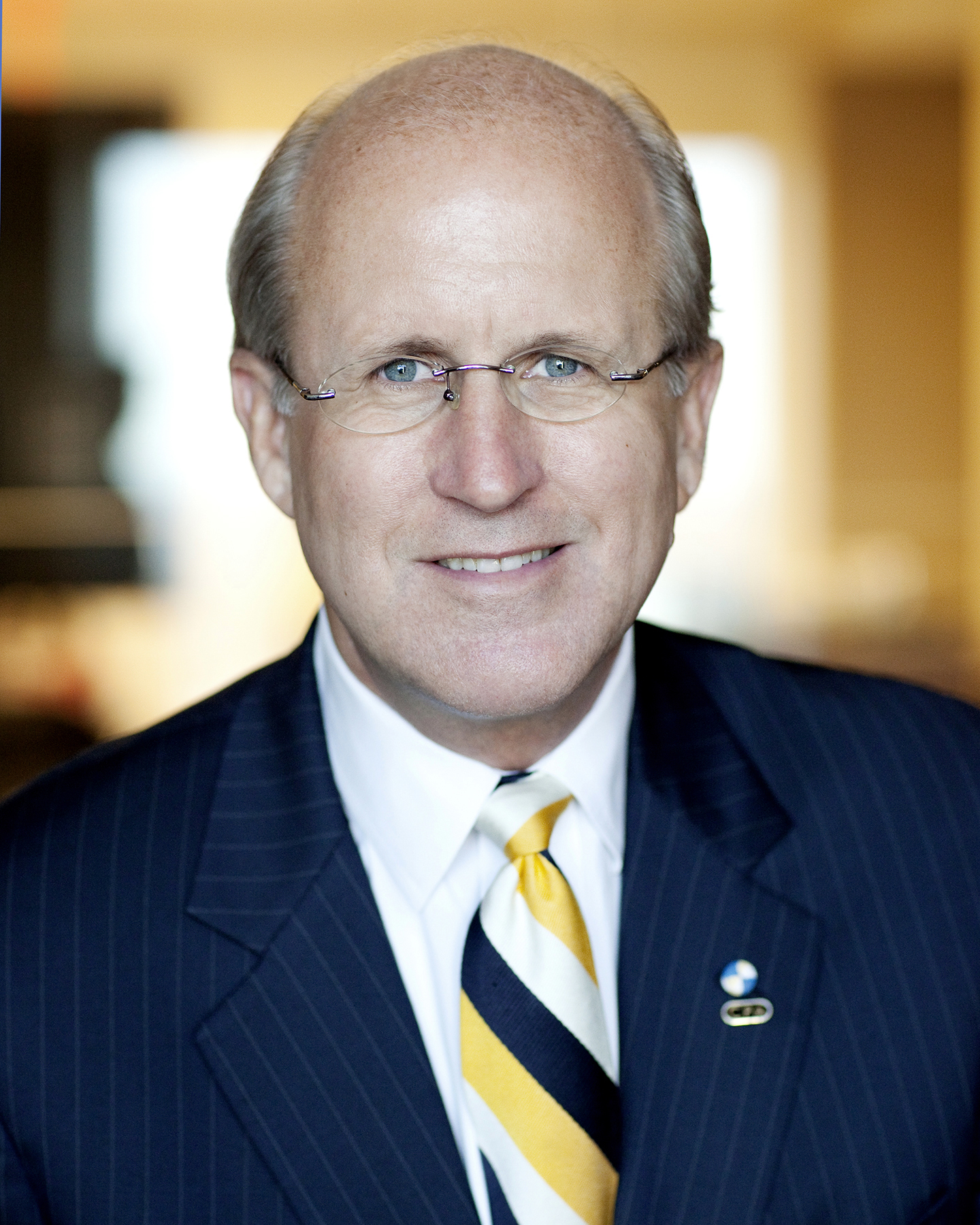
Hon. David M. Walker
Senior Strategic Advisor, PwC
Former U.S. Comptroller General

Hon. David M. Walker

Dave Walker

Dave currently serves as the first Senior Strategic Advisor for the Global Public Sector Practice at PricewaterhouseCoopers (PwC). He is a well-recognized fiscal responsibility/accountability, government transformation, and retirement security expert.

Dave received Presidential appointments with unanimous Senate confirmation from Reagan, Bush (41) and Clinton, including serving as Comptroller General of the United States and head of the U.S. Government Accountability Office (GAO) for almost 10 years. He previously served as a Partner and Global Managing Director with Arthur Andersen LLP. Dave also served as the first Chairman of the United Nations Independent Audit Advisory Committee for four years. He currently serves on a number of non-profit boards, including AARP. He is also is an inductee into the International Accounting Hall of Fame.

See David Walker’s Presentation Slides.

Speaker — October 19, 2016
Ute Wartenberg Kagan
Introduction To The World Of Numismatics

Ute Wartenburg-Kagan

Ute Wartenburg-Kagan

Ute Wartenberg Kagan, whose primary research focus is on ancient Greek coinage, has spent most of her academic career in the museum world. From 1991 through 1998 she worked as the Curator of Greek Coins in the British Museum in London, and since 1999 she has been the Executive Director of the American Numismatic Society in New York. The American Numismatic Society is the pre-eminent national institution focused on the research and the advancement of the appreciation of coins and related objects. It maintains a museum collection of over 800,000 objects dating from 650 BCE to the present.

Educated in Saarbrucken, Germany, Dr. Wartenberg Kagan was a Rhodes Scholar at Oxford University where she received her doctorate in papyrology. She has published more than 50 books and articles on numismatics and papyrology, is recognized public speaker, and is frequently interviewed for newspapers, radio, and television. In connection with her active interest in current U. S. coinage, Dr. Wartenberg Kagan has testified about coin design before the Senate Banking Committee, and she has been appointed by the Secretary of the Treasury to various coin advisory committees. She was formerly a member of the German national fencing team.

At the DMA Dr. Wartenberg Kagan will provide an entertaining, amusing, and educational introduction to the world of numismatics, including stories of rare and valuable coins, counterfeit coins, the discoveries of treasure coins, and a discussion of how coins are our only means by which we might have a realistic visage of Cleopatra.