
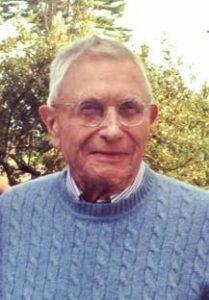
 Daniel Russell Cooney, 92, of Darien and Waldoboro, Maine, died on June 24. Born in Brooklyn on Dec. 12, 1924, he was the son of Mae Bossert and Russell S. Cooney. He grew up in Plandome, Long Island and in Waldoboro, attended Exeter Academy, and served in the U.S. Army in World War II in the European Theater. After the war, he entered Yale University and graduated in 1950. He worked as a securities analyst for Lord Abbett & Co. in New York City, and in 1973, he became portfolio manager of the newly established Lord Abbett Developing Growth Fund, one of the earliest funds to focus specifically on the over-the-counter market. After his retirement in 1987, he served as Trustee of Robertson Stephens Emerging Growth Fund.
Mr. Cooney married the love of his life, Alice Knotts, on July 9, 1949, in Falmouth, Maine, and they spent 67 devoted years together between Darien and Waldoboro, raising two daughters, many Norwich terriers, and daylilies galore. His devotion to Alice, who predeceased him by nine months, was exemplified by the care he gave her over the last 25 years of her life, when she was suffering from Alzheimer’s Disease. He was supported in her care by a team of women who, in turn, watched over and looked after him. His daughters are grateful for each of them, they said.
He had an infectious smile and a curious nature that endeared him to all. A long-standing member of the Noroton Yacht Club, he owned sailboats in numerous classes that included Lightnings, Sonars, and Ideal 18s. He shared his wife’s passion for antiques, but his interest had a nautical focus, embracing everything from marine paintings, decoys, scrimshaw, and early rigging and sailmakers tools that he appreciated as much for their history as for their craftsmanship and beauty. His interests were vast and ever growing, ranging from planting a collection of rhododendrons and rare pines to showing Norwich Terriers and making wine. But most of all, he was a gentleman of the old school in the truest sense.
Mr. Cooney was predeceased by his three siblings, James S. Cooney, Barbara Cooney, and David C. Cooney. He is survived by his daughters Rebecca T. Cooney, and her husband Tito Pizarro, of New York City, and Alice Cooney Frelinghuysen, and her husband George L. K. Frelinghuysen, also of New York City; and two grandsons, Henry O. H. Frelinghuysen of Stamford, and Russell S. C. Frelinghuysen of Asheville, North Carolina.
He will have a private family burial in Waldoboro in August. A memorial service will be held in his honor on Sept. 7 at 11 a.m. at St. Luke’s Parish, 1864 Post Road, Darien.
Memorial, donations in Daniel’s memory may be made to St. Luke’s Parish, 1864 Post Road, Darien, CT 06820, or to Yale University, Development Office, 157 Church Street, New Haven, CT 06510-2100.
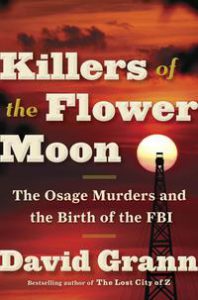 From New Yorker staff writer David Grann, #1 New York Times best-selling author of The Lost City of Z, a twisting, haunting true-life murder mystery about one of the most monstrous crimes in American history In the 1920s, the richest people per capita in the world were members of the Osage Indian nation in Oklahoma. After oil was discovered beneath their land, they rode in chauffeured automobiles, built mansions, and sent their children to study in Europe. Then, one by one, the Osage began to be killed off. The family of an Osage woman, Mollie Burkhart, became a prime target. Her relatives were shot and poisoned. And it was just the beginning, as more and more members of the tribe began to die under mysterious circumstances. In this last remnant of the Wild West—where oilmen like J. P. Getty made their fortunes and where desperadoes like Al Spencer, the “Phantom Terror,” roamed—many of those who dared to investigate the killings were themselves murdered. As the death toll climbed to more than twenty-four, the FBI took up the case. It was one of the organization’s first major homicide investigations and the bureau badly bungled the case. In desperation, the young director, J. Edgar Hoover, turned to a former Texas Ranger named Tom White to unravel the mystery. White put together an undercover team, including one of the only American Indian agents in the bureau. The agents infiltrated the region, struggling to adopt the latest techniques of detection. Together with the Osage they began to expose one of the most chilling conspiracies in American history. In Killers of the Flower Moon, David Grann revisits a shocking series of crimes in which dozens of people were murdered in cold blood. Based on years of research and startling new evidence, the book is a masterpiece of narrative nonfiction, as each step in the investigation reveals a series of sinister secrets and reversals. But more than that, it is a searing indictment of the callousness and prejudice toward American Indians that allowed the murderers to operate with impunity for so long. Killers of the Flower Moon is utterly compelling, but also emotionally devastating.