

Month: September 2023

Hiking and Happy Wanderers: October 26, 2023, 8:30AM – Walkway Across the Hudson, Poughkeepsie NY

HIKING AND HAPPY WANDERERS
WALKWAY ACROSS THE HUDSON
POUGHKEEPSIE, NY
OCTOBER 26, 2023

The Walkway Across the Hudson is billed as “The Longest Elevated
Pedestrian Bridge in the World” as it spans the Hudson River between
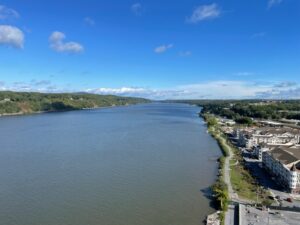
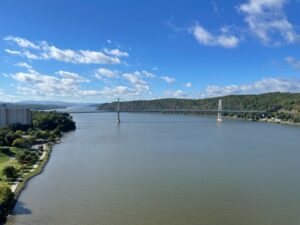
Poughkeepsie NY and Highland NY. It provides magnificent panoramic views
of the Hudson, and at 212 feet above the river, this 1.28 mile linear park
boasts scenic views north to The Catskills and south to the Hudson Highlands.
The Walkway structure dates from 1889 when it was built as a railroad bridge
eventually carrying as many as 3000 train cars a day. A fire on May 8, 1974
halted train traffic forever but after 35 years the bridge was reopened as the
Walkway on October 3, 2009 as a part of the Hudson Valley Rail Trail
Network. For more information on the Walkway see Walkway.org
TRIP PLAN
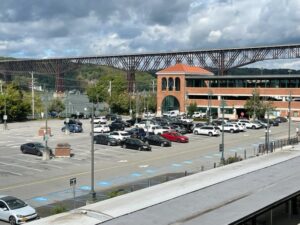
We will gather at the DCA for an 8:30 AM departure for Poughkeepsie by car
pool. The drive takes about 1.5 hours to the parking lot at 61 Parker Avenue
which is at the east end of the Walkway. We will cross the entire span to the
west bank of the Hudson, taking our time to enjoy the views and then retrace
our steps back to the Poughkeepsie starting point. On the Poughkeepsie side
of the bridge is an elevator down to the riverbank. If it’s open, we have the
option of a ride down and back. Once back up on the Walkway we will
proceed to lunch at Lola’s, a very good sandwich shop right under the
Walkway. There are restrooms at either end of the Walkway. We should be
back at the DCA by 3:00 PM.
As always, spouses and guests are invited. There will be a sign up sheet at the
DMA meetings on October 11, 18 and 25.

Dave McCollum

Bob Plunkett

David Mace

Joe Spain


Trip report:
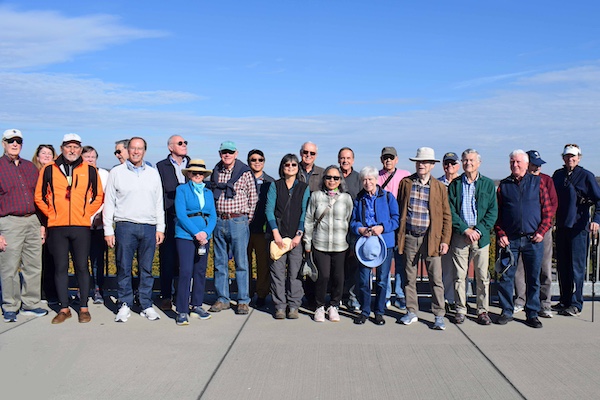
On a late October day with weather more like early September about 35 DMAers, spouses and friends crossed the Hudson River on the spectacular repurposed railroad bridge from the 1890s. At its peak, the bridge carried more than 3000 train cars a day. A fire in 1974 closed the bridge but it was reborn in 2009 as the “Walkway”. 

Usually we can get an accurate headcount but here walkers came from different points and at slightly different times due to the distance from Darien. All of us traversed the 1.25 mile length to the west side of the river and then wandered back across, stopping often to admire the fantastic views of the river below and for miles up and down. The only boats visible today were an oil barge pushed by a tug and a sailboat moving slowly in the light wind.

Most enjoyed a sandwich lunch at Lola’s situated under the bridge on the Poughkeepsie side. Lola’s has really good food but seating is limited and it is popular so it took some patience for most to be fed. A smaller number opted for lunch at Tavern 23, a short walk from the bridge. 

We think all would agree it was a day well spent despite the long trip. Thanks to all who participated!


Dave McCollum Robert Plunkett Joe Spain David Mace


November 16th at 2pm Ric Grefé will lead a discussion on Immigration and Immigrants and their Impact on America

How we as a country manage immigration has become a critical economic, social, humanitarian, political, and security issue. Migration flows have never been more substantial throughout the world due to displacement due to climate change, economic conditions, and social violence. The United States is still a country that attracts millions of migrants seeking either asylum from personal dangers in their origin countries or for economic opportunity. In 2022,  we issued 500,000 permanent immigrant visas; last year, an additional 2.8 million migrant border crossings resulted in apprehension or deportation.

Ric will outline the dimensions of the issue and identify recommendations across the political spectrum on how we might manage the inflow in a manner that meets several principles (economic, social, and security). Mike Wheeler will bring the conversation from the macro policy level to the human level by introducing a number of immigrants locally and what they have encountered in seeking to fulfill their dreams of a better life in the US.

Articles  of Interest

WSJ : Rebound in Immigration Comes to Economy’s Aid 

Rise in  foreign-born labor force boosts worker supply, eases wage pressure and aids Federal Reserve’s goal of ‘soft landing’

Subscription Required

Axios: Immigrants are saving a worker-starved U.S. Economy

How to get a Green Card in the United States

Green-Card-Flow-Chart

Opinion | Michael Bloomberg: How Biden and Congress Should Fix the Immigration Crisis in Our Cities – The New York Times

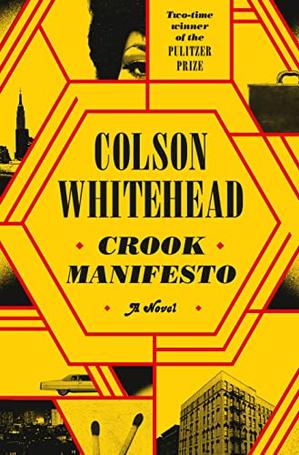
Book Club: Crook Manifesto by Colson Whitehead, Nov 8, 2023

CROOK MANIFESTO

It’s not just crime fiction at its craftiest, but shrewdly rendered social history.

Two-time Pulitzer Prize winner Whitehead continues his boisterous, incisive saga of late-20th-century Harlem and of a furniture dealer barely keeping his criminal side at bay.

The adventures of entrepreneur, family man, and sometime fence Ray Carney, which began with Harlem Shuffle (2021), are carried from the Black Citadel’s harried-but-hopeful 1960s of that book to the dismal-and-divided ’70s shown here. In the first of three parts, it’s 1971, and Carney’s business is growing even amid the city’s Nixon-era doldrums and the rise of warring militant groups like the Black Panthers and the Black Liberation Army. Carney barely thinks about sliding back into his more illicit vocation until his teenage daughter, May, starts hankering to see the Jackson 5 perform at Madison Square Garden. And so he decides to look up an old contact named Munson, a seriously bent White NYPD officer and “accomplished fixer,” who agrees to get free “up close” seats for the concert if Carney will fence stolen jewelry stuffed in a paper bag. But the job carries far more physical peril than advertised, culminating in a long night’s journey into day with Carney getting beaten, robbed, and strong-armed into becoming Munson’s reluctant, mostly passive partner in the cop’s wanton rampage throughout the city. In the second part, it’s 1973, and Pepper, Carney’s strong, silent confidant and all-purpose tough guy, is recruited to work security on the set of a blaxploitation epic whose female lead inexplicably goes missing. The third and final part takes place in the bicentennial year of 1976, the nadir of the city’s fiscal crisis, marked by widespread fires in vacant buildings in Harlem and elsewhere in New York’s poorer neighborhoods. When an 11-year-old boy is seriously injured by a seemingly random firebombing, Carney is moved to ask himself, “What kind of man torches a building with people inside?” He resolves to find out with Pepper’s help. What recurs in each of these episodes are vivid depictions of hustlers of varied races and social strata, whether old-hand thieves, crass showbiz types, remorseless killers, or slick politicians on the make with the business elite. Whitehead’s gift for sudden, often grotesque eruptions of violence is omnipresent, so much so that you almost feel squeamish to recognize this book for the accomplished, streamlined, and darkly funny comedy of manners it is. If its spirits aren’t quite as buoyant as those of Harlem Shuffle, it’s because the era it chronicles was depressed in more ways than one. Assuming Whitehead continues chronicling Ray Carney’s life and times, things should perk up, or amp up, for the 1980s.

It’s not just crime fiction at its craftiest, but shrewdly rendered social history.