
Month: March 2024
HIKING – SHERWOOD ISLAND STATE PARK
WESTPORT, CT
MARCH 14, 2024
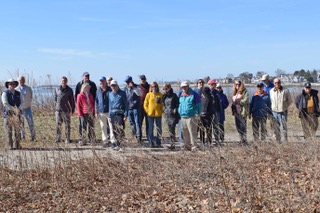
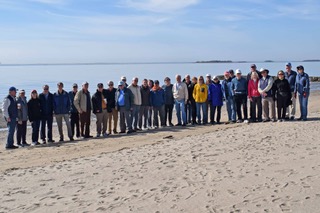
We finally had some beautiful weather with mild temperatures and sunny skies for our hike today at Sherwood Island. A total of 32 hikers came out to enjoy the day. Our walk of just over three miles included a stroll on the beach followed by a hike in the woods on a loop trail and then onto various paths nearby and along another part of the beach. We also spent some time reflecting at the meaningful 9/11 memorial. Following the hike, 12 of us enjoyed lunch at The Little Barn in Westport.
Robert Plunkett

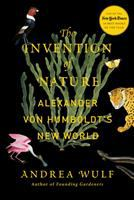 Alexander von Humboldt (1769-1859) was an intrepid explorer and the most famous scientist of his age. His restless life was packed with adventure and discovery, whether climbing the highest volcanoes in the world or racing through anthrax-infested Siberia. He came up with a radical vision of nature, that it was a complex and interconnected global force and did not exist for man’s use alone. Ironically, his ideas have become so accepted and widespread that he has been nearly forgotten.
Now Andrea Wulf brings the man and his achievements back into focus: his investigation of wild environments around the world; his discoveries of similarities between climate zones on different continents; his prediction of human-induced climate change; his remarkable ability to fashion poetic narrative out of scientific observation; and his relationships with iconic figures such as Simón Bolívar and Thomas Jefferson. Wulf examines how his writings inspired other naturalists and poets such as Wordsworth, Darwin, and Goethe, and she makes the compelling case that it was Humboldt’s influence on John Muir that led him to his ideas of preservation and that shaped Thoreau’s Walden.
Humboldt was the most interdisciplinary of scientists and is the forgotten father of environmentalism. With this brilliantly researched and compellingly written audiobook, she makes clear the myriad, fundamental ways that Humboldt created our understanding of the natural world.
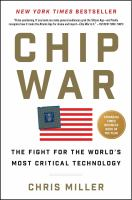 “An epic account of the decades-long battle to control what has emerged as the world’s most critical resource–microchip technology–with the United States and China increasingly in conflict. You may be surprised to learn that microchips are the new oil–the scarce resource on which the modern world depends. Today, military, economic, and geopolitical power are built on a foundation of computer chips. Virtually everything–from missiles to microwaves, smartphones to the stock market–runs on chips. Until recently, America designed and built the fastest chips and maintained its lead as the #1 superpower. Now, America’s edge is slipping, undermined by competitors in Taiwan, Korea, Europe, and, above all, China. Today, as Chip War reveals, China, which spends more money each year importing chips than it spends importing oil, is pouring billions into a chip-building initiative to catch up to the US. At stake is America’s military superiority and economic prosperity. Economic historian Chris Miller explains how the semiconductor came to play a critical role in modern life and how the U.S. become dominant in chip design and manufacturing and applied this technology to military systems. America’s victory in the Cold War and its global military dominance stems from its ability to harness computing power more effectively than any other power. But here, too, China is catching up, with its chip-building ambitions and military modernization going hand in hand. America has let key components of the chip-building process slip out of its grasp, contributing not only to a worldwide chip shortage but also a new Cold War with a superpower adversary that is desperate to bridge the gap. Illuminating, timely, and fascinating, Chip War shows that, to make sense of the current state of politics, economics, and technology, we must first understand the vital role played by chips”–Amazon.