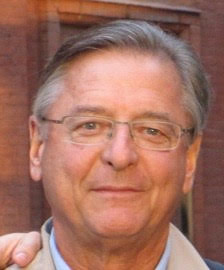
David Earle was born in Williamstown, MA., and moved to Darien when he was three. He attended Darien High School, then Williams College and L’Ecole Normale de Musique as a music and theater major, graduating in 1968. His career began with teaching high school French in Arizona and evolved into college text book publishing, arts administration, public television, cable television, broadcast television, technology consulting and human resources consulting.
Month: January 2025
Pat Gannon was born in Manhattan and raised in the Bronx. He received a BBA degree in Economics and Management from St. John’s University where he played freshman basketball and varsity baseball, pitching for St John’s in the College World Series in Omaha, Nebraska.
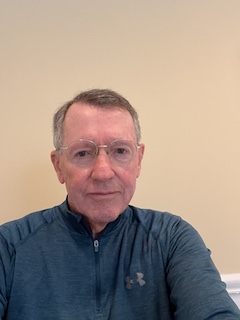
I was born in Berkeley, California. I lived in the Bay area until 1962. We then moved to Woodcliff Lake, NJ. We moved to Bloomfield Hills, Michigan in 1965. I graduated from Albion College in 1972 with a degree in Religion. I then briefly attended Boston University Seminary.
In Boston I worked for the U.S. Defense Department and later I sold steel. In 1986 I received my MBA and MS in MIS from Boston University.
Later that year I moved to the New York area and worked for Swiss Bank Corp which became UBS. At the bank I managed the FX trade processing department and helped design and install trade processing systems. In the IT department I was responsible for the bank’s US dollar payment and investigations systems. I also managed the bank’s MIS department and worked on some of the bank’s credit systems.
I met my wife Jane in a bereavement group. We married in 1999. My late wife Diana died a year after the bank moved us to CT in 1996. My daughter Katie died in 1990. My adopted son Dave was born in southern India. He and his wife Catherine live with their six year old daughter in Norwalk. Jane’s son Derek and his wife Judy also live in Norwalk. Their twin boys are both college freshmen.
Jane and I are both members of the Noroton Presbyterian Church. I am currently serving as an Elder on the Mission team. I have been legally blind from birth and became totally blind in the early 2000s.
I play guitar, read extensively and am very interested in current events and in investing. I root for the Red Sox, Michigan and I am a disappointed Lions fan.
I have lived in Darien for 38 years in the same house on Allwood Road. We raised three daughters here and now have six grandchildren.
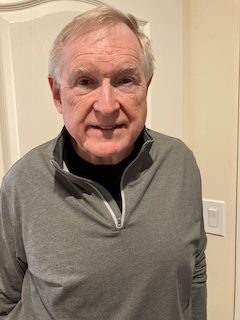
I was a research analyst in NYC for 45 years following consumer staples. I was on the sell side for 30 years mostly at Donaldson, Lufkin & Jenrette (DLJ) where I worked for over 20 years. After that I worked at Banc of America Securities, Neuberger Berman and TIAA-CREF.
After 30 odd years on Metro North, I retired in 2017. I am currently on the boards of the Avon Movie Theatre and Orchestra Lumos (formerly the Stamford Symphony) in Stamford and Okemo Trailside and the investment committee of Kurn Hattin Homes for Children in Vermont. I was formerly on the boards of Northwood School in Lake Placid and the Norwalk Yacht Club and on the admission committee of the University Club in NY.
I graduated from NYU in 1973. We are currently members of Wee Burn CC, Ox Ridge Riding and Racquet Club, the Norwalk YC, the University Club in NY and the Coral Beach Club in Bermuda. I have been married to my wife, Cate, for 42 years. She was formerly a dancer with the NY City Ballet and is now a fine artist.
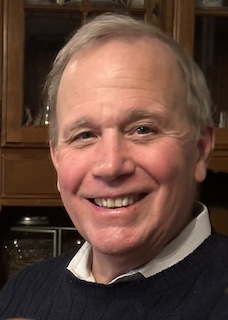
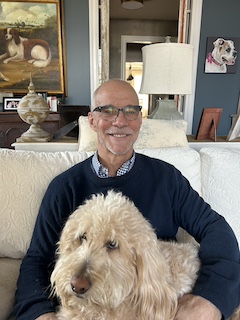
Jon was born and raised in Huntington, Long Island, New York. He graduated from Cornell University in 1980 with a B.A. in History, and given the limited choices of that degree, went to Stanford Law School, graduating in 1984. He then worked as an entertainment lawyer for 39 years in New York City, first at Paul, Weiss, Rifkind, Wharton & Garrison for 2 years, then as a business affairs attorney in-house at William Morris Agency until 2000, and then as head of Business Affairs at Disney Theatrical Productions until he elected to retire in September of 2023.
In 2024, Jon undertook health and life coach training and is now a certified (not certifiable) health and life coach.
On the personal side, Jon got married in 1988 to his first wife (whereabouts unknown), lived in Huntington and raised 2 kids.
He got divorced in 2012 and moved to Long Island City, where he met his current wife, Ana. They bought a weekend home in West Norwalk in 2020 and now live there full time since his retirement in 2023 with their 2 goldendoodles, Lucy and Murphy.
Jon’s interests include longevity, tennis, definitely NOT pickleball, paddle tennis, fitness, self-improvement and cooking.
We will meet in the Lillian Gade Room and on Zoom.
Representative Marra is the ranking member on the Energy and Technology committee. She also serves on Public Health and Transportation. Other members of our delegation have been invited as well.
Governor Lamont opened the 2025 legislative session with his State of the State address,
Preview of 2025 Legislative Session
Preview Legislative Session_20250115_0001
Lawmakers are expected to focus on addressing the state’s housing crisis. This includes:
- Revisiting zoning reforms, such as transit-oriented development efforts and the “Work, Live, Ride” bill to encourage housing near transportation hubs
- Addressing homelessness and housing affordability.
- Discussing the establishment of a right to housing policy
Energy and Environment
Environmental legislation appears to be a top priority, with several key issues:
- Tackling high energy costs and utility rates
- Enhancing the state’s aging electrical grid
- Reducing greenhouse gas emissions and building climate resilience
- Potentially regulating offshore wind projectHealthcare and Public Health
Healthcare-related issues on the agenda include:
- Addressing the shortage of healthcare professionals in the state.
- Discussing potential expansion of “HUSKY for immigrants” eligibility.
- Tackling medical costs, including a task force on high prescription price
Key education-related priorities include:
- Increasing funding for public education, special education, and student resources.
- Addressing teacher recruitment and retention
- Improving paraeducator hiring and retention
There will likely be debates over the state’s “fiscal guardrails”:
- Some lawmakers want to retain or modify these fiscal controls, which have generated budget surpluses and allowed debt reduction.
- Others argue for redirecting more funds to core services like education and healthcare
Our next Social Event, following the Holiday Party, will be Saturday, January 18th. We’ll follow our usual format: a family style dinner starting at 4:30 pm at Ralph & Rich’s, 815 Main Street, Bridgeport where we will share a salad, three different entrees (chicken francaise, veal parm and broiled salmon), smashed potatoes, sauteed vegetables and Italian cookies and pastries for dessert—with coffee or tea.
Seating will be in a separate curtained off area and we will have our own dedicated waiter/waitress.
Throughout dinner there will be two choices of wine (one white; one red). For those who do not drink wine, soft drinks will be available. Mixed drinks or beer, if desired, must be paid for on your own at the bar. Likewise, if you wish to order anything else from the menu you will be asked to pay for it separately on your own.
As in past years, we will carpool to the restaurant—which provides us with 6 hours of free parking. However, to obtain free parking you must provide the desk with your license plate number upon entering.
The Total Mortgage Arena is a very short walk from the restaurant. The game starts at 7:00 pm and usually ends about 9:30. This year the Bridgeport Islanders, the top affiliate of the NHL New York Islanders, will be facing off against the Springfield Thunderbirds, the top affiliate of the NHL St. Louis Blues. Food (if you have any room), beverages, etc. are available for purchase on your own at the Arena.
Please note: it is best for the ladies to bring a clutch to the game (if necessary) as pocketbooks will be searched for security reasons.
Cost per person is $80. Make checks payable to “DMA”.
There will be a sign up sheet at our December 11 and 18 DMA meetings. Or, you may reserve by contacting Gehr Brown or Tom Lom. Attendance is limited to a maximum of 24.
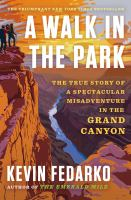
A deeply moving account ever of walking the Grand Canyon, a highly dangerous, life-changing 750-mile trek. The Grand Canyon is an American treasure, visited by more than 6 million people a year, many of whom are rendered speechless by its vast beauty, mystery, and complexity. Now, in A Walk in the Park , author Kevin Fedarko chronicles his year-long effort to find a 750-mile path along the length of the Grand Canyon, through a vertical wilderness suspended between the caprock along the rims of the abyss and the Colorado River, which flows along its bottom. Consisting of countless cliffs and steep drops, plus immense stretches with almost no access to water, and the fact that not a single trail links its eastern doorway to its western terminus, this jewel of national parks is so challenging that when Fedarko departed fewer people had completed the journey in one single hike than had
walked on the moon. The intensity of the effort required him to break his trip into several legs, each of which held staggering dangers and unexpected discoveries. Accompanying Fedarko through this sublime yet perilous terrain is the award-
winning photographer Peter McBride, who captures the stunning landscape in breathtaking photos. Together, they encounter long-lost Native American ruins, the remains of Old West prospectors’ camps, present day tribal activists, and signs that
commercial tourism is impinging on the park’s remote wildness. An epic adventure, action-packed survival tale, and a deep spiritual journey,
A Walk in the Park gives us an unprecedented glimpse of the crown jewel of America’s National an iconic landscape framed by ancient rock whose contours are recognized by all, but whose secrets and treasures are known to almost no one, and whose
topography encompasses some of the harshest, least explored, most awe-inspiring terrain in the world.
Goodreads
John McCarthy, the computer scientist who coined the term “artificial intelligence” in 1955, defined it as “the science and engineering of making intelligent machines.” Nearly 70 years later, AI—as we now call it in almost jaded shorthand—is present in every facet of life. It can be used (to name but a few applications) to cheat on a college essay, treat cancer, play chess and design spaceships. It can also be used to wage war and sabotage elections.
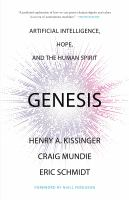
AI is an invention that has the capacity to revolutionize human life, on a par with fire, electricity, the printing press and atomic power. Its profound importance can be gauged from the fact that the late Henry Kissinger focused more intently on AI in the last years of his life than on any other subject. In 2018, at age 95, he startled everyone by writing an essay on artificial intelligence in the Atlantic magazine. In 2021 he co-authored “The Age of AI” with Eric Schmidt (a former chief executive of Google) and Daniel Huttenlocher (an MIT professor), a book that compared the advent of AI with the 18th-century Enlightenment for its ability to shape the human mind. And now, almost a year after Kissinger’s death, we have in our hands another book, titled “Genesis,” about “artificial intelligence, hope, and the human spirit,” which Kissinger co-authored with Craig Mundie (a former chief research officer at Microsoft) and (again) Mr. Schmidt.
Henry Kissinger was one of the great statesman-sages of his time, and the brief but moving “In Memoriam” section at the start of the book describes him as a “student of the nineteenth century, master of the twentieth, and oracle of the twenty-first,” the last accolade referring in part to his drive to educate us on the complexities of AI. In “Genesis,” the Kissingerian imprint—that elegant mix of idealism and realism—is evident everywhere. The tone and thrust of the book, write its three authors, is one of “sober optimism,” which, in fact, encapsulates Kissinger’s outlook on life.
If there is a key question that animates “Genesis,” it is this: Should AI become more like humans, or should humans become more like AI? Put another way: Should we control, or be controlled by, AI? The authors stress throughout that, when it comes to artificial intelligence, the worst thing we could possibly do as a civilization—or species—is to drop our guard: “to declare too early, or too completely, that we understand it.”
If Messrs. Kissinger, Mundie and Schmidt sound resigned, in places, to the primacy of artificial intelligence in human life, it is because of the irrefutable computational and problem-solving superiority of AI—or “AIs,” as they often pluralize it, acknowledging that “there will not be just one supreme AI but rather multiple instantiations of superior intelligence in the world.” How could it be otherwise when the average AI supercomputer is (as the authors tell us) already 120 million times faster than the processing rate of the human brain?
“Genesis” is as much a philosophy book—drawing on all that is best in the Western tradition—as it is a book that grapples with a techno-scientific phenomenon. It raises tough, often disconcerting, sometimes harrowing questions. The authors point out that AI allows humans “to know new things . . . but not to understand how the discoveries were made.” The internal processes of the machine are beyond our grasp, so we must resort to a kind of faith in the machine’s logic and authority. Will the age of AI, the authors ask, “catalyze a return to a premodern acceptance of unexplained authority?” Are we, they ask, on the verge of a “dark enlightenment”?
The development of ever more sophisticated forms of AI, we’re told, is “a project led almost exclusively by private corporations and entrepreneurs.” Could corporations form alliances to compound their already immense clout, even accruing military and political power in the process? What impact would that coup have on diplomacy, global stability and the Westphalian order of sovereign nation-states?
While celebrating the role that could be played by AI in the curing and prevention of disease and talking up its potential to be an almost heaven-sent “library of pharmaceuticals” for the benefit of mankind, Messrs. Kissinger, Mundie and Schmidt address moral questions that should make us squirm. Just as we have begun to use AI to “correct” congenital disease, might we not start using it to “install congenital advantages” in our offspring, “advantages that may not belong to either biological parent or, in the extreme, to any other human”? Would we redesign the human race? “What does the perfect human look like?” they ask. “Should we attempt to find out?” Would such genetic alterations cause the human species to “split into multiple lines?”
AI even raises theological questions. If humans come to believe that they’ve been replaced by machines as the foremost intellectual entities on earth, might not some people “attribute a kind of divinity to the machines themselves, thereby potentially spurring further human fatalism and submission”? While the authors don’t offer answers, it is quite right that they have prompted us to search for them.
“Genesis” is a wise and deeply sane book. But it’s at its least convincing in its expressions of belief that our political and scientific leaders must—and therefore will—find a way to act in a coordinated global fashion to instill into machines the core values of human “dignity.” Machines, the authors write, must be “compelled to build from observation a native understanding of what humans do and don’t do.” They must, in other words, learn how to be human from the examples that humans set.
Therein lies the problem. Messrs. Kissinger, Mundie and Schmidt call for “the inscription of globally inclusive moralities onto silicon-based intelligence.” These moralities include some—Communist Chinese, Putinist Russian and Islamist Iranian—that fall far short of our own standards. Our definition of dignity is quite unlike theirs. So much so that our machines may one day be benign and merciful, while those of our foes may be exactly the opposite.
Wall Street Journal 11/25/2024