The presentation of U.S. Sen. Richard Blumenthal has been delayed to another date to be determined.
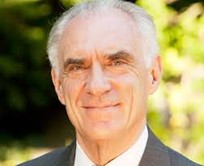 John Blankley has graciously agreed to present to us on November 12.
Alexis de Tocqueville was a prominent French 19th century political philosopher, historian, and politician. He is best known for publishing a seminal work in two books published in the 1830’s and 1840’s that were collectively called Democracy in America. Tocqueville wrote about America’s then burgeoning experiment in democracy, the social condition of its people and their relationship to the state. From the moment it was published, his work was considered to be a masterpiece of political science and sociology and even today is regularly quoted in commentary on the state of our current politics. One of the great thinkers of his day, Tocqueville’s views are particularly relevant today because our government is currently undergoing the longest shutdown in American history.
John will begin his presentation with a brief history to explain the times in which Tocqueville lived, his background (he was from an aristocratic family in France), his attempts at a political career and his journey to America. Toqueville’s two-volume Democracy in America was the first analysis of what made democracy work in America (Vol. 1) and what was required to make it work elsewhere in other Western societies (Vol. 2). Equality and liberty are the two touchstones of his work, and he viewed their interaction as necessary to make true democracies work.
Tocqueville was much in demand in the Paris salons as a brilliant debater but was less successful in politics, as he regarded most politicians of the age as intellectually inferior. He was an advocate of parliamentary government, especially the bi-cameral structure that he admired in America. He was skeptical of the extremes of majoritarianism. The highlights of his political career were serving in the National Assembly (the lower house of the bicameral French Parliament, joining the militia to suppress a French insurrection in 1848, serving as Foreign Minister and being imprisoned briefly under the authoritarian rule of Napoleon III.
John Blankley is a businessman, entrepreneur, and Connecticut politician (now retired), who will offer his thoughts based on his long-lived affinity with the earliest, and still foremost, interpreter of the American experiment in democracy. Drawing on his personal experience and his reading and knowledge of Tocqueville’s works and modern interpretations, his conclusions may surprise you.
Born in England, John came to America 42 years ago, but unlike Tocqueville, he stayed and became an American citizen. From his roots in the U.K., his degree in modern history from Oxford University and his journey to citizenship, he brings a unique perspective and appreciation of our country. Beginning his career with Price Waterhouse, he rose to become chief financial officer and board member of BP North America, BP’s major overseas subsidiary; chief financial officer and board member of Stolt-Nielsen, the world’s largest chemical tanker company; and senior leadership positions in several other companies. In 2000, he co-founded and is currently chairman of Flagship Networks Inc., a private computer consulting and systems integration company.
John is currently the 105th president of the St. Andrew’s Society of the State of New York, the oldest charity in the state (founded in 1756), is a trustee of the Greenwich Library and is chairman of Greenwich Green & Clean, a local non-profit environmental group. Like Tocqueville, he has been active in politics; he formerly served on the Greenwich Representative Town Meeting and the Board of Estimate & Taxation and ran for the position of Greenwich’s First Selectman and for several state offices including as a state representative, a state senator and as the Connecticut state treasurer.
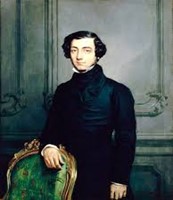
Alexis de Tocqueville
Arranged by Doug Bora
Summary of Presentation:
John Blankley is the former chief financial officer of several major corporations and civic leader in Greenwich, and he is currently president of the St. Andrew’s Society of New York. His presentation to the DMA was titled, “What Would Alexis de Tocqueville Think of Our Democracy Today.” British-born and a naturalized American, John framed his talk around Alexis de Tocqueville, the French aristocrat whose masterpiece writings in Democracy in America in the 1830’s and 1840’s sought to explain the “great experiment” of government by the people.
John sketched Tocqueville’s background: Born into a noble family scarred by the French Revolution, with relatives guillotined in the French Reign of Terror, Tocqueville nonetheless devoted his life to studying and defending democracy. From 1831–1832, Tocqueville toured the United States, nominally to study prisons but really to observe this new democratic society. He marveled at Americans’ habits of association, local self-government, the balance of power between states and a federal center and the separation of powers. Tocqueville was especially fascinated by a lower house that expressed popular passions and an upper house that cooled them.
Tocqueville saw democracy as a delicate balance between liberty and equality and warned of both tyranny of the majority and over-centralized state power. He admired American equality of conditions — opportunity rather than inherited privilege — while condemning slavery and predicting it would endanger the Union, a prediction the Civil War later confirmed. He contrasted the relatively orderly American Revolution with the violent, destabilizing French Revolution, which he compared to similar revolutionary patterns in Russia and Weimar Germany in the 20th Century, where democratic experiments collapsed into dictatorship.
John fast-forwarded to the present, imagining Tocqueville confronting today’s superpower America, with its transforming technology and polarized politics. John believes that Tocqueville would worry about minority rule, gerrymandering, erosion of respect for courts, misuse of the Electoral College and rising authoritarian temptations — as particularly illustrated by the events of January 6, 2021. John posited that Tocqueville’s final judgment, however, would be guardedly hopeful; America’s democracy has historically survived immense tests, continues to correct its failures and depends above all on a renewed commitment to democratic principles and to accepting political opponents as legitimate partners in shaping the nation’s future.