The earth’s natural heat flow could theoretically provide an unlimited 24/7 “green” energy resource for America’s power generation and heating. For example, Iceland, which sits on a geologic hot spot with more than 200 volcanoes, gets 66% of its primary energy from geothermal sources, including 27% of its electricity and 90% of its residential power. Conversely, geothermal power currently provides only 0.4% of the United States’ electricity generation (3.7 gigawatts), although there is potential to provide 20 times as much (8%) according to some experts.
G. Warfield “Skip” Hobbs will discuss the geology of hydrothermal resources, how the resource is identified and developed, technical and economic barriers, and the traditional and exciting new “enhanced” and “closed loop” geothermal systems. The cost and economics of geothermal power compare very favorably with other renewable energy systems and fossil fuel resources.
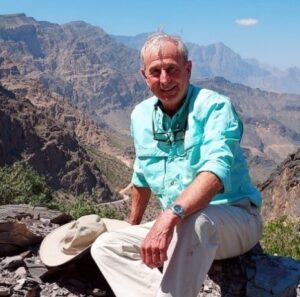
Skip is a geologist and founder and managing partner of Ammonite Resources, a firm of international petroleum and mining geotechnical and business consultants that has been headquartered in New Canaan since 1982. He holds a B.S. in geology from Yale College and an M.S. in petroleum geology from Imperial College London’s Royal School of Mines. Prior to founding Ammonite, Skip worked internationally in the 1970s as an exploration geologist for Texaco and Amerada Hess. He has served as an officer of the American Association of Petroleum Geologists. From 2004–2012, he served on the Executive Committee of the American Geological Institute, a federation of 50 geoscience professional societies representing more than 250,000 members in every earth science discipline and served as its president from 2010–2011. Skip was also a member of the Council of Scientific Society Presidents in Washington, D.C., from 2009–2024, where he served as co-chair of its Committee on Energy and the Environment and as a board member. He is a fellow of the Geological Society of America.
From 2000–2014, he was a trustee of the New Canaan Nature Center and served as its president from 2012–2014. He writes and lectures frequently on energy economics, energy policy and environmental issues. In his spare time, Skip manages a family farm in Massachusetts that produces organically grown vegetables, honey, maple syrup, grass-fed beef and timber.
Arranged by Doug Bora
Summary of Skip Hobbs’s Presentation
Geologist and energy consultant Skip Hobbs offered a wide-ranging look at geothermal energy — its current use, technical challenges, economic dynamics and future potential. He opened by contrasting Iceland, where volcanic heat supplies most residential energy and a quarter of electricity, with the United States, where geothermal accounts for only 0.4% of electric generation despite vast untapped potential.
Skip focused on high-temperature geothermal systems, not the shallow residential heat-pump systems common in places like Darien. Conventional geothermal plants operate where volcanic heat, faults and fractured rock allow super-heated water or steam to rise from several thousand feet below the surface. Facilities such as The Geysers in California and McGinness Hills Geothermal Complex in Nevada run around the clock, emit virtually no greenhouse gases and occupy far less land than large solar arrays.
Yet, geothermal has grown slowly due to technical and economic hurdles. Wells must intersect naturally fractured, permeable rock, and the corrosive fluids require specialized metallurgy. Projects are risky; some wells underperform, reservoirs cool over time, and developers must prove 20-year production reliability to secure financing. Skip’s firm conducts due-diligence studies for investors like J.P. Morgan, analyzing flow rates, reservoir cooling, and long-term output.
Despite these challenges, he emphasized geothermal’s rising strategic value. Electricity demand is surging largely because of AI-driven data centers, while long lead times for gas turbines and increasingly ambitious renewable-energy mandates make around-the-clock clean power more attractive. Power-purchase agreements above $100/MWh are becoming common, improving project economics, and federal tax credits further strengthen returns.
The biggest transformation, according to Skip, will likely come from new technologies. Enhanced geothermal systems (EGS) use modern oil-and-gas techniques — horizontal drilling, high-temperature cement and multi-stage fracking — to tap hot rock where no natural hydrothermal system exists. Closed-loop designs circulate working fluids through sealed underground pipe networks, avoiding brine-related corrosion and water loss. Companies such as Fervo, Eavor, and XGS are piloting these systems, with early commercial deals including a 150 MW supply agreement with Meta.
Skip concluded that geothermal could expand dramatically worldwide, not just in volcanic regions, as drilling costs fall and new designs mature. While risks remain, he sees geothermal poised to become a far larger contributor to clean, always-available power in the decades ahead.