 George Gershwin (1898–1937) is one of America’s greatest composers and a true rarity. He was at home in many different musical worlds, from Broadway and Hollywood musicals to opera and symphonic works with his compositions spanning jazz, popular and classical music. Among his best-known works are “Rhapsody in Blue,” “Swanee,” “An American in Paris,” “Porgy and Bess,” “Embraceable You,” “I Got Rhythm,” “Summertime” and “Of Thee I Sing.”
The 1920s, in particular, saw the establishment of a new American spirit on Broadway. Inspired by Jerome Kern’s shows in the late teens, a new, young group of American composers and lyricists threw off the European trappings of former shows and created the concept of the ‘American Musical’. Brassy and irreverent, these shows featured such composers and lyricists as George Gershwin and his brother Ira Gershwin, Rogers and Hart, Jerome Kern, Dorothy Fields, Irving Berlin and Cole Porter. Many of their songs and lyrics remain a part of our American heritage today, a century later.
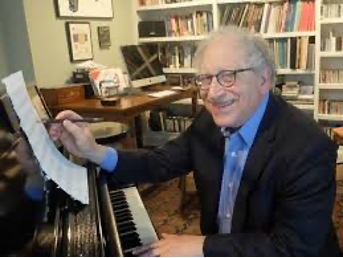
Dr. Orin Grossman is renowned internationally for his knowledge of music. He has been closely associated with the music of George Gershwin, lecturing and performing concerts of his music to critical praise around the world, including performances in Florence, Cairo, and St. Petersburg. Dr. Grossman was also chosen to play for the New York City Mayor’s Awards of Honor for Arts and Culture. He graduated magma cum laude in music from Harvard College and continued his studies at Yale University, earning a Ph.D. in music. Dr. Grossman became assistant professor of fine arts at Fairfield University in 1975 and dean of its College of Arts and Sciences in 1991. He was then appointed to be the university’s academic vice president in 1999. In 2009, he returned to teaching as professor of visual and performing arts.
Orin’s presentation will include live unique piano performances, which will use Gershwin’s own piano arrangements — arrangements that Gershwin created to give the public a sense of how he played his own songs at private parties.
Summary of Dr. Orin Grossman’s DMA Presentation on January 14, 2026
Dr. Grossman explored why George Gershwin remains one of America’s most important composers, not only for his famous concert works like “Rhapsody in Blue”, “An American in Paris”, and “Porgy and Bess,” but also for the popular songs that became the backbone of the great American songbook. Grossman described Gershwin as uniquely at home in multiple musical worlds — Broadway, jazz, popular song and classical composition — and emphasized how his melodies have lasted for a century because they combine sophistication with emotional directness.
Grossman traced Gershwin’s early life in New York as a lower-middle-class kid who dropped out of school as a teenager, took odd jobs in the music business and pursued music with relentless drive. Grossman noted that although many people assume Gershwin was mostly self-taught, he had formal musical training as well as a deep curiosity that pushed him to develop his own style. His breakthrough came with “Swanee,” which Gershwin wrote when he was about age 20, and which was made famous by entertainer Al Jolson. Grossman placed the song in the context of the blackface/minstrel tradition, explaining how that world shaped early American entertainment and how Gershwin later became embarrassed that his career began there.
A key point of the talk was how Gershwin’s songs remain popular because performance styles changed. Early recordings from the 1920s often sound stiff to modern ears because singers had to keep a strict beat for dancing. With the rise of the microphone and more advanced recording techniques, artists like Bing Crosby, Louis Armstrong and, later, Frank Sinatra developed conversational phrasing — slightly ahead of or behind the beat — that made songs feel like spoken poetry. Grossman demonstrated this with “The Man I Love,” contrasting an early recording with a later, smoother interpretation.
Grossman also highlighted Gershwin’s extraordinary productivity, especially in 1924, in which he wrote songs for the George White Scandals, which were popular Broadway revues modeled after the Ziegfield Follies, and premiered “Rhapsody in Blue.” He also produced a major Broadway hit that year with his brother Ira. In closing, Dr. Grossman performed “Summertime” on the piano, noting Gershwin’s admiration for Duke Ellington and his insistence that “Porgy and Bess” be performed only by black artists. In Q&A, Grossman explained that Gershwin respected both popular and classical music. Grossman noted that Gershwin may have shown greater personal ambition with respect to classical compositions but surmised that this may have been because Gershwin was unique among popular composers in being able to excel in both traditions.