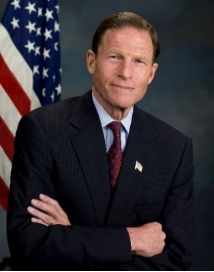
 Sen. Richard Blumenthal will discuss relevant current topics, including Ukraine, AI, veterans, the economy, workforce development, tariffs and manufacturing. Sen. Blumenthal served as a U.S. attorney for Connecticut from 1977–1981. He then served in the Connecticut House of Representatives from 1984–1987 and the Connecticut State Senate from 1987–1990. From 1991–2011, he served as Connecticut’s attorney general for an unprecedented five terms.
Sen. Blumenthal was sworn in to represent Connecticut in the U.S. Senate in 2011. Having been re-elected in 2016 and 2022, he is serving his third term. He is a member of the U.S. Senate’s Committee on the Judiciary, Committee on Homeland Security & Governmental Affairs, Committee on Armed Services, Committee on Veterans’ Affairs and the Special Committee on Aging. He has built a longtime advocacy for consumers by holding companies accountable for the safety of their products and is working to bring Connecticut’s transportation systems and infrastructure into the 21st century. Working with Connecticut’s congressional delegation, he has secured billions of dollars of federal funding to improve rail safety, promote climate resiliency, and protect Long Island Sound and Connecticut’s rivers and streams.
His father, who fled Nazi Germany at age 18, and mother, who left Nebraska’s farmland to become a social worker, raised Sen. Blumenthal with a deep dedication to public service, a duty to give back by helping others and a bedrock belief in hard work. Those values carried him through his childhood and his education at Harvard College and Yale Law School. At Harvard, he was editorial chairman of The Harvard Crimson and achieved Phi Beta Kappa and magna cum laude recognition. In law school, he was editor-in-chief of the Yale Law Review. He also worked as assistant to Daniel Patrick Moynihan when he was assistant to the President of the United States.
After graduating from law school in 1973, Sen. Blumenthal clerked for then U.S. District Judge Jon Newman and then for U.S. Supreme Court Justice Harry A. Blackmun. Sen. Blumenthal then transitioned to lead the staff of Connecticut’s U.S. Sen. Abraham A. Ribicoff as an administrative assistant (a position now known as chief of staff).
Arranged by Bob Fiske
Summary of Presentation by Senator Blumenthal on 1/21/26
Senator Blumenthal thanked the group for the invitation to speak and reflected on his early years in public service. He paid tribute to Bob Fiske, a long-time DMA member who passed away last year. Bob and Blumenthal had been good friends. Bob had served as U.S. Attorney for the Southern District of New York, and Blumenthal praised him as having been a great source of help to Blumenthal when he served as U.S. Attorney for Connecticut. Blumenthal pointed out that Fiske had emphasized the importance of cooperation among local, state, and federal law enforcement, and Blumenthal criticized what he describes as a breakdown in that relationship in Minneapolis, arguing that effective prosecutions require the trust and knowledge of the local community held by local police.
Addressing the possibility of a federal shutdown when the current Continuing Resolution expires at the end of January, Blumenthal said that he does not expect one because shutdowns have no winners and Congress has enough time to finish its appropriations before the Continuing Resolution expires. He pivoted to cost-of-living concerns about which he has heard from constituents he has visited throughout Connecticut, particularly electricity, food, and healthcare costs. He argued that continuing to subsidize health insurance coverage makes sense because it encourages preventive care and avoids the more expensive alternative of uninsured people relying on Emergency Room care at hospitals.
Speaking as ranking member on the Senate’s Veterans Affairs Committee, he said the VA has lost 30,000 staff, harming access to care, and he has held oversight hearings and created a report on this issue on that agency. On national security, he called for strong defense funding, especially submarines built in Connecticut, and expressed concern about China’s growing naval capacity. He has strongly supported aid to Ukraine, recounting his multiple visits there, and argued that U.S. support is essential to protecting American security and stopping Putin from seeking to restore Russia to the size of the former U.S.S.R. Blumenthal stressed the benefits of bipartisanship, citing his work on AI policy and the “Kids Online Safety Act” which passed the Senate overwhelmingly but stalled in the House amid Big Tech lobbying. He reminded members about a practical concern regarding USPS postmark practices, informing us that the USPS has acknowledged that due to recent process changes, postmarks are no longer a reliable indicator of the date a letter is mailed — important for time-sensitive filings.
In Q&A, he was asked for his view about imposing age limits for holding high public office. He replied that elections serve as the main “limit.” Reflecting on astory about Supreme Court Justice William Douglas suffering a stroke when Blumenthal was clerking for another Justice, noting that Douglas had to be persuaded to resign even though he had been hospitalized and had been unable to perform his duties, Blumenthal conceded that age limits might make sense for some senior roles. He added wryly that such limits would be difficult to enact because every office holder wants to hold office forever. On immigration, he endorsed comprehensive reform — border security plus an earned path to citizenship — and condemned demonization of immigrants, describing naturalization ceremonies as a powerful reminder of American ideals, including his own family’s immigrant story.
Pressed about President Trump and Ukraine, he refused to speculate about the President’s psychology but admitted to being baffled by President Trump’s posture because he believes that strength through allied relationships is needed to maintain peace. Asked about ICE and protests, he asserted that ICE agents have acted recklessly. He called for higher training and enforcement standards, and stated that excluding local police is a serious mistake. He also stressed that protests must remain peaceful.
Asked about America’s economic resilience and sufficiency of manufacturing capacity, he noted his support for current industrial policy in critical areas like semiconductors and tied supply-chain vulnerability to lessons learned during the COVID period. He also warned about market concentration. As an example of his concern, he asserted that consolidation and private equity ownership of fire truck manufacturers have led to higher prices, delays in delivery dates and reduced ability for purchasers to customize.
Asked how the U.S. can restore civil discourse, he replied that it starts with individual responsibility and leaders modeling restraint. On the issue of whether the U.S. should acquire Greenland, he argued the U.S. can pursue resources and security interests through investment and partnership rather than “bullying,” and he closed by emphasizing that alliances — especially NATO — are essential in a world of rising threats. He ended on a note of optimism, expressing confidence in American strength and civic engagement.