 When John F. Kennedy challenged the United States to be the first nation to land a man on the moon by the end of the 1960s, we went for geopolitical reasons during the Cold War to demonstrate America’s preeminence in a global power struggle with the Soviet Union and to prove American “exceptionalism.” Now, 57 years later, the moon is about to be a very busy place, with 84 announced missions through 2030. There are more missions scheduled to land on the moon in the next five years than in the past six decades. This time, we’re going for completely different reasons — not only for adventure and wonder, but also because we want to know whether we can actually live and work on the moon and whether the moon can create its own lunar economy.
The key to developing the moon may be its lunar dirt (or regolith) because it happens to be packed with two valuable elements: silicon and oxygen. Many nations and private companies believe they can make a business out of the regolith with big profits. Silicon in the regolith could be used to make solar panels on the Moon, and many are planning ways to manufacture giant solar panels there by the 2060s or 2070s. Some could be made into huge solar sails, each the size of several football fields, that would be towed to Earth orbit to supply Earth with essentially unlimited electricity with zero climate or carbon impact. Oxygen could be used for breathing, and when combined with hydrogen that could be extracted from lunar ice, it could make rocket fuel for spaceships to travel to Mars and beyond.
Other scientists believe that humans will have the ability to place a telescope on the moon that will be so powerful it could possibly photograph a planet within a close-in solar system (up to about 40 light years away) with the same detail we can now look at Mars. The magic isn’t the moon, but rather that it’s a unique place to do space science — far better than Earth, or even out in space, because the far side is radio silent and because the moon has essentially no atmosphere, giving optical telescopes nearly unlimited resolution. Futurists believe that it might be possible in a few decades to see features on far off planets such as forests, mountaintops, the glistening of light reflecting off oceans or if there are cities, possibly even their lights.
NASA, SpaceX and Blue Origin are planning to send astronauts back to the moon imminently, first with a lunar fly by scheduled for April 2026, and a human landing scheduled for mid-2027. China’s space agency aims to put that nation’s first astronauts on the moon in 2030. India, which first put a lander on the moon in 2023, is designing a mission to return to lunar soil, too. Russia, Japan, South Korea, Italy, the United Arab Emirates are just some of the nations with lunar ambitions. Other missions from a dozen or more private companies are planning robotic missions to the moon.
Charles Fishman is an award-winning reporter and New York Times bestselling author, whose storytelling ranges from his captivating cover story in the September 2025 issue of National Geographic magazine about the future of Moon exploration, titled “The Next Great Moon Rush,” and his most recent book, One Giant Leap: The Impossible Mission that Flew Us to the Moon, a retelling of the race to the Moon in the 1960s that became a New York Times bestseller in its first week.
Charles is also co-author with Oscar-winning Hollywood producer Brian Grazer of the #1 New York Times bestseller, A Curious Mind: The Secret to a Bigger Life, in addition to several other books. He is a three-time winner of the Gerald Loeb Award, the most prestigious prize in business journalism, and lives in Washington, D.C. with his wife, who is also an award-winning journalist.
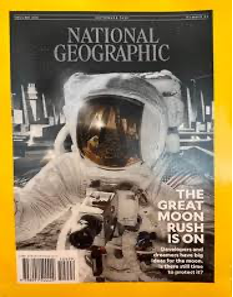
| National Geographic Cover Story
by Charles Fishman (Sept. 2025) |
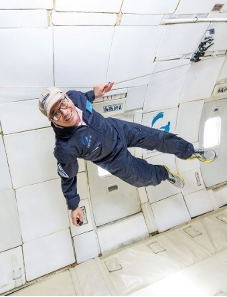
Charles Fishman experienced zero gravity when writing about the Moon |
Summary of Presentation by Charles Fishman on Feb. 18, 2026
In the 1960s, America raced to the Moon for Cold War prestige and proof of American “exceptionalism.” Now, more than half a century later, the Moon is poised to become a crowded destination again — this time driven less by geopolitics than by a new goal: learning whether humans can live and work there, and whether a true lunar economy can emerge. Award-winning journalist and author Charles Fishman framed the moment as a coming “Moon Rush,” with nations and private companies planning a surge of missions through 2030 and beyond.
Fishman began by pulling listeners back into Apollo 11’s dramatic descent. The 13-minute trip from lunar orbit to the surface was calm at first, then spiraled into crisis. Neil Armstrong and Buzz Aldrin discovered their intended landing site was strewn with boulders, forcing Armstrong to take manual control while fuel drained at an alarming rate. Worse, the lunar module’s computer triggered loud alarms repeatedly. Only one expert in Mission Control could decode them quickly enough; he realized the computer was overloaded but cleverly shedding nonessential tasks to keep flying. At one point, the screens went blank for 10 seconds as the computer prioritized flight over display. Armstrong and Aldrin kept working, and the Eagle touched down with seconds of fuel remaining — while Mission Control “started breathing again.”
From there, Fishman explained what’s different today. The Apollo program had no business case — the United States wanted to demonstrate its technological exceptionalism. We stopped going to the Moon because it was too expensive without clear returns. Now, companies are trying to turn lunar dirt (regolith) and water into infrastructure and profit. Regolith is abrasive and hazardous, but it is rich in oxygen and silicon and can be melted into bricks, landing pads, blast walls and even solar cells, potentially enabling on-site power generation. Water — likely trapped as ice mixed into soil in permanently shadowed polar craters — could support astronauts and be split into hydrogen and oxygen for rocket fuel, although extracting it in extreme cold will require advanced robotics.
He ended with a caution: the Moon is unforgiving. Recent private landers have tipped over, and major gaps remain — communications networks, traffic coordination, property and resource rules, and protections for the Moon’s radio-quiet far side. Even so, Fishman believes the space age is accelerating, and the lunar economy is already being assembled on Earth.