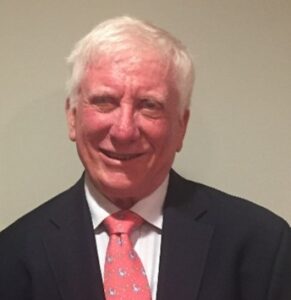
 Greg Steinmetz was scheduled to speak, but due to an injury cannot appear. We are fortunate to have DMA member and former president Charles Salmans step into the breach with a talk on a timely subject. [Editor’s note: This subject seems related to the October 29, 2025, presentation by Carleen Lyden Walker, “Revitalizing the U.S. Maritime Industry – A National Necessity.”]
America was largely isolationist before World War II and had to pivot to a wartime economy with rapid industrial development at a never-before-seen pace. DMA member Charles Salmans will discuss the fascinating story of quickly building up American industrial might against an existential foe.
Aircraft production in the 1930s, in particular, was only a cottage industry where only one aircraft was manufactured at a time. But with war raging in Europe – even before the attack on Pearl Harbor – America knew it needed to build up its military power and become the ‘Arsenal of Democracy’ to defend European freedom.
In 1940, Ford Motor Company was asked by the federal government to completely switch its business from building cars to mass production of the B-24 bomber, among other things. At the time, Henry Ford was an isolationist and wanted to turn down the government’s request, but his son Edsel fortunately persuaded him to agree. When factory construction started in 1941, it became an enormous undertaking, affecting 42,000 employees who switched from making cars to planes. Ford’s plant at Willow Run in Michigan was the largest in the world and the effort was one of America’s unparalleled success stories because a B-24 was able to roll off the production line every 55 minutes.
This presentation is an inspiring and instructive story because American manufacturing has atrophied, and the Ukraine and Iran wars have revealed shortages of defenses against missiles and drones. As a result, the Pentagon is concerned about the depletion and difficulty of replacing key weapons needed in war as it is now fought. This is a timely topic since The New York Times reported on April 18, 2026, that it was in conversations with Ford and General Motors to gauge whether the auto industry can help the military to acquire vehicles, munitions and other hardware more quickly and at lower costs.
Charles was formerly president of Corporate PR Advisors LLC, director of global public relations of Mercer, senior vice president of corporate communications at Bank of America (and predecessors Fleet Bank and Quick & Reilly), senior vice president and managing director of JP Morgan Chase (and predecessor Chemical Bank) and account supervisor at Burson-Marsteller Public Relations. He graduated from Northwestern University and received a Master of Business Administration degree from Columbia University.
Summary
DMA member Charles Salmans discussed America before World War II, when it was somewhat isolationist but had to quickly pivot its industrial base into being a protector of Europe as the “arsenal of democracy.” Doing so was one of the most remarkable transformations in American industrial history.
Charles focused on Ford Motor Company’s mass production of the B-24 bomber at the Willow Run Plant in Michigan, a story that illustrated how America converted a largely hand-built, cottage-industry aircraft manufacturing process into a mass-production industrial powerhouse. In the 1930s, airplanes were produced one at a time by highly skilled workers. By contrast, Willow Run became the world’s largest assembly plant, employing 42,000 workers and eventually turning out a B-24 every hour. Ford had to solve enormous challenges, from handling an aircraft with more than 1.2 million parts (compared to 15,000 for an automobile at the time) to training a workforce in which many had never worked on an assembly line and 40% were women.
Charles used the B-24 story not just as history, but as a lens on the present. He noted that today’s wars and tensions have exposed shortages in missiles, drones, and defense equipment, raising doubts about whether the United States could ramp up military production as quickly now as it did in the 1940s. He also broadened the discussion by highlighting other wartime industrial leaders such as Henry Kaiser, Andrew Higgins and William Knudsen, whose innovations helped transform shipbuilding, landing craft, and production planning.
The presentation ended with questions and personal reflections from members, many of whom shared moving stories about fathers and relatives who flew B-17s and B-24s or served during the war. The discussion closed on a note of deep gratitude for what one member reminded us has been called “the greatest generation,” whose sacrifice, discipline and hard work during the Depression and World War II helped build modern America.