Host: Bob Baker
Discussion Leader: David Mace
Host: Bob Baker
Discussion Leader: David Mace
Host: Bab Baker
Discussion Leader: Joe Spain
 David Frank Hurwitt of New Canaan, CT passed away November 19, 2020. David was born on April 8, 1938 in Kansas City, MO, the son of Irwin and Nancy Hurwitt. He is survived by his wife of fifty-seven years, Susan, their four children – Douglas, Laura Towle, David, and Sarah Clark, their spouses, 11 grandchildren, his sister, Joann Kinney, and many beloved cousins, nieces, and nephews.
Dear Family and Friends,
We hope you will save the date and join us for a virtual celebration of David’s life on Sunday, April 18 at 4:00 pm EDT.
Please register for the event by clicking on the link below today. Once registered, Zoom will send you all the details needed to attend.
https://zoom.us/meeting/register/tJArce6gqz0tHdQDcC5Rrs-am5eM-6YIveWM
You are welcome to forward this information to others you know who would appreciate being included.
We are so looking forward to gathering together to celebrate our precious dad and husband with you.
With love,
Susie, Doug, Laura, Dave and Sarah
 Thomas J. Ross was born in Brooklyn, New York in 1954, grew up in Darien and graduated from Darien High School in 1973. He received a BS in Economics from the University of Dayton in 1977 and an MBA from Pace University in 1981. He has had a long career in the financial services industry starting in retail banking and then product management with Citibank and EF Hutton. He then joined the Stamford office of Shearson Lehman Brothers as a Financial Advisor in 1991. He stayed with the company as it morphed into many different firms until it became Morgan Stanley where he is now a Senior Vice President. Tom is a lifelong sailor and a long-time member of the Noroton Yacht Club and the Darien Boat Club. Tom has been active in town where volunteered at Hindley school, spent many years on the town’s RTM and was on the Board of the Darien Community Association (DCA) and a member of their investment Committee. He has been an active volunteer at the Noroton Yacht Club where he was most recently the Commodore. He and his wife, Anne, have three children and enjoy sail boat racing, cruising on their powerboat, tennis and paddle tennis, reading, playing bridge and trying to learn Golf.
 THE NEW MAP
The latest on global energy geopolitics from the pen of an expert.
Yergin is the Pulitzer Prize–winning author of multiple magisterial volumes on world affairs as they relate to energy. In The Quest (2011), he described the stormy rivalry between an America struggling to maintain its hegemony in the face of upcoming rivals Russia and China. The following decade has not improved matters, and the current global pandemic is proving to be a disaster. However, bad news often makes for entertaining reading, and Yergin delivers a fascinating and meticulously researched page-turner. He maintains that an energy revolution has transformed the world to America’s benefit. However, it’s not wind and solar but fracking. American oil production had been dropping since 1970, but after 2000, fracking changed the game. In 2018, the U.S. overtook Russia and Saudi Arabia to again become the world’s largest oil producer. Production tripled between 2008 and 2020. Yergin astutely examines how other nations responded. Russia, with an economy “only slightly larger than Spain’s,” depends on oil income as much as the old Soviet Union. Responding to American oil sanctions, Putin has vastly improved relations with China, by many measures the world’s leading economy. “China,” writes the author, “has become what Britain had been during the industrial revolution—the manufacturing ‘workshop of the world.’ ” It’s already the largest producer of steel, aluminum, and computers as well as the largest energy consumer. Turning to the Middle East, Yergin describes an unhappy collection of failed states, civil wars, oppressive theocracies, bloody insurgencies, and wealthy ministates, all dealing with plummeting oil prices. The author views Trump with the same mild disapproval he applies to Putin and China’s Xi Jinping, and he chastises environmentalists for getting certain facts wrong. Yergin accepts that humans have dramatically affected the climate, but he doubts the practicality of proposed solutions.
Required reading. Another winner from a master.
Contact Dave McCollum or Bob Plunkett
“HIKING” SHERWOOD ISLAND STATE PARK
SHERWOOD ISLAND CONNECTOR
WESTPORT, CT
FRIDAY DECEMBER 11, 2020 AT 10:00
We will be walking about 3 miles through Sherwood Island State Park on mostly hard and gravel paths. Very little up and down. We will meet in the Pavilion parking lot at 10:00 AM. The Park hugs the Sound shoreline and is often quite windy. Dogs are permitted on a leash and, as always, bring anyone with you who would enjoy a one hour plus walk in a beautiful setting. NO LUNCH after.
HISTORY
Sherwood Island State Park is the oldest state park in Connecticut dating to 1914. The island itself was first settled by Daniel Sherwood in1787 where he built a grist mill. Over the next 70 years the land was farmed by many others but around 1860 the property became known as “Sherwood’s Island”
After the Connecticut State Park Commission was formed in 1911 the search for suitable shorefront property to buy was on. The first piece of the existing park was purchased in 1914 making this the oldest state park. The park officially opened in 1932 but not until 1950 did the Army Corps of Engineers build the jetties and extend the beaches. The Pavilion opened in 1959 and a 911 Memorial was added in 2002.
DIRECTIONS
This one is easy! Take Exit 18 off I-95 (Sherwood Island connector) and turn right towards the Sound. The road goes directly into the Park. Keep straight onto the wide roundabout and take the exit marked “Pavilion Parking”. We’ll meet at the front of that lot up towards the Pavilion.
Recap of hike:
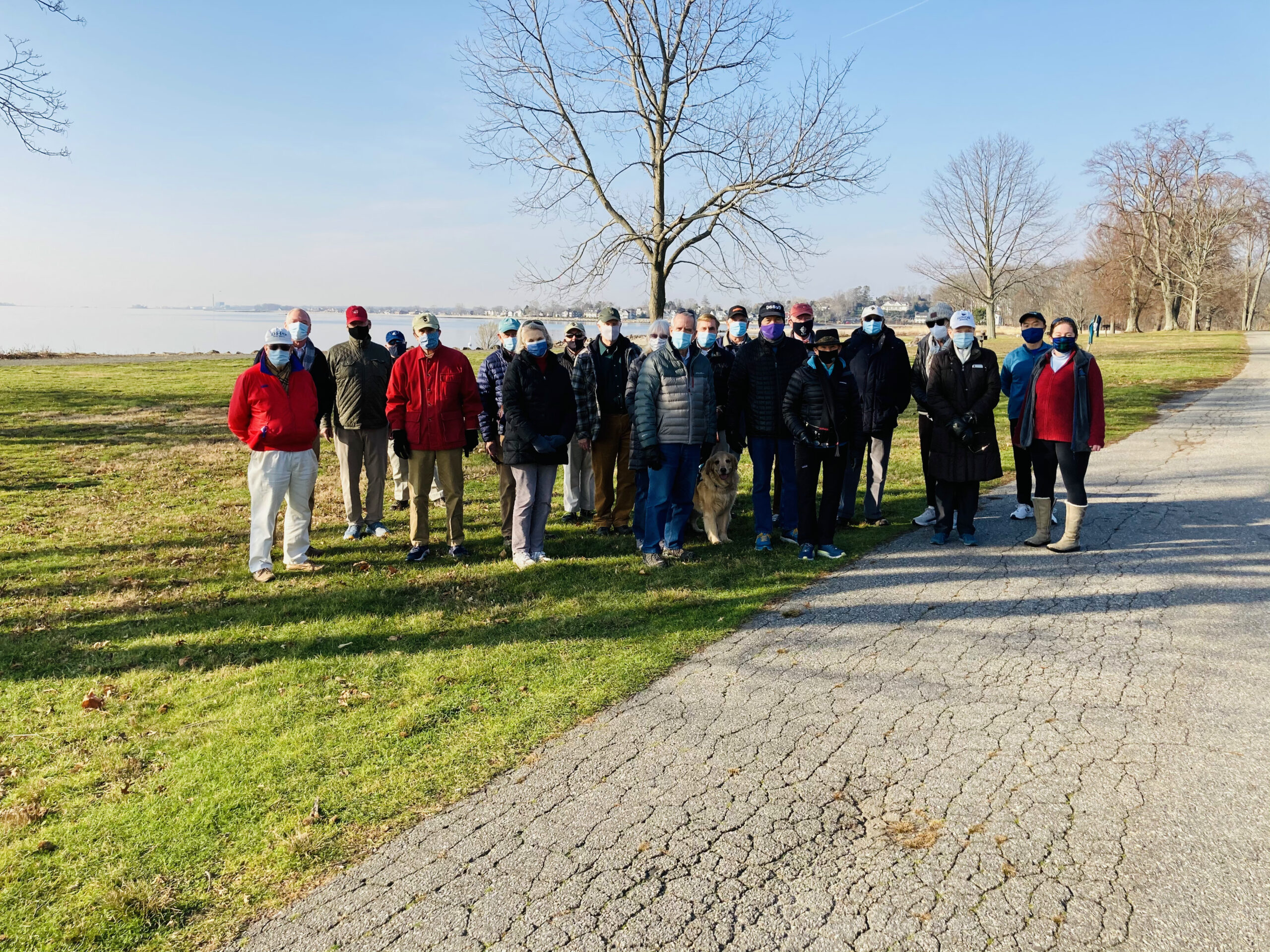
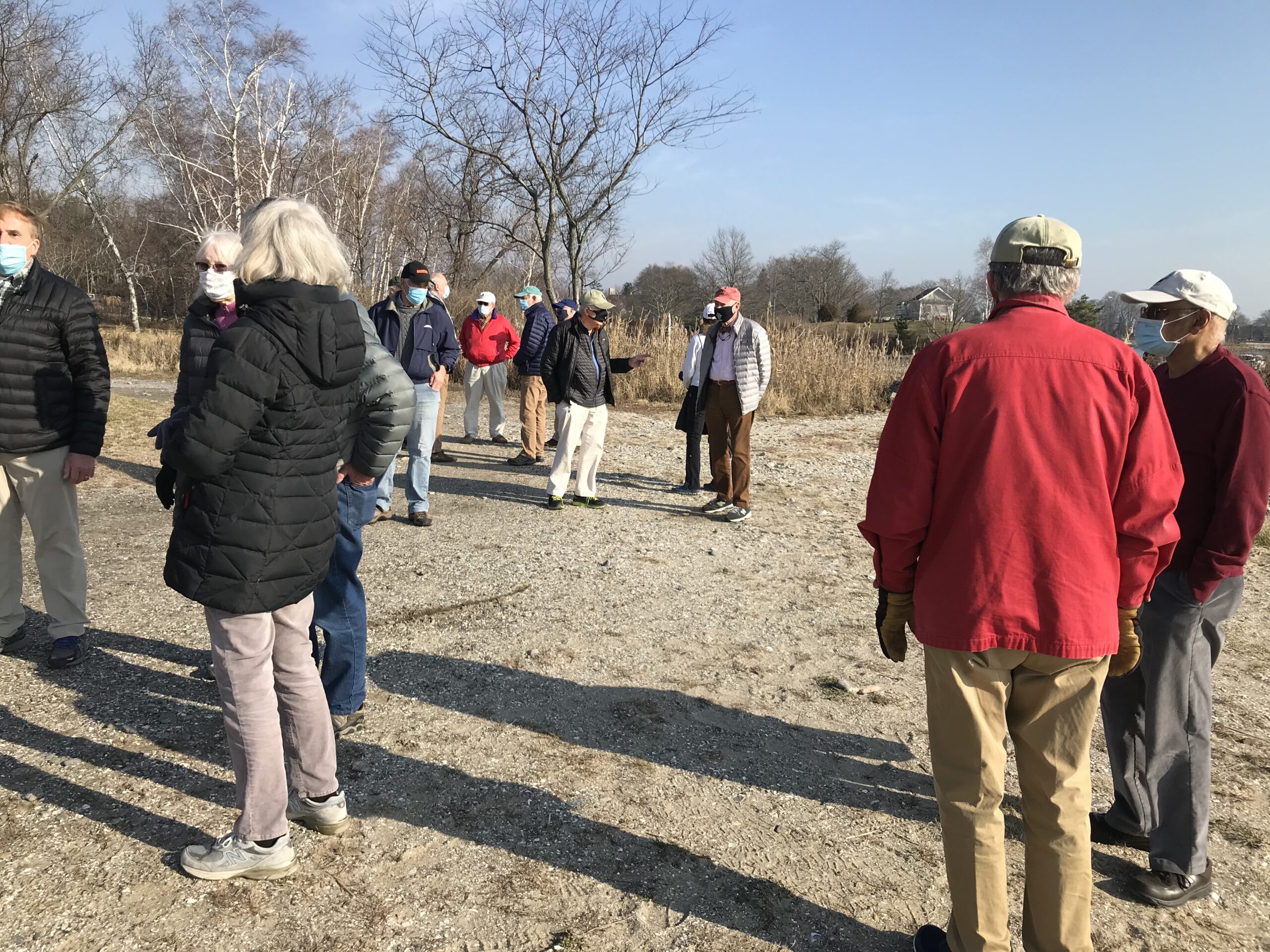
A near record 22 DMA members, spouses and friends spent a wonderful hour and 45 minutes touring the perimeter of Sherwood Island on mostly flat and hard surface trails. The weather was magnificent as was the opportunity for hikers to see and talk to each other (even through our masks) rather than on Zoom. The easy terrain and wide paths made conversation possible and we took advantage of it by taking nearly two hours to walk three miles!
Sherwood Island, the oldest state park in Connecticut, covers 234 acres of mostly open shoreline but has a substantial wooded area as well. A beautiful feature of the park is the Connecticut 911 Memorial sited on a point with a direct view down towards New York City. The names of all Connecticut residents who died from that attack are memorialized on stones embedded on the monument. From that point we walked ¾ of a mile along East Beach to the end of the park at New Creek and then back to our starting point.
A thoroughly enjoyable day and a great way for us to get together outside during this pandemic. We will explore further walks over the winter.



cancelled
A LONG PETAL OF THE SEA
BY ISABEL ALLENDE ; TRANSLATED BY NICK CAISTOR & AMANDA HOPKINSON
 Two refugees from the Spanish Civil War cross the Atlantic Ocean to Chile and a half-century of political and personal upheavals.
We meet Victor Dalmau and Roser Bruguera in 1938 as it is becoming increasingly clear that the Republican cause they support is doomed. When they reunite in France as penniless refugees, Roser has survived a harrowing flight across the Pyrenees while heavily pregnant and given birth to the son of Victor’s brother Guillem, killed at the Battle of the Ebro. Victor, evacuated with the wounded he was tending in a makeshift hospital, learns of a ship outfitted by poet Pablo Neruda to take exiles to a new life in Chile, but he and Roser must marry in order to gain a berth. Allende (In the Midst of Winter, 2017, etc.) expertly sets up this forced intimacy between two very different people: Resolute, realistic Roser never looks back and doggedly pursues a musical career in Chile while Victor, despite being fast-tracked into medical school by socialist politician Salvador Allende (a relative of the author’s), remains melancholy and nostalgic for his homeland. Their platonic affection deepens into physical love and lasting commitment in an episodic narrative that reaches a catastrophic climax with the 1973 coup overthrowing Chile’s democratically elected government. For Victor and Roser, this is a painful reminder of their losses in Spain and the start of new suffering. The wealthy, conservative del Solar family provides a counterpoint to the idealistic Dalmaus; snobbish, right-wing patriarch Isidro and his hysterically religious wife, Laura, verge on caricature, but Allende paints more nuanced portraits of eldest son Felipe, who smooths the refugees’ early days in Chile, and daughter Ofelia, whose brief affair with Victor has lasting consequences. Allende tends to describe emotions and events rather than delve into them, and she paints the historical backdrop in very broad strokes, but she is an engaging storyteller. A touching close in 1994 brings one more surprise and unexpected hope for the future to 80-year-old Victor.
A trifle facile, but this decades-spanning drama is readable and engrossing throughout.

BB3GGJ Minutemen leaving for the Battle of Concord Massachusetts 1775
Our Westport–Ridgefield Wandering will take place on this coming Tuesday, October 27. Our walking focus will be the Danbury Raid, a military incursion of the British that took place in April 1777, during the Revolutionary War.
We will drive to Westport and meet there at 9:30 AM on the 27th at the main Compo Beach Parking Lot. The shortest and most direct route is to go on I-95N toward New Haven and get off at Exit 17. There go straight at the end of the exit ramp and through the railroad station neighborhood, over the old girder bridge, and then to South Compo Road and onto Compo Beach Road. When I made a trial run the other day, it took about 14 minutes after I entered at Exit 11.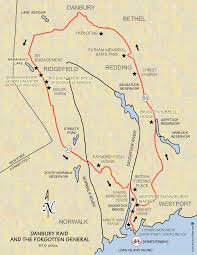
The street address of the entrance to Compo Beach Park is 80 Compo Beach Road. There turn south into the park, past the gate house, which is closed for the season, and continue to the south end of the parking lot, adjacent to two large decorative black metal canons on the south end of the beach. There we will meet our guide, Edward Hynes, and will park and assemble for the beginning of our Wandering. There are public restrooms in the park.
 After about an hour and a half walk in Westport, we will end up back at the beach parking lot, from which we will drive north to Ridgefield, following, at least in part, the general route that the invaders followed on their way toward Danbury. The second part of our tour will be centered in Ridgefield and will focus on the actions taken by the Connecticut based militias to attack, harass and deter the British forces as they marched north to their objective: the Continentals’ supply depots in Danbury. After walking through some of the parks and locations of the Battle of Ridgefield, we will have access to some picnic tables there to eat the sandwiches you need to bring. There are no restaurants nearby. You may also choose to return to Darien if you prefer. Below is a list of our wanderers. If you want to pair with somebody to drive please make your own arrangements.
Finally, please bring a mask, which is required in the parks. I am assuming we can take off the mask when we do our walking.
If you have questions, you can reach me on my cell phone at 203-554-4201. Below is the list of wanderers.
Looking forward to seeing you all on Tuesday. Happy Wandering!
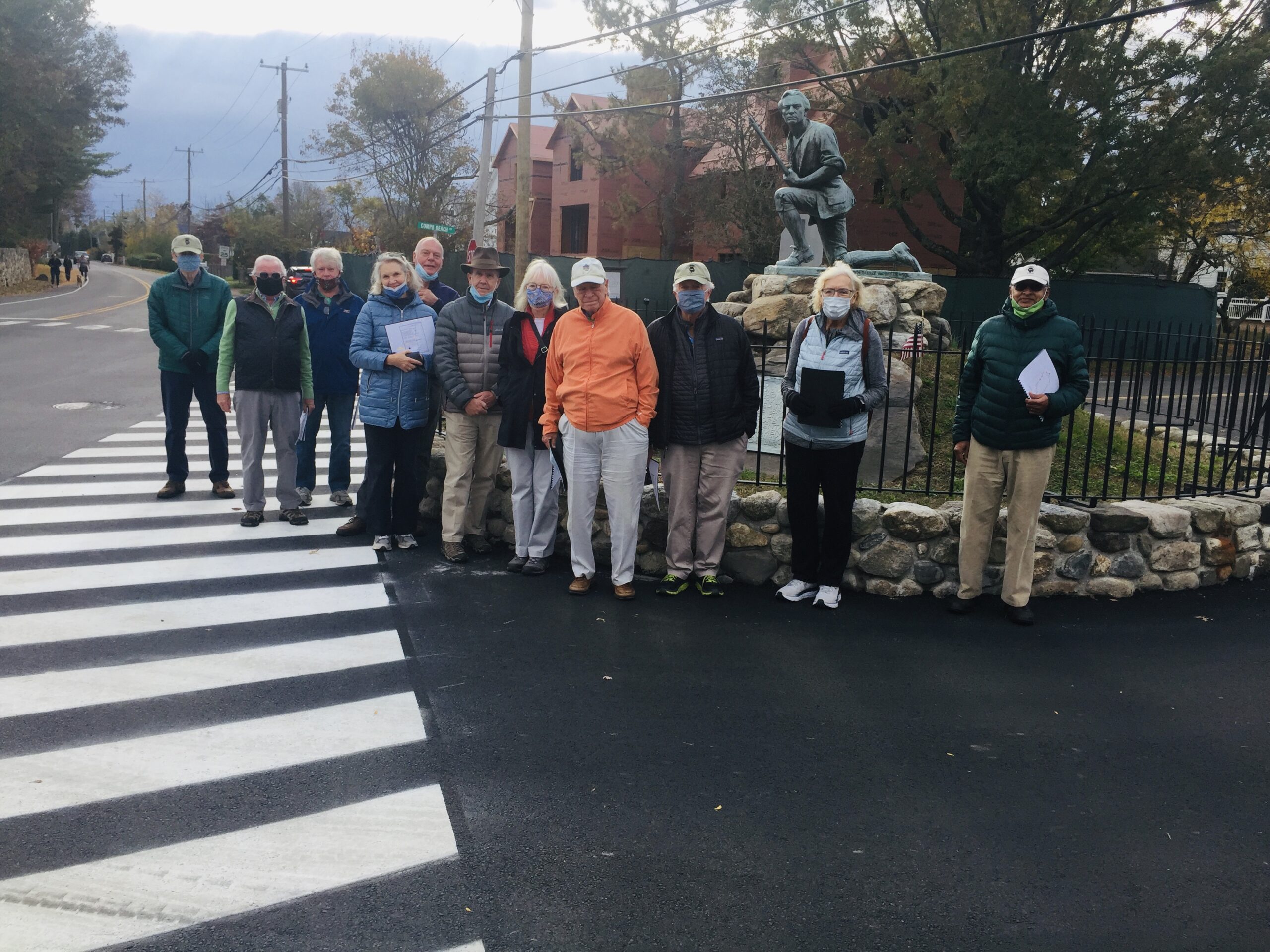
Your hosts: David Mace & Joe Spain
Mark Shakley and I just returned from a visit to the Jamaica Bay Wildlife Refuge This is a spectacular venue in Queens (900 acres) looking toward the Rockaways and back to the Verrazano Bridge. We walked the 1.7 mile loop around West Pond. Along the way we met a number of birders with cameras and telescopes. We saw a multitude of bird species including several Osprey platforms built by the National Parks Service. Jamaica Bay is part of the Gateway Recreation Area under the National Parks. We will have a Wandering to Jamaica Bay on Thursday November 5. It is a one hour drive from Darien. We will take sandwiches and eat on picnic tables at the Visitors Center. Mark your calendar for November 5. If you are interested please email David Mace.
https://npplan.com/parks-by-st
HIKING THE LEON LEVY PRESERVE
SOUTH SALEM, NY
THURSDAY OCTOBER 22, 2020
9:30 AM
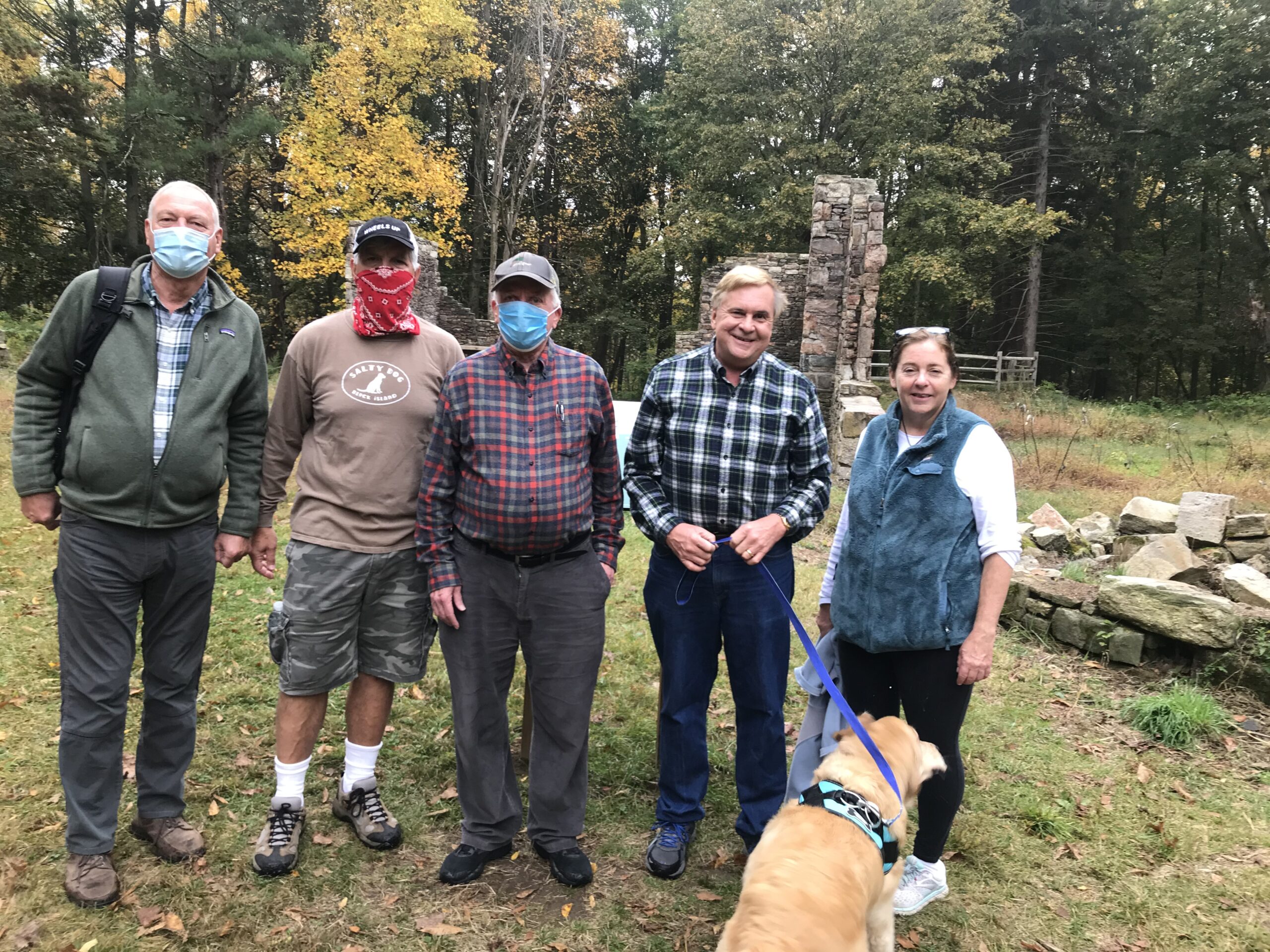
The Leon Levy Preserve, formerly the Bell property, was purchased by the Town of Lewisboro in 2005. It is 383 acres of forest and wetland located in the watersheds of both New York City and Stamford. The preserve has an extensive, well marked, trail system, the ruins of the Black mansion (1899-1979) and other outbuildings. The scenery at this time of year is spectacular and the Preserve encompasses an impressive gorge and numerous large rock outcroppings.
The hike of about 3+ miles (2 hours) we will take features mostly wide and well maintained trails which range from easy to moderate levels of difficulty. This hike should appeal to hikers of all levels of experience. As always, we welcome spouses, friends and dogs on a leash. No lunch.
DIRECTIONS:
The actual address of the Preserve is 2-50 Smith Ridge Road (Route 123) but Google 45 Smith Ridge Road in South Salem, NY which is a private house on the right side of the road. Just beyond that address is a sign for the Preserve on the left side indicating a left turn into the parking lot. The location is well up Rt 123 into NY State past Vista but short of Rt 35. There is ample parking.
Contacts:
Dave McCollum and Bob Plunkett
Bob Plunkett


Theme by Anders Noren — Up ↑