Westchester Broadway Theater
Lunch and Performance
Author: Webmaster (Page 93 of 97)
Celebration of Paul’s life, St. Luke’s Episcopal Church, Saturday, January 28, 2:30 p.m.
Paul Steven Larson of Norwalk and former longtime Darien resident, died on January 24, 2017 at home, surrounded by his devoted family, after a courageous cancer battle. Paul took on his disease as he took on everything in life, with tenacity and grace.
Paul was born May 22, 1943 in Bristol, CT to Arnold Lee Larson and Lou Manchester Larson. He graduated from Wesleyan University in 1965 where he captained the track and cross country team and was a member of Kappa Nu Kappa fraternity. He obtained his M.B.A. from the University of Rochester in 1967. He proudly served his country in the United States Naval Reserve as a supply officer aboard the U.S.S. Caloosahatchee, and retired as a Lieutenant Commander.
Paul began his career as a securities analyst at Chase Investors Corp., was then an assistant vice president at the General Electric Pension Fund, and finally an equity analyst/portfolio manager with General Reinsurance.
Paul will be remembered for his compassion for others, his kindness, his spirit, and his generosity. His unconditional love for his family was always his first priority. He was quick-witted and always had a joke at-the-ready. He believed laughter was the remedy for all. He truly loved his country, Christmas, and the 4th of July, as well as boating and beach vacations in Maine. He also was a diehard Red Sox fan. He was a friend of Bill’s for 15 years, which brought him serenity and peace.
Paul firmly believed in giving back to one’s community. He served as a Darien youth sports coach, Holmes School PTA co-chair, and Darien Boat Club officer. Paul served on the Darien RTM and the Board of Education. He was a member of Darien Kiwanis Club, Darien Men’s Association, the Country Club of Darien, and St. Luke’s Episcopal Church. After moving to Norwalk in 2004, Paul became an officer with the Norwalk Association of Silvermine Homeowners, a volunteer at the Maritime Aquarium at Norwalk, and a member of the Norwalk Community Chorale.
He is survived by his wife and best friend, Molly Schumann Larson whom he married July 20, 1968; his daughters Katherine Larson Farnham (Barrett) of Chester Springs, PA, and Anne Larson Brakeman (Robert) of Monroe, CT; his son, Steven Hamilton Larson (Jessica) of San Francisco, CA; his brother, Lee Larson (Kathy) of Lyme, NH; two sisters, Sally Carignan and Mary Larson of Brunswick, ME, and several nieces and nephews. Four grandchildren also survive him: William and Elizabeth Brakeman and Helen and Marshall Farnham. His beloved standard poodles, Phineas and Atticus, also survive him.
Calling hours are from 4-7pm on Friday, January 27, 2017 at Edward Lawrence Funeral Home, 2119 Post Road Darien. A Celebration of Paul’s life will be held at 2:30pm on Saturday, January 28, 2017 at St. Luke’s Episcopal Church, 1864 Post Road, Darien.
In lieu of flowers, the family requests contributions in Paul’s memory to Memorial Sloan Kettering Cancer Center Rare Cancer Research, 1275 York Avenue, New York, NY 10065, https://giving.mskcc.org, or the Lustgarten Foundation for Pancreatic Cancer Research, 1111 Stewart Ave., Bethpage, NY 11714, https://www.lustgarten.org/donate.

Sanctuary Cities – Their impact on
– Immigration
– Local economies
– Legal system
– Law enforcement
Discussion leader: Bob Baker
Resources:
Sanctuary Cities in Vermont
http://digital.vpr.net/post/sanctuary-cities-vermont#stream/0
https://www.washingtonpost.com/graphics/national/sanctuary-cities/
Campus Politics in the Age of Trump – The New York Times “sanctuary”
https://www.nytimes.com/2017/02/10/opinion/campus-politics-in-the-age-of-trump.html?
_r=0
Here’s a recent editorial by the WSJ’s Jason Riley, I thought you might find interesting.
http://www.wsj.com/articles/seeking-their-own-refuge-sanctuary-cities-go-to-court-1487116166
https://www.victoriaadvocate.com/news/2015/jul/26/procon-should-there-be-sanctuary-cities/
Connecticut Governor Sends Immigrant Enforcement Recommendations To Police Chiefs, School Superintendents – Darien, CT Patch
This shows potential conflict between governor and law enforcement officials in CT.
I (Charles Salmans) am from Garden City, a small town in Western Kansas that had a population of 5,000 when I was growing up in the 1950s. Today, in contrast to towns that have become ghost towns across the prairie Midwest, Garden City has a population of 26,000. Our big high school rival, Dodge City, Kansas, has remained at around 5,000. Many towns have simply disappeared. The influence of immigration on Garden City was profiled last week on NPR.
What a shock! I’ve never had my hometown profiled anywhere nationally.
I think linking the growth to immigration alone is overly simplistic. The key reason is the vertical integration of agriculture. First, in the 1970s came a beef packing plant and today to serve meat packing, 140,000 head of cattle are being raised in feedlots at any given time. Farmers shifted from wheat to feed corn from cattle. Then came an ethanol plant. And huge “unit trains” take grain to the coast (much like the unit coal trains). Now they are diversifying into vertically integrated dairy farming by building the world’s largest plant to dehydrate milk.
But working in beef packing, which started it all, is one of the most dangerous, least desirable jobs in America. It’s extremely difficult to get people to work in the plant and there is a long tradition of recruiting immigrants. There is a large Vietnamese population (boat people of the 1970s) as well as those of Mexican ancestry and other backgrounds, who work in the meat packing plant and other difficult jobs and many, I am sure, are illegals.
I’m simply offering this up for one of the discussion points, as it doesn’t “prove” one side of the sanctuary argument or the other in my opinion. Here are the two (of two) NPR segments:
Segment 1
http://www.npr.org/2017/02/18/515849383/a-tale-of-two-kansas-towns-one-thrives-as-another-struggles
Segment 2
http://www.npr.org/2017/02/19/516016940/a-thriving-rural-towns-winning-formula-faces-new-threats-under-trump-administrat
How can the federal government motivate states to enforce federal laws??
http://tenthamendmentcenter.com/2013/12/28/states-dont-have-to-comply-the-anti-comandeering-doctrine/
ACLU Immigration Detainers
https://www.aclu.org/issues/immigrants-rights/ice-and-border-patrol-abuses/immigration-detainers
Editorial in WSJ today, (March 13) ” Crime and Immigration” gives factors relating to “Sanctuary Cities”
List of sanctuary cities:
http://www.ajc.com/news/national/what-are-sanctuary-cities-here-list-sanctuary-cities-counties-states/Y452wnIOx2hemgKx8T4gIP/
Sanctuary cities protect 11,800 criminal aliens.
http://www.wnd.com/2016/08/no-deportation-sanctuary-cities-protect-11800-criminal-aliens/
Our state’s one of only a few where illegal immigration is up | The Seattle Times
http://www.seattletimes.com/seattle-news/data/our-states-one-of-a-few-where-illegal-immigration-is-up-and-half-is-from-asia/
Murder – Page 2 – United States Illegal Alien Crime Report
http://www.illegalaliencrimereport.com/category/murder/page/2/
Discussion Guide:
Sanctuary Cities “SC”
(more than 300 sanctuary “entities”)
Basic Facts
1. No legal definition of “sanctuary” cities or states or colleges. No legal procedure for their establishment
Can be formal (policies written), or informal (all policies are implied)
2. ICE (Immigration and Customs Enforcement) is a federal responsibility
The US government cannot force states to enforce federal laws
But states may voluntarily assist in enforcement
Formal state “sanctuaries” cannot force municipalities to comply with policies
3. Perception of justification of “sanctuaries” probably influenced by attitudes:
“The US welcomes immigrants and they deserve protection” or
“The US needs to enforce immigration laws and deport illegal immigrants”
(These are not mutually exclusive but create differences on policy)
What are motivations of states, cities, universities to establish SCs?
Are the SCs providing “sanctuaries” only for immigrants not convicted of felonies, or to protect undocumented immigrants which may be subject to deportation?
Legal obligation under warrants, detainer requests
Enforcement mechanisms if perceived violations
Is there a humanitarian argument for “sanctuaries”?
Conn. (Gov. Malloy) announced the state is a SC, what are our views and options?
(the first, fourth and tenth amendments have been cited in arguments for/against SCs)
Related issue—“Kates Law”
Mainstream journalists today are being subjected to disintermediation. Anyone with access to the Internet can post most anything posing as “news” on Facebook, Google, YouTube, and a variety of other websites. Journalism as practiced in the 1960s is a distant memory, as when Walter Cronkite of CBS declared that the Vietnam war could not be won and President Lyndon Johnson lamented, “If I have lost Cronkite, I’ve lost Middle America.”
The proliferation of cable channels, talk radio, news websites, and other sources of “news”, most would agree, has plusses and minuses. We no longer have our news delivered by “The Voice of God”, whether it’s Walter Cronkite or Henry Luce’s Time Magazine and we can easily access a wider range of opinion and policy proposals.
But many of us would admit that we tend to access news sources that will reinforce our own biases, and to ignore those outlets that would challenge our opinions. Possibly this has eroded the power of politicians at the “center” and made political compromise in Congress more difficult.
Fake News is reflective of the trend of fragmentation of sources, but different
What fewer would debate is that our country is not well served by “fake news” that undermines the power of an informed citizenry. Educated voters can hold our political leaders to account for policies and actions but world history is replete with the danger if public opinion is based on lies.
There are a number of reasons for the rise of “fake news”, but one especially strong incentive is that you can make a lot of money by creating it. The process is pretty simple and straightforward. Set up a website, create headlines — the more provocative the better — and get advertisers to pay based on the number of visitors to the site.
The New York Times profiled a recent college graduate who makes between $10,000 and $30,000 a month from creating fake news.
His masterpiece: playing on the fear of Trump supporters that there would be a rigged election. His headline: “Breaking: Tens of thousands of fraudulent Clinton votes found in Ohio warehouse.”
None of this was true. The story was illustrated with a stock photo of plastic crates labeled “Ballot Box”, which was actually a photo from an election in Britain. See image above.
https://www.nytimes.com/2017/01/18/us/fake-news-hillary-clinton-cameron-harris.html?hp&action=click&pgtype=Homepage&clickSource=story-heading&module=b-lede-package-region®ion=top-news&WT.nav=top-news
“Fake News” content creators are found around the world. Eastern Europe is a particularly fertile ground for such individuals, who need only a computer. Earning $1,000 or $3,000 a month can put the individual at the upper end of the income range in some of these countries.
https://www.nytimes.com/2016/11/25/world/europe/fake-news-donald-trump-hillary-clinton-georgia.html?_r=0
Fake news technology can now change facial expressions and audio to put false statements into the mouths of anyone a target of fake news and make falsehoods seem believable.
http://www.vanityfair.com/news/2017/01/fake-news-technology
NY Times: 10 Times Trump Spread Fake News
https://www.nytimes.com/interactive/2017/business/media/trump-fake-news.html?emc=eta1
Also:
http://thefederalist.com/2017/02/06/16-fake-news-stories-reporters-have-run-since-trump-won/
Researchers asked survey respondents whether they had heard various pieces of news on the two presidential candidates. These fell into three categories:
1) News that was true
2) News that had been posted that was fake
3) News that researchers created that was fake “fake news”. In other words, it had never been circulated.
In the second category, 15.3% of respondents remembered seeing the fake news stories and 7.9% recalled seeing them and believing them. But roughly the same number of people remembered seeing and believing the news in the third category.
https://www.nytimes.com/2017/01/18/upshot/researchers-created-fake-news-heres-what-they-found.html?ref=todayspaper&_r=0
The conclusion of the researchers: Some 8% of the adult population is willing to believe anything that sounds plausible and fits their preconceptions about the heros and villains in politics.
What to do about this?
Both Facebook and Google have recently adopted a policy to refuse to place ads on sites controlled by fake news publishers. But the purveyors and profit-makers from fake news are likely to be nimble and set up new websites when their discredited ones have been shut down.
http://www.wsj.com/articles/mark-zuckerberg-explains-how-facebook-plans-to-fight-fake-news-1479542069
Here is a wikipedia list of all the fake websites and their founders, etc. Notice they are deliberately close to legitimate news sites. https://en.m.wikipedia.org/wiki/List_of_fake_news_websites Several are operated by the same person/organization.
The New York Times solicited ideas and came up with four proposals:
Facebook must acknowledge and change its financial incentives
Algorithms could help social media users spot fake news
3) Users must be more critical of online content
4) Social media companies need to hire human editors
http://www.nytimes.com/roomfordebate/2016/11/22/how-to-stop-the-spread-of-fake-news
There are several sites that try to investigate and debunk fake rumor and news including factcheck.org, snopes.com, and politifact.com but in entering some of the “fake news” stories I found, these didn’t always come up as stories discredited.
Another proposal is to create a crowdsourced, open list of false news sites regularly updated and refined by consensus (like Wikipedia) and persuade Google, Facebook, YouTube and other social media to agree to abide by this list and block such site advertising. Employ self-policing as with Wikipedia.
Also I found the following 32 page guide to fake news sites. There is a directory of specific sites and warning flags that can be deduced from the URL. For example, if the site ends in .com.co it’s a website in Colombia, not a traditional dot com.
https://docs.google.com/document/d/10eA5-mCZLSS4MQY5QGb5ewC3VAL6pLkT53V_81ZyitM/preview
Issues for Discussion
Who is the arbiter of “fake news”? It’s the age-old conundrum of the rights of free speech vs. censorship. The line between satire and “lying for cash” may be difficult to draw.
Should there be penalties for those who knowingly create “fake news”? Is it the equivalent of “shouting fire in a crowded theater”?
Should prominent social media sites such as Facebook and Google be legally required to root out fake news sites, or even to face fines for failure of due diligence?
What is the obligation of politicians to be accountable for exercising due diligence on stories that they distribute? Donald Trump has been accused of re-tweeting fake news without checking the validity of a story.
What methods should be adopted to educate citizens about how to test the truthfulness of stories they may see on social media and the Internet?
Do mainstream journalists need to change their methods of communicating and sourcing stories in order to offer a more legitimate and accessible alternative to fake news?

Finally, Dilbert cartoonist Scott Adams started a series today in which the dumb pointy-haired boss has re-tweeted a racist conspiracy theory. We’ll see where he takes that in the coming days and whether it could be an amusing addition to what we have pulled together. Too soon to tell. Here’s the first panel:
http://dilbert.com/strip/2017-01-25?utm_source=dilbert.com/newsletter&utm_medium=email&utm_campaign=brand-loyalty&utm_content=strip-image
Other Reading
https://www.brookings.edu/research/what-the-debate-over-journalism-post-trump-gets-wrong/
https://theintercept.com/2017/01/19/major-fake-news-operation-tracked-back-republican-operative/
https://www.nytimes.com/2017/01/22/us/politics/president-trump-inauguration-crowd-white-house.html
Discussion leader: Charles Salmans
Resources:
WINNER OF THE 2016 PULITZER PRIZE FOR GENERAL NONFICTION

“A Best Book of 2015”—The New York Times
In a thrilling dramatic narrative, Pulitzer Prize-winning reporter Joby Warrick traces how the strain of militant Islam behind ISIS first arose in a remote Jordanian prison and spread with the unwitting aid of two American presidents. Drawing on unique high-level access to CIA and Jordanian sources, Warrick weaves gripping, moment-by-moment operational details with the perspectives of diplomats and spies, generals and heads of state, many of whom foresaw a menace worse than al Qaeda and tried desperately to stop it. Black Flags is a brilliant and definitive history that reveals the long arc of today’s most dangerous extremist threat.
Recommended by Harris Hester
Discussion leader: David Mace
Following his blockbuster biography of Steve Jobs, The Innovators is Walter Isaacson’s revealing story of the people who created the computer and the Internet. It is destined to be the standard history of the digital revolution and an indispensable guide to how innovation really happens. What were the talents that allowed certain inventors and entrepreneurs to turn their visionary ideas into disruptive realities? What led to their creative leaps? Why did some succeed and others fail? In his masterly saga, Isaacson begins with Ada Lovelace, Lord Byron’s daughter, who pioneered computer programming in the 1840s. He explores the fascinating personalities that created our current digital revolution, such as Vannevar Bush, Alan Turing, John von Neumann, J.C.R. Licklider, Doug Engelbart, Robert Noyce, Bill Gates, Steve Wozniak, Steve Jobs, Tim Berners-Lee, and Larry Page. This is the story of how their minds worked and what made them so inventive. It’s also a narrative of how their ability to collaborate and master the art of teamwork made them even more creative. For an era that seeks to foster innovation, creativity, and teamwork, The Innovators shows how.

Discussion leader: Gary Banks
The Electoral College:
– Why was it created?
– How it works.
– Is it still relevant?
Discussion Leader: Jim Phillips
Obituary: Robert Birney Crane, Darien High Class of ‘36, life-time competitive sailor
By Darien Times on December 6, 2016
Robert Birney Crane of Darien, CT crossed the bar on Wednesday November 30th, 2016. Born to Albert Eli Crane and Florence Luray Overton Crane on February the 8th 1920 in Plainfield, N.J. , Bob thoroughly enjoyed life for over 96 years. He moved to Darien with his family at the age of 8. Bob attended Miss. Thomas’s School and Saint Luke’s Academy before graduating from the Darien High School in 1936. Following his graduation Bob attended Middlebury College and New York University graduating with a BS Degree in Engineering in 1942.
If you enjoy researching and discussing current affairs then you should join the DMA Current Affairs Discussion Group.
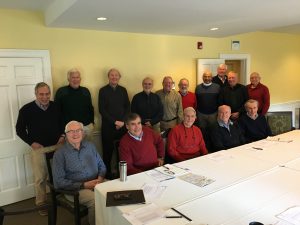

The Current Affairs group meets on the third Thursday of each month (Sep-Jun) at 11:00 AM in the Lillian Gade Room on the second floor of the DCA.

The structure is as follows: With input from the group, the Current Affairs Coordinator will maintain a list of potential discussion topics. At the end of each meeting, a topic and discussion leader is chosen for the next meeting. The discussion leader will (i) define and articulate the topic; (ii) assemble and have posted on the website background materials; (iii) lead the discussion. All members are encouraged to share information they find informative and relevant. The topic will be posted on this website.
We are not debating so the focus is on being better informed. The discussion leader will maintain this focus and allow everyone the opportunity to summarize what they have learned from the articles and what struck them as meaningful.
We hope to see you there.
Mike Wheeler & Mark Nunan
Future and recent past discussion topics include:
“Hiking” Greenwich Point Park,
6 Tod’s Driftway, Greenwich
Thursday, December 1, 2016
We will be walking Greenwich Point Park on Thursday, December1 at 10.30 am. Note that this is an hour later than our usual start time of 9.30 am.

Greenwich Point is a beautiful peninsula surrounded on three sides by Long Island Sound. The walking trail is completely flat and does not require any special skills other than a desire to walk amid some pretty spectacular scenery. We will be doing the full circuit of about 3 miles in about 1 ½ hours.
Following the walk we will have lunch at the highly recommended Italian Restaurant Applausi Osteria Toscana,199 Sound Beach Avenue, Old Greenwich, Conn. Take a look at the menu here.
Directions: Google Greenwich Point for the best directions.
Take Exit 5 off the South bound I-95. At the end of the exit ramp make a sharp right onto Rt 1 and then at the first traffic light make a right onto Sound Beach Road. Continue on Sound Beach for 1.8 miles, then at the T junction make right on Shore Road which becomes Tods Driftway after 1.3 miles. You enter Greenwich Point Park through a stone gateway and park in the first parking lot on the right where we will meet.
This park is open only for Greenwich Residents during the season, but this being off-season anyone can enter. However incoming cars are checked to make sure there are no dogs as they are not allowed in the park.
Clothing: It is usually quite windy at Greenwich Point and will probably be chilly as well. Be appropriately clad. Walking will warm you up and it should be invigorating and fun. All are welcome.
( Rain date: Friday December 2 at 10.30am)
Contact: Sunil Saksena 203-561-8601
Join us Thursday October 27 November 3 as we hike a portion of the Westchester Wilderness Walk at the 150-acre Zofnass Family Preserve in Pound Ridge, NY ― near the North Stamford border. We’ll be at Zofnass during height of the changing leaves in an undeveloped area noted for its beautiful rock outcroppings, upland forests, wetlands and ancient stone walls. We’ll hike about 3 ½ miles of the preserve’s 8 miles of trails.
And after the hike we’ll reward ourselves with lunch at the nearby Long Ridge Tavern on Long Ridge Road in North Stamford.
Invite your wife or significant other to join us both for this special hike ― and for lunch.
Because parking is extremely limited at the Zofnass Preserve we’ll meet at the Long Ridge Tavern at 9:30 a.m. and car pool the five minute drive to trail head.
Directions to Long Ridge Tavern, 2635 Long Ridge Road, Stamford, CT 06903.
― Merritt Parkway, exit 34, Long Ridge Road (CT 104)
― Drive north on Long Ridge Road (CT 104) 3.8 miles to Long Ridge Tavern
― Long Ridge Tavern will be on the right
― Meet in the parking lot
Cell service in Zofnass is limited, so if you need to contact hike leader Rich Sabreen the day of the hike try 917-951-8267 before we leave the Tavern about 9:30 a.m.
From a former marine and Yale Law School graduate, a powerful account of growing up in a poor Rust Belt town that offers a broader, probing look at the struggles of America’s white working class Hillbilly Elegy is a passionate and personal analysis of a culture in crisis—that of white working-class Americans. The decline of this group, a demographic of our country that has been slowly disintegrating over forty years, has been reported on with growing frequency and alarm, but has never before been written about as searingly from the inside. J. D. Vance tells the true story of what a social, regional, and class decline feels like when you were born with it hung around your neck. The Vance family story begins hopefully in postwar America. J. D.’s grandparents were “dirt poor and in love,” and moved north from Kentucky’s Appalachia region to Ohio in the hopes of escaping the dreadful poverty around them. They raised a middle-class family, and eventually their grandchild (the author) would graduate from Yale Law School, a conventional marker of their success in achieving generational upward mobility. But as the family saga of Hillbilly Elegy plays out, we learn that this is only the short, superficial version. Vance’s grandparents, aunt, uncle, sister, and, most of all, his mother, struggled profoundly with the demands of their new middle-class life, and were never able to fully escape the legacy of abuse, alcoholism, poverty, and trauma so characteristic of their part of America. Vance piercingly shows how he himself still carries around the demons of their chaotic family history. A deeply moving memoir with its share of humor and vividly colorful figures, Hillbilly Elegy is the story of how upward mobility really feels. And it is an urgent and troubling meditation on the loss of the American dream for a large segment of this country.
Discussion leader: John Wolcott
Gentlemen–Hillbilly Elegy is an extremely important book, perhaps more because so many pundits are liberally quoting it than might truly be the case–and therein lies an intriguing paradox. However, Elegy is extraordinarily well-written (the pages fly by) and relates an absorbing, disturbing, yet at times uplifting story set in Appalachia, referred to by politicians, some sympathetically, others, condescendingly, as the Rust Belt. Our discussion will be both lively and provocative.
Once you’ve put the book down (but not before), please read the attached book review from The New Yorker. I’ve read a number of others, and none comes close. It’s so good that you could almost skip the book, but again, the book is so well crafted that you shouldn’t miss it. The article also refers to several other sources that might be worth a look.
See you all January 11. In the meantime, Happy Holidays and a Wonderful New Year, speaking of which, make reading Hillbilly Elegy your first New Year’s Resolution!
–John