Author: Webmaster (Page 94 of 97)

Book Club: The Last Hurrah by Edwin O’Connor, December 14, 2016

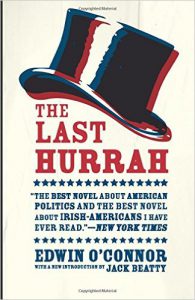
last-hurrah“We’re living in a sensitive age, Cuke, and I’m not altogether sure you’re fully attuned to it.” So says Irish-American politician Frank Skeffington—a cynical, corrupt 1950s mayor, and also an old-school gentleman who looks after the constituents of his New England city and enjoys their unwavering loyalty in return. But in our age of dynasties, mercurial social sensitivities, and politicians making love to the camera, Skeffington might as well be talking to us.
Not quite a roman á clef of notorious Boston mayor James Michael Curley, The Last Hurrahtells the story of Skeffington’s final campaign as witnessed through the eyes of his nephew, who learns a great deal about politics as he follows his uncle to fundraisers, wakes, and into smoke-filled rooms, ultimately coming—almost against his will—to admire the man. Adapted into a 1958 film starring Spencer Tracy and directed by John Ford (and which Curley tried to keep from being made), Edwin O’Connor’s opus reveals politics as it really is, and big cities as they really were. An expansive, humorous novel offering deep insight into the Irish-American experience and the ever-changing nature of the political machine, The Last Hurrah reveals political truths still true today: what the cameras capture is just the smiling face of the sometimes sordid business of giving the people what they want.

Discussion Leader: David Mace

Book Club: Destiny of the Republic: Madness, Medicine & the Murder of a President by Candice Millard, November 9, 2016

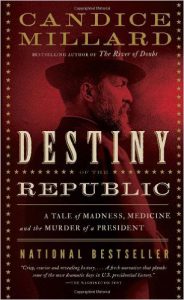
destinyoftherepublicThe extraordinary New York Times bestselling account of James Garfield’s rise from poverty to the American presidency, and the dramatic history of his assassination and legacy, from bestselling author of The River of Doubt, Candice Millard.

James Abram Garfield was one of the most extraordinary men ever elected president. Born into abject poverty, he rose to become a wunderkind scholar, a Civil War hero, a renowned congressman, and a reluctant presidential candidate who took on the nation’s corrupt political establishment. But four months after Garfield’s inauguration in 1881, he was shot in the back by a deranged office-seeker named Charles Guiteau. Garfield survived the attack, but become the object of bitter, behind-the-scenes struggles for power—over his administration, over the nation’s future, and, hauntingly, over his medical care. Meticulously researched, epic in scope, and pulsating with an intimate human focus and high-velocity narrative drive, The Destiny of the Republic brings alive a forgotten chapter of U.S. history.

Discussion leader: Joe Spain

Book Club: Alibaba: The House That Jack Ma Built by Duncan Clark, October 12, 2016

alibaba-coverAn engrossing, insider’s account of how a teacher built one of the world’s most valuable companies—rivaling Walmart & Amazon—and forever reshaped the global economy.
In just a decade and half Jack Ma, a man from modest beginnings who started out as an English teacher, founded and built Alibaba into one of the world’s largest companies, an e-commerce empire on which hundreds of millions of Chinese consumers depend. Alibaba’s $25 billion IPO in 2014 was the largest global IPO ever. A Rockefeller of his age who is courted by CEOs and Presidents around the world, Jack is an icon for China’s booming private sector and the gatekeeper to hundreds of millions of middle class consumers.
Duncan Clark first met Jack in 1999 in the small apartment where Jack founded Alibaba. Granted unprecedented access to a wealth of new material including exclusive interviews, Clark draws on his own experience as an early advisor to Alibaba and two decades in China chronicling the Internet’s impact on the country to create an authoritative, compelling narrative account of Alibaba’s rise.
How did Jack overcome his humble origins and early failures to achieve massive success with Alibaba? How did he outsmart rival entrepreneurs from China and Silicon Valley? Can Alibaba maintain its 80% market share? As it forges ahead into finance and entertainment, are there limits to Alibaba’s ambitions? How does the Chinese government view its rise? Will Alibaba expand further overseas, including in the U.S.?
Clark tells Alibaba’s tale in the context of China’s momentous economic and social changes, illuminating an unlikely corporate titan as never before.

Hiking the Leon Levy Preserve in South Salem NY
Thursday Sept 29, 2016 at 9.30am

The Leon Levy Preserve was established approximately 10 years ago when the 400 acre Bell property was purchased by the Westchester Land Trust. The hiking trails here are wide, well maintained, well marked and range from an easy to a light moderate level of difficulty.

See: Leon Levy Preserve

We have chosen this particular hike to encourage wide participation. The hike should appeal to hikers of all levels of experience. We welcome spouses and significant others: they will enjoy this hike.

We will start at 9.30am, hike for perhaps 3.5 miles and be done by approximately 12 noon.

Following the hike, an optional lunch will be at Chef Luis in the heart of downtown New Canaan.

See: Chef Luis

Directions:

The best directions can be had by googling 45 Smith Ridge Road in South Salem, NY. This is a private home on Route 123 very close to the Preserve. In fact, a few yards from their mailbox is a brown sign saying the the Leon Levy Preserve is just ahead on the left. There is ample parking.

For those traveling from Darien, you will basically being going up Mansfield Ave (Route 124) into New Canaan and there connect to Route 123 N which is Smith Ridge Road in New Canaan. Proceed on Route 123 N well into New York State till you see the mailbox for 45 Smith Ridge Road in South Salem and spot the Leon Levy sign mentioned above.

Rain date: Friday, Sept 30, 2016

Contact for this hike: Sunil Saksena, 203­561­8601; ssaksena44@gmail.com

Philip Batterman Smith
Passes Away

obit-smith-02-04Philip Batterman Smith died on January 29th in Delray Beach Florida, after a brief illness. Mr. Smith was born in New York City on January 5, 1936 to Allen Batterman Smith and Eleanor Irving of Rye, NY. He was a resident of Darien, CT for 55 years, and part time resident of Delray Beach, Florida and Edgartown, Massachussetts.


Phil is survived by his wife of 55 years, Linda May Smith and his three daughters, Susan Smith Pettenati (John) of Ridgewood, NJ, Elizabeth Smith Klein (Michael) of Darien, CT and Alice Smith Clark (Jonathon) of New Canaan, CT, and his son in law, Kenneth A. Southworth. He was predeceased by his daughter Eleanor Smith Southworth. He is also survived by his 10 grandchildren Jack, Michael and Luke Pettenati; Molly, Larsen, and Grace Klein; Caroline and Jack Clark; Katherine and Alden Southworth and many more relatives including his two nieces, Marjorie Roney of Darien, CT and Dorothy Holt of Cumberland Foreside, ME and their families, and his cousin William H. Morton of Vero Beach Florida.
Continue reading

Book Club: All the Light We Cannot See by Anthony Doerr, April 8, 2015

51765Ptvm+L._AA160_NATIONAL BOOK AWARD FINALIST.  From the highly acclaimed, multiple award-winning Anthony Doerr, the beautiful, stunningly ambitious work about a blind French girl and a German boy whose paths collide in occupied France as both try to survive the devastation of World War II. ( 25 weeks on the New York Times bestseller list)

Discussion Leader: John Podkowsky.  A list of discussion questions was previously circulated.

DMA May selection: AGENT STORM by  Morten Storm, Paul Cruickshank, and Tim Lister

Agent Storm is the remarkable memoir of a Danish convert-turned-extremist who managed not only to infiltrate al Qaeda’s ranks but would later become one of West’s most valued human intelligence assets in the war on terrorism. As a true spy-story, this book brings you incredibly close to what it actually takes to be an extremist and get into a terrorist group while balancing loyalty and treachery in the world of intelligence. Essential reading for everyone interested in how the war on terrorism is actually fought in the shadows.”
“Agent Storm opens a unique window onto bleak interlocking landscapes—the radicalization of European Muslims that has now been energized by the Syrian civil war, the leadership and organization of global jihad, and the twilight struggle waged by western intelligence agencies against an elusive and implacable enemy.”

Discussion Leader:  John Podkowsky

Book available at the Darien Library the second week of April; Discussion date:  May 13.

March 25, 2015
Stuart Waack, Silvermine’s Head Golf Professional since 1998, will talk about his process of obtaining his PGA membership, his journey to be a Head Professional and the state of the game today.

Stuart Waack

Stuart is a PGA Professional The PGA of America that comprises 27,000 men and women professionals with one singular goal in mind – to make the game of golf more enjoyable for you.

Stuart was born in Nyack, New York and raised in New City, NY where he graduated from Clarkstown School district. Played high school and college golf and was Captain of University of Rhode Island Golf Team and graduated in 1987 with a B.S. in Finance.

Caddied Dellwood Country Club, New City, NY 1977-1987 and was 1st Assistant Blue Hill Golf Course, municipal golf course in Pearl River, NY from 1987-1989 and 1st Assistant Woodway Country Club, Darien, CT from 1990-1998 and Head Golf Professional Silvermine Golf Club from 1998-present. Currently, Head Golf Coach of Wilton High School Girl’s Golf Team.

Awards and leadership positions: 2007 MET PGA Junior Golf Leadership Award, 2013 MET PGA Junior Golf Leadership Award. A member of MET PGA Board of Directors from 2009-2015, 2011-2013 MET PGA Secretary and MET PGA Vice President from 2014-2015.

Arranged by Alex Garnett.

March 18, 2015
Jim Lewis will speak about the challenges and current hot topics in the franchise world and specifically McDonalds’ Franchising.

Jim Lewis McDonaldsThe issues facing franchisees today include the sharing of rising costs, profit split, lifespan of franchise concepts, chasing trends and who carries the risk. Current regulatory environment affects franchise on several levels. Managing real estate cost and franchising business models.

McDonald’s Specific Issues include product perception, profit split due to unique real estate partnership, labor force challenges, doing business in NYC, and advertising–structure.

Jim Lewis has been in the McDonald’s system since 1986 and as an Owner/Operator since 1993. He currently owns 17 Restaurants in Manhattan and Queens including the famous Times Square and 42nd St McDonald’s. Prior to his involvement in McDonald’s he worked as a Sales Manager for AT&T in Southfield, Michigan. Jim began his career as an Account Executive with Michigan Bell Telephone in 1981.

Jim is currently on the Board of Directors for the New York Metro Marketing Cooperative and has served as President of that Board in the past. He is currently the Co-Chairman of the Marketing Strategy Committee for New York. Jim has served on many National and Divisional teams for the McDonald’s system during his tenure.

Arranged by Tom Lom.

March 11, 2015
Tara Contractor, a staff member of the Bruce Museum, will speak about the Story Behind the Story of the Northern Baroque Splendor Exhibition at the Bruce Museum.

Tara ContractorTara Contractor, the Kress Interpretive Fellow at the Bruce Museum, will present the highlights of the current exhibition, Northern Baroque Splendor: The HOHENBUCHAU COLLECTION From LIECHTENSTEIN. This collection consists of 64 paintings and displays the Golden Age of Dutch and Flemish art between the late 16th and early 18th centuries.

The paintings cover a wide range of subjects to illustrate everyday life of that time. The show, the Bruce’s largest ever, is roughly arranged chronologically and exhibits beautiful and alluring still-life pictures of fruits, intricate goblets and detailed tapestries; landscapes of rural scenes, turbulent seas and tranquil rivers, and portraits of an assortment of characters and emotions. The artists are also numerous and include such well-known names Gerard Dou and Peter Paul Rubens.

Contractor is a graduate of Scripps College and Courtauld Institute of Art, U. of London and has worked directly with the museum’s director in organizing this outstanding exhibit.

Arranged by Frank Johnson.

February 25, 2015
Art Gottlieb, local historian on military history, will talk about the “Battle of the Bulge”.

Art GottliebThe Battle of the Bulge (16 December 1944 – 25 January 1945) was a major German offensive campaign launched through the densely forested Ardennes region of Wallonia in Belgium, France and Luxembourg on the Western Front toward the end of World War II in Europe. Hitler planned the offensive with the primary goal to recapture the important harbor of Antwerp. The surprise attack caught the Allied forces completely off guard. United States forces bore the brunt of the attack and incurred the highest casualties for any operation during the war. The battle also severely depleted Germany’s war-making resources.

The battle was known by different names. The Germans referred to it as Unternehmen Wacht am Rhein (“Operation Watch on the Rhine”), while the French named it the Bataille des Ardennes (“Battle of the Ardennes”). The Allies called it the Ardennes Counteroffensive. The phrase “Battle of the Bulge” was coined by contemporary press to describe the way the Allied front line bulged inward on wartime news maps and became the best known name for the battle.

The German offensive was supported by several subordinate operations known as Unternehmen Bodenplatte, Greif, and Währung. As well as stopping Allied transport over the channel to the harbor of Antwerp, these operations were intended to split the British and American Allied line in half, so the Germans could then proceed to encircle and destroy four Allied armies, forcing the Western Allies to negotiate a peace treaty in the Axis Powers’ favor. Once that was accomplished, Hitler could fully concentrate on the eastern theatre of war.

The offensive was planned by the German forces with utmost secrecy, minimizing radio traffic and moving troops and equipment under cover of darkness. Despite their efforts to keep it secret, the Third U.S. Army’s intelligence staff predicted a major German offensive, and Ultra indicated that a “substantial and offensive” operation was expected or “in the wind”, although a precise date or point of attack could not be given. Aircraft movement from the Russian Front and transport of forces by rail, both to the Ardennes, was noticed but not acted upon, according to a report later written by Peter Calvocoressi and F. L. Lucas at the code-breaking centre Bletchley Park.

Near-complete surprise was achieved by a combination of Allied overconfidence, preoccupation with Allied offensive plans, and poor aerial reconnaissance. The Germans attacked a weakly defended section of the Allied line, taking advantage of heavily overcast weather conditions, which grounded the Allies’ overwhelmingly superior air forces. Fierce resistance on the northern shoulder of the offensive around Elsenborn Ridge and in the south around Bastogne blocked German access to key roads to the northwest and west that they counted on for success; columns that were supposed to advance along parallel routes found themselves on the same roads. This and terrain that favored the defenders threw the German advance behind schedule and allowed the Allies to reinforce the thinly placed troops. Improved weather conditions permitted air attacks on German forces and supply lines, which sealed the failure of the offensive. In the wake of the defeat, many experienced German units were left severely depleted of men and equipment, as survivors retreated to the defenses of the Siegfried Line.

About 610,000 American forces were involved in the battle, and 89,000 were casualties, including 19,000 killed. It was the largest and bloodiest battle fought by the United States in World War II.

Art Gottlieb is a local historian on subjects of political and military history.  He was formerly a professional curator of naval history and the Technical Director of Exhibits at the Intrepid Sea-Air-Space Museum in New York City.  In these roles, Mr. Gottlieb worked regularly with veterans of all services towards the creation of exhibits accurately illustrating the history of 20th century warfare.

From 1989 through 1997, Mr. Gottlieb coordinated with all branches of the armed services and National Guard towards the preservation of historic ships, aircraft and armor from around the world, and has facilitated the recovery of scores of artifacts from warships slated for demolition from reserve fleets.

For the past 10 years Mr. Gottlieb has refocused his professional efforts towards reaching out and addressing the growing needs of aging veterans and their families.  In addition to maintaining a private practice as a Counselor and Certified Senior Advisor in Norwalk, CT, he is a field instructor for Sacred Heart University.  Mr. Gottlieb offers Pro Bono counseling services to soldiers returning from Iraq and Afghanistan.

Mr. Gottlieb served as an Auxiliary Officer of the United States Coast Guard for 17 years and for 4 years was Commander of Flotilla 7-2, Division 1 (Southern Region), Sector Long Island Sound North.

Arranged by Alex Garnett

February 18, 2015
Speaker Eric Chandler will speak about Sheldon’s Horse, 2nd Regiment Light Dragoons “Washington’s Eyes” & “Watchdogs of the Highlands”

Sheldon's HorseMany people are unaware that the first commissioned cavalry in the history of the United States, one of four congressionally commissioned dragoon regiments, was formed in and consisted largely of men from Connecticut.

In addition to being the first commissioned cavalry, Sheldon’s Horse formed the first pony express; constituted part of the first organized spy ring under General Washington; executed the first cavalry charge by US forces on American soil; counted twenty of its members as part of Washington’s official entourage and who were with him at the Siege of Yorktown; was the only force to achieve victories on foot, on horse, and at sea; included one of the first recipients of the Order of Merit – the Purple Heart – for bravery in action against the enemy.

Commissioned December 12, 1776, the regiment operated extensively in the Hudson River Valley, the Mohawk Valley, lower New England and across Long Island Sound until its return to state control in 1783.

Sheldon’s Horse is credited with playing a significant part in winning the American War for Independence and a key role in unwinding the Arnold-Andre affair.

Eric Chandler is a resident of Norwalk, CT and has been involved in American Revolutionary War Living History since 1974. He has been a member of Sheldon’s Horse since 1996 and serves as the regimental adjutant. He has portrayed infantry, light infantry, whale-boat raider and both mounted and dismounted dragoons. He may also have been a spy. Come and find out.

Arranged by Andre Guilbert

« Older posts Newer posts »