
Author: webmaster (Page 2 of 3)
 Darien is undergoing one of the most significant transformations in its history. With historic levels of new development underway, some residents are concerned about how the town’s character — and its hometown “feel” — may change.
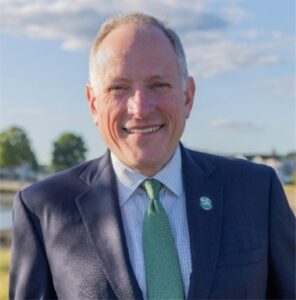
Darien First Selectman and DMA member Jon E. Zagrodzky will discuss what these shifts could mean for Darien’s culture, day-to-day life, and infrastructure needs, and how the town is working to manage growth proactively. A key part of that effort is the new Plan of Conservation and Development (POCD), which will set Darien’s long-term vision for the next decade. The draft POCD is expected to be finalized by April 30, followed by a public hearing in July and Planning & Zoning Commission action later that month.
Darien has more than 400 multi-family housing units newly completed, under construction or planned, representing several hundred million dollars in investment. At the same time, the town may be affected by a new state affordable housing law that became effective on January 1, 2026: House Bill 8002, An Act Concerning Housing Growth. Jon will address the potential impacts of this new law, along with Darien’s broader housing strategy.
There will be ample time for Q&A, and Jon is happy to discuss related topics such as Great Island or town debt — nothing is off limits!
Jon was elected First Selectman for the Town of Darien in November 2023 and re-elected in November 2025. His prior town positions include chairman of the Board of Finance, member of the Town and Police Pension Boards and member of the Public Works Garage and Ox Ridge School Building Committee Boards. He had also served as a member and president of the Darien Historical Society.
Until his December 2023 retirement, Jon served as chief operating officer and chief financial officer of Rhône Group L.L.C., a middle market private equity firm, where he was responsible for finance, operations, human resources, administration, information technology and business planning. Prior to Rhône, he was chief administrative officer and chief compliance officer at Oak Hill Capital Management and before that spent 16 years at McKinsey & Company.
Jon earned a B.A. in economics and romance languages from Washington and Lee University and an M.B.A. from The Wharton School of the University of Pennsylvania. He is a commercial pilot and owns a Piper Seneca III based in Bridgeport. Jon moved to Darien with his wife Sara and their two children, Maggie and Jack, in 2005.
 Dr. Eric Byrne was appointed the new superintendent of Darien’s schools in November 2025 and will discuss the changes in public school education today, with particular focus on Darien. Most senior citizens went to school in the 1950’s–1970s, a period of minimal technology, stricter discipline and more uniform curriculum. Today’s schools are far more tech-driven, individualized, regulated and influenced by AI. Key differences from 60 years ago include:
- Technology: Chalkboards morphed into smartboards; slide rules to Chromebooks; libraries to Google and AI; today’s inescapable social media.
- Curriculum: More emphasis today on STEM (science, technology, engineering and mathematics), coding, global history, environmental science and social-emotional learning.
- College expectations: A high school diploma once sufficed; today’s students face stronger pressure to attend elite colleges. Some colleges seek to “engineer” their peer rankings, and some observers question why a liberal arts education is needed at all because many jobs are changing from being knowledge-based to skill-based.
- Fiscal Challenges: There are numerous state-imposed mandates on schools today as well as transportation challenges and requirements for Special Education, that are now big budget drivers.
- Mental Health: Schools must now grapple with the challenges of student anxiety, depression, substance-abuse and other mental health concerns.
Many senior citizens feel that civic literacy and respect for institutions are declining. Schools now struggle to balance traditional civics with polarized political climates. There used to be a strong focus on U.S. history, the Constitution and traditional narratives of patriotism; but there are now more debate-based civics lessons, polarized social media forms, communications outlets and exploration of multiple perspectives on historical events.
Pertinent questions will be discussed, including which changes have strengthened education, which changes feel like losses and how Darien students experience school differently than seniors citizens did. Dr. Byrne will also discuss how should we teach young people about democracy today, and whether they know enough about American history and government.
Dr. Byrne previously served as superintendent of the Rye City Schools District from 2017 until starting in Darien. He holds an Ed.D. in educational leadership and administration from Fordham University. He is a product of New York City public schools, beginning his career in education in New York City before transitioning to Westchester County and Fairfield County. Prior to his superintendency, Dr. Byrne served as an assistant superintendent for curriculum and instruction, elementary school principal, assistant principal and high school science teacher. He believes that schools must work to develop critical thinkers, effective communicators, collaborators, creative problem solvers, and caring individuals
Summary of Presentation by Dr. Eric Byrne on Feb. 25, 2026
Dr. Eric Byrne, newly appointed Superintendent of Darien Public Schools, introduced himself by reflecting on how dramatically education has evolved since the 1950s, 60s, and 70s. Drawing on his own upbringing in New York City public schools and his career spanning being a teacher, a principal, and a superintendent, he framed modern education as a system navigating profound technological, societal and economic change.
Dr. Byrne described how schools once mirrored the industrial era — rows of desks, chalkboards, minimal technology and standardized expectations. Today’s classrooms are collaborative, flexible spaces equipped with laptops, interactive flat panels and AI-driven tools. Students now carry devices more powerful than any computer available a generation ago. Yet with these advancements come challenges: screen-time concerns, social media impacts and the need to regulate emerging technologies such as artificial intelligence.
He emphasized that academic pressure has intensified, particularly in affluent communities like Darien. College admissions have become increasingly competitive due to online applications, test-optional policies and national ranking systems. Students now apply to many more schools, competing for limited seats at elite institutions. This has heightened stress and anxiety, which in turn contributes to growing mental health concerns among adolescents.
Financial pressures on school systems have also grown. Rising healthcare costs, extensive state mandates, increasing special education expenses and mental health support strain local budgets, especially in towns that receive limited state funding. Meanwhile, schools must address evolving safety realities, including active shooter drills — an unimaginable circumstance during earlier generations’ education.
Throughout the discussion, Dr. Byrne underscored the enduring mission of public education: preparing students not only for careers and college but also for citizenship in a democratic society. He affirmed the continued importance of civics, humanities and leadership development alongside STEM and career pathways.
In closing, he acknowledged uncertainty about whether the traditional “American Dream” formula — education plus hard work equals stability — feels as attainable for today’s students. Schools, he suggested, must continue adapting to ensure opportunity, resilience and thoughtful citizenship in an increasingly complex world.
For the bowlers who braved the cold temperatures and snowy roads, today was a story of “the good, the bad, and the ugly”. That there were 14 of us is a testimony to what we’ve put together as a group.
Let’s start with the good. Once again, Frank D was on fire, rolling many strikes all day, having two games of 211, and ending with another 600 series that was even better than last week – 617 vs. 602. He is scheduled to return to Florida later in the week, though there is speculation he may cancel his flight reservation in order to bowl again next week  . What should worry us all is that the pattern of recent times is that whenever Frank takes a break from bowling, he comes back and bowls even better than when he left – so watch out. Tom had a rough start, struggling with the oily lane conditions. In game two, he began to find a better line, and by game three, he managed the day’s high game of 214 for a 552 series. John also got off to a rough start, including six splits in game one (see
 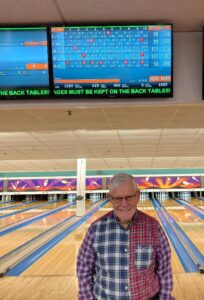 photo) but finished with two strong games and his season high series of 360 (+57). Also, Dave Smith had a nice series of +16.
. What should worry us all is that the pattern of recent times is that whenever Frank takes a break from bowling, he comes back and bowls even better than when he left – so watch out. Tom had a rough start, struggling with the oily lane conditions. In game two, he began to find a better line, and by game three, he managed the day’s high game of 214 for a 552 series. John also got off to a rough start, including six splits in game one (see photo) but finished with two strong games and his season high series of 360 (+57). Also, Dave Smith had a nice series of +16.Next, there was Alex. Two weeks ago, he had a five-year low series of 376. Last week wasn’t much better, leaving him despondent about the state of his game. But with his usual smile and “never say die” attitude, he reeled off three consistently good games for a 518 series, which was +77. That deserves a “Yeah, baby!” and BoD honors for sure. Let’s hope the turnaround continues.
For several others who shall remain nameless, there was some below average bowling that was “bad,” but for the four guys on lanes 11/12 (the “Graveyard”?), their bowling could only be called “uggggly”! Here were four guys who each were averaging 150+, and not a single one bowled a 400 series. The good news is that across the four bowlers and 12 games they each managed to break 100 in all three games (though not without some effort, as three of the 12 games were 101 ). Their bowling was so ugly that their first poker hand turned out to be a game of “four card stud” (see photo  )!
)! 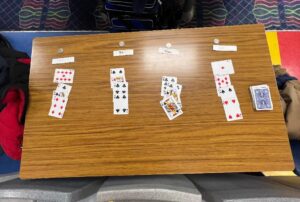
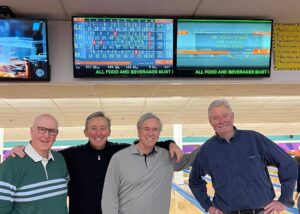
). Their bowling was so ugly that their first poker hand turned out to be a game of “four card stud” (see photo )! What was not ugly was the great photo of these four chaps smiling like they all just won the lottery…isn’t that what our group is all about.
What a milestone day it was today at Nutmeg! First of all, we set a record for attendance with 15 bowlers. WOW! Next, for the second week in a row we welcomed a new bowler to the group: Steve Gruppo. I’ve known Steve for years as a fellow member of The Country Club of Darien. He’s thrashed me on the paddle courts more than a few times and is an avid golfer, especially now that he’s retired. Now we hope he’ll become an avid bowler  . Third we had a lot of excellent bowling, including some individual milestones.
. Third we had a lot of excellent bowling, including some individual milestones.Our Bowler of the Day had both high game and high series, and he wasn’t even supposed to be with us. When I strolled into Nutmeg, who did I see but none other than Frank DeLeo. Frank told us he’d be in Florida until late February, but he was needed up north this week, and we were glad he could be a surprise show. As is always the case with Frank, a little absence seems to help his game, and so it was in spades today. His first game looked like it was headed for a 200+ until a slight hiccup made it “only” a 197. Game two saw him get even better, as he had a 234 even with an open frame! In game three, he continued to have a few strikes but did miss a few spares. That said, he came through with a clutch 10th frame spare and nine fill to get his first-ever DMA 600 series at 602. As if high game and high series weren’t enough, his +77 was best plus of the day. Way to go Frank!!
Another milestone today was John B’s personal best game of 140, helping him to a series that was +56. Ed Smith was “Mr. Consistency” with games of 183/182/179 for 544 (+49). Ben had his sixth 400 series in his last seven outings. His 441 was +33. Of note, Ben’s Last 21 average is up to 140! On November 1, his Last 21 was 123talk about HOT. George G started out strong with a 186 and finished at +6. Ted had two strong games in the 170s for a +23. Dave had a game three 122 and ended at +12. Bill’s 181 middle game helped overcome a slow start and get him to +3. We should report that again the “new kid”, this time Steve, improved game to game during his series, finishing with a game of 153 and a three-game average of 129 (+36). He even had a Ben Briggs Spare (BBS)! Steve’s ball speed of 15 mph and his smooth delivery have us all expecting a bright future as a DMA bowler. Finally, the Commish had two more 200 games (203/215) after the two he had last week. His 591 series was only 11 behind Frank’s.
Lots of split conversions to report today. Let’s start with The Professor, who converted three 3-10 splits in one game! John, Bill and Tom also made 3-10s. Frank and Tom each made a 5-7 within 60 seconds of one another. Also, Alex also had a BBS today .
.I don’t know about you readers, but I’m exhausted after writing this  . That said, let’s hope we have similar excitement next week.
. That said, let’s hope we have similar excitement next week.I also want to include a couple of health updates. One is that Linc joined us this morning for the first time since his hip surgery last fall. While he was shaking off the cobwebs of his bowling much of the session, Linc seemed none the worse for wear after three games and we are delighted to have him back! The other is to say that I spoke with Woody last evening. He reports that he is making progress in his recuperation from a bout of pneumonia at Christmastime. He sounded in great spirits (as he always does!) and looks forward to being back with us soon.
The highlight of any day of DMA bowling is when we have a new member join us for the first time. So it was today, as Ian Webb made his first appearance. Clearly, he is an athlete who just hasn’t bowled very much. It’s nice to report that Ian saved his best game for last, giving him encouragement to have another go next week.
Some other highlights for the11 of us included a 201 game by Bill in game three, enabling his team to take that game for a win each by the three teams. Tom had two 200 games of 200 and 202. He needed a double in the 10th frame of game one not only to get the 200, but also to help his team win that one by just eight pins. Marty continued his good bowling with a second straight 531 series, leading us to believe that this is now his “new normal!” In addition to Bill, Tom and Marty having “plus” series of +40, +26, and +57, Ben was at +13 and Ted was at +28. We also had two nice split conversions: a 4-5 by Ed Sm and a rarely seen and even more rarely made 6-7-9-10 by Tom.
The Social Events Committee has arranged a lunch and theater outing on Sunday, March 1 in New Canaan. Lunch will be at Lombardi’s (lombardisnc.com), in downtown New Canaan. Following lunch, a short drive to Waveny Park and the Town Players of New Canaan (tpnc.org) theater to watch One Man, Two Guvnors a hilarious farce by Richard Bean, set in swinging 1960s Brighton, England. The play was a major hit, originating at the National Theatre in 2011and transferring to the West End and Broadway, nominated for seven Tony Awards.
The plan is to be seated at Lombardi’s by 11;45. The play will begin at 2:00. The cost for lunch and theater is $100 per person. Guests are welcome. Sign up during the Wednesday general meetings or email Ted Helms (thelms125@gmail.com) or Chuck Andreae (candreae1@gmail.com).