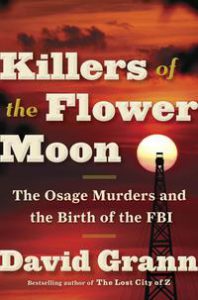
 From New Yorker staff writer David Grann, #1 New York Times best-selling author of The Lost City of Z, a twisting, haunting true-life murder mystery about one of the most monstrous crimes in American history In the 1920s, the richest people per capita in the world were members of the Osage Indian nation in Oklahoma. After oil was discovered beneath their land, they rode in chauffeured automobiles, built mansions, and sent their children to study in Europe. Then, one by one, the Osage began to be killed off. The family of an Osage woman, Mollie Burkhart, became a prime target. Her relatives were shot and poisoned. And it was just the beginning, as more and more members of the tribe began to die under mysterious circumstances. In this last remnant of the Wild West—where oilmen like J. P. Getty made their fortunes and where desperadoes like Al Spencer, the “Phantom Terror,” roamed—many of those who dared to investigate the killings were themselves murdered. As the death toll climbed to more than twenty-four, the FBI took up the case. It was one of the organization’s first major homicide investigations and the bureau badly bungled the case. In desperation, the young director, J. Edgar Hoover, turned to a former Texas Ranger named Tom White to unravel the mystery. White put together an undercover team, including one of the only American Indian agents in the bureau. The agents infiltrated the region, struggling to adopt the latest techniques of detection. Together with the Osage they began to expose one of the most chilling conspiracies in American history. In Killers of the Flower Moon, David Grann revisits a shocking series of crimes in which dozens of people were murdered in cold blood. Based on years of research and startling new evidence, the book is a masterpiece of narrative nonfiction, as each step in the investigation reveals a series of sinister secrets and reversals. But more than that, it is a searing indictment of the callousness and prejudice toward American Indians that allowed the murderers to operate with impunity for so long. Killers of the Flower Moon is utterly compelling, but also emotionally devastating.
Charlie Rose interviews the author:
https://charlierose.com/videos/30603
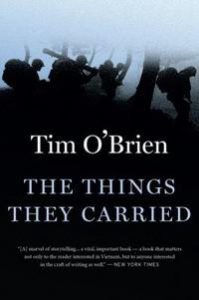 A classic work of American literature that has not stopped changing minds and lives since it burst onto the literary scene, The Things They Carriedis a ground-breaking meditation on war, memory, imagination, and the redemptive power of storytelling. The Things They Carrieddepicts the men of Alpha Company: Jimmy Cross, Henry Dobbins, Rat Kiley, Mitchell Sanders, Norman Bowker, Kiowa, and the character Tim O’Brien, who has survived his tour in Vietnam to become a father and writer at the age of forty-three. Taught everywhere from high school classrooms to graduate seminars in creative writing it has become required reading for any American and continues to challenge readers in their perceptions of fact and fiction, war and peace, courage and fear and longing. The Things They Carried won France’s prestigious Prix du Meilleur Livre Etranger and the Chicago Tribune Heartland Prize; it was also a finalist for the Pulitzer Prize and the National Book Critics Circle Award., A classic, life-changing meditation on war, memory, imagination, and the redemptive power of storytelling, with more than two-million copies in print Depicting the men of Alpha Company-Jimmy Cross, Henry Dobbins, Rat Kiley, Mitchell Sanders, Norman Bowker, Kiowa, and the character Tim O’Brien, who survived his tour in Vietnam to become a father and writer at the age of forty-three-the stories in The Things They Carried opened our eyes to the nature of war in a way we will never forget. It is taught everywhere, from high school classrooms to graduate seminars in creative writing, and in the decades since its publication it has never failed to challenge our perceptions of fact and fiction, war and peace, and courage, longing, and fear., Tim O’Brien’s modern classic that reset our understanding of fiction, nonfiction, and the way they can work together, as well as our understanding of the Vietnam war and its consequences.
 “Dispatches” by Michael Herr. According to John Wolcott, who served in Viet Nam, this accurately captures the life of a grunt. One of the greatest examples of war journalism ever written, Michael Herr’s clearheaded yet unsparing retellings of the day-to-day events in Vietnam take on the force of poetry, finding clarity in one of the most incomprehensible events in our modern era. A National Book Critics Circle finalist and highly acclaimed upon its publication, Dispatches still retains its resonance as America finds itself amidst another military quagmire.
 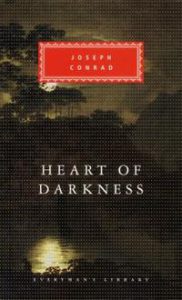 “Heart of Darkness” by Joseph Conrad. Charles Marlow is a steamboat captain on the River Thames near Gravesend England. He and his crew work for an ivory trading company. One day he recounts to his fellow crew the story of his life and how he became a captain for the steam boat company. The focus of his story involves the journey Marlow undertook to the outer reaches of the company’s operations. Here he tells of his wild encounters with Mr. Kurtz, a man with a great reputation for bringing in the most ivory for the company. Kurtz is widely respected by the natives, yet Marlow has some differing opinions as he struggles to understand Kurtz’s way of life, while uncovering secrets about the strange way Kurtz conducts his business.
 Award-winning screenwriter Malla Nunn delivers a stunning and darkly romantic crime novel set in 1950s apartheid South Africa, featuring Detective Emmanuel Cooper — a man caught up in a time and place where racial tensions and the raw hunger for power make life very dangerous indeed.
 When the Nazi Blitzkrieg subjugated Europe in World War II, London became the safe haven for the leaders of seven occupied countries–France, Belgium, Holland, Luxembourg, Norway, Czechoslovakia and Poland–who fled there to avoid imprisonment and set upgovernments in exile to commandeer their resistance efforts. The lone hold-out against Hitler’s offensive, Britain became a beacon of hope to the rest of Europe, as prominent European leaders like French general Charles De Gaulle, Queen Wilhelmina of Holland, and King Haakon of Norway competed for Winston Churchill’s attention while trying to rule their embattled countries from the precarious safety of ‘Last Hope Island'”
 How a Nobel Prize–winning theory of the mind altered our perception of reality. Forty years ago, Israeli psychologists Daniel Kahneman and Amos Tversky wrote a series of breathtakingly original studies undoing our assumptions about the decision-making process. Their papers showed the ways in which the human mind erred, systematically, when forced to make judgments in uncertain situations. Their work created the field of behavioral economics, revolutionized Big Data studies, advanced evidence-based medicine, led to a new approach to government regulation, and made much of Michael Lewis’s own work possible. Kahneman and Tversky are more responsible than anybody for the powerful trend to mistrust human intuition and defer to algorithms.
 The Library has 4 copies of a shorter book, Think Twice by Michael Mauboussin, that addresses the subject. He lives in the area and has spoken at the Library. He’s Managing Director, Global Strategies, Credit Suisse. Gary Banks
 From New York Times bestselling author of Destiny of the Republic and The River of Doubt, a thrilling narrative of Winston Churchill’s extraordinary and little-known exploits during the Boer War.
 s to war: Occupied Paris for the first time since Red Gold (1999 pub), Furst has set this novel during the war itself, instead of on the eve of the war. Members of the French Resistance network young and old, aristocrats and schoolteachers, defiant heroes and ordinary people all engaged in clandestine actions in the cause of freedom. From the secret hotels and Nazi-infested nightclubs of Paris to the villages of Rouen and Orleans. An action-packed story of romance, intrigue, spies, bravery, and air battles.
 WINNER OF THE 2016 PULITZER PRIZE FOR GENERAL NONFICTION
 Following his blockbuster biography of Steve Jobs, The Innovators is Walter Isaacson’s revealing story of the people who created the computer and the Internet. It is destined to be the standard history of the digital revolution and an indispensable guide to how innovation really happens. What were the talents that allowed certain inventors and entrepreneurs to turn their visionary ideas into disruptive realities? What led to their creative leaps? Why did some succeed and others fail? In his masterly saga, Isaacson begins with Ada Lovelace, Lord Byron’s daughter, who pioneered computer programming in the 1840s. He explores the fascinating personalities that created our current digital revolution, such as Vannevar Bush, Alan Turing, John von Neumann, J.C.R. Licklider, Doug Engelbart, Robert Noyce, Bill Gates, Steve Wozniak, Steve Jobs, Tim Berners-Lee, and Larry Page. This is the story of how their minds worked and what made them so inventive. It’s also a narrative of how their ability to collaborate and master the art of teamwork made them even more creative. For an era that seeks to foster innovation, creativity, and teamwork, The Innovators shows how.
 From a former marine and Yale Law School graduate, a powerful account of growing up in a poor Rust Belt town that offers a broader, probing look at the struggles of America’s white working class Hillbilly Elegy is a passionate and personal analysis of a culture in crisis—that of white working-class Americans. The decline of this group, a demographic of our country that has been slowly disintegrating over forty years, has been reported on with growing frequency and alarm, but has never before been written about as searingly from the inside. J. D. Vance tells the true story of what a social, regional, and class decline feels like when you were born with it hung around your neck. The Vance family story begins hopefully in postwar America. J. D.’s grandparents were “dirt poor and in love,” and moved north from Kentucky’s Appalachia region to Ohio in the hopes of escaping the dreadful poverty around them. They raised a middle-class family, and eventually their grandchild (the author) would graduate from Yale Law School, a conventional marker of their success in achieving generational upward mobility. But as the family saga of Hillbilly Elegy plays out, we learn that this is only the short, superficial version. Vance’s grandparents, aunt, uncle, sister, and, most of all, his mother, struggled profoundly with the demands of their new middle-class life, and were never able to fully escape the legacy of abuse, alcoholism, poverty, and trauma so characteristic of their part of America. Vance piercingly shows how he himself still carries around the demons of their chaotic family history. A deeply moving memoir with its share of humor and vividly colorful figures, Hillbilly Elegy is the story of how upward mobility really feels. And it is an urgent and troubling meditation on the loss of the American dream for a large segment of this country.
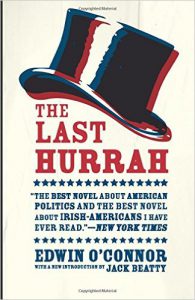 “We’re living in a sensitive age, Cuke, and I’m not altogether sure you’re fully attuned to it.” So says Irish-American politician Frank Skeffington—a cynical, corrupt 1950s mayor, and also an old-school gentleman who looks after the constituents of his New England city and enjoys their unwavering loyalty in return. But in our age of dynasties, mercurial social sensitivities, and politicians making love to the camera, Skeffington might as well be talking to us.
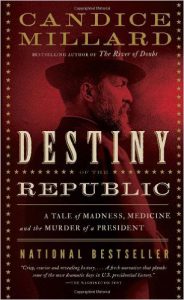 The extraordinary New York Times bestselling account of James Garfield’s rise from poverty to the American presidency, and the dramatic history of his assassination and legacy, from bestselling author of The River of Doubt, Candice Millard.