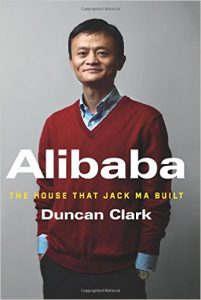
 An engrossing, insider’s account of how a teacher built one of the world’s most valuable companies—rivaling Walmart & Amazon—and forever reshaped the global economy.
In just a decade and half Jack Ma, a man from modest beginnings who started out as an English teacher, founded and built Alibaba into one of the world’s largest companies, an e-commerce empire on which hundreds of millions of Chinese consumers depend. Alibaba’s $25 billion IPO in 2014 was the largest global IPO ever. A Rockefeller of his age who is courted by CEOs and Presidents around the world, Jack is an icon for China’s booming private sector and the gatekeeper to hundreds of millions of middle class consumers.
Duncan Clark first met Jack in 1999 in the small apartment where Jack founded Alibaba. Granted unprecedented access to a wealth of new material including exclusive interviews, Clark draws on his own experience as an early advisor to Alibaba and two decades in China chronicling the Internet’s impact on the country to create an authoritative, compelling narrative account of Alibaba’s rise.
How did Jack overcome his humble origins and early failures to achieve massive success with Alibaba? How did he outsmart rival entrepreneurs from China and Silicon Valley? Can Alibaba maintain its 80% market share? As it forges ahead into finance and entertainment, are there limits to Alibaba’s ambitions? How does the Chinese government view its rise? Will Alibaba expand further overseas, including in the U.S.?
Clark tells Alibaba’s tale in the context of China’s momentous economic and social changes, illuminating an unlikely corporate titan as never before.
Category: Books (Page 10 of 11)
 The Girl on the Train is a mystery and suspense novel by Paula Hawkins. It follows the lives of three women – Rachel, Anna, and Megan – and the events surrounding Megan’s murder, ultimately bringing the lives of the three women together.
But what really makes The Girl on the Train such a gripping novel is Hawkins’ remarkable understanding of the limits of human knowledge, and the degree to which memory and imagination can become confused.
New York Times Best Seller list for 35 weeks and counting. “Nothing is more addicting than The Girl on the Train”.–Vanity Fair
 Our next book selection is Redeployment, by Phil Klay
Winner of the 2014 National Book Award for Fiction · Winner of the John Leonard First Book Prize · Selected as one of the best books of the year by The New York Times Book Review, Time, Newsweek, The Washington Post Book World, Amazon, and more
Phil Klay’s Redeployment takes readers to the frontlines of the wars in Iraq and Afghanistan, asking us to understand what happened there, and what happened to the soldiers who returned. Interwoven with themes of brutality and faith, guilt and fear, helplessness and survival, the characters in these stories struggle to make meaning out of chaos.
In “Redeployment”, a soldier who has had to shoot dogs because they were eating human corpses must learn what it is like to return to domestic life in suburbia, surrounded by people “who have no idea where Fallujah is, where three members of your platoon died.” In “After Action Report”, a Lance Corporal seeks expiation for a killing he didn’t commit, in order that his best friend will be unburdened. A Morturary Affairs Marine tells about his experiences collecting remains—of U.S. and Iraqi soldiers both. A chaplain sees his understanding of Christianity, and his ability to provide solace through religion, tested by the actions of a ferocious Colonel. And in the darkly comic “Money as a Weapons System”, a young Foreign Service Officer is given the absurd task of helping Iraqis improve their lives by teaching them to play baseball. These stories reveal the intricate combination of monotony, bureaucracy, comradeship and violence that make up a soldier’s daily life at war, and the isolation, remorse, and despair that can accompany a soldier’s homecoming.
Redeployment is poised to become a classic in the tradition of war writing. Across nations and continents, Klay sets in devastating relief the two worlds a soldier inhabits: one of extremes and one of loss. Written with a hard-eyed realism and stunning emotional depth, this work marks Phil Klay as one of the most talented new voices of his generation.
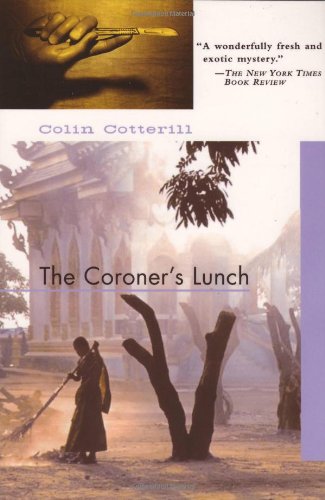 Laos is an impoverished, landlocked socialist republic in southeast Asia, bordering with the more dominant nations of China, Vietnam, Cambodia and Thailand. The Coroner’s Lunch is set in 1976, a year after the end of a long civil war that resulted in the Soviet-backed communist Pathet Lao coming to power.
The protagonist of this wonderful book is Siri Paiboun, a doctor and a widower who, rather than being able to enjoy a peaceful retirement at the age of 72, is made the country’s only coroner. One of the many delights of this book about ordinary people’s experiences of living under the communist regime are the small everyday acts of subversion and rebellion that avoid the notice of the unimaginative authorities but cause a liberating sense of personal triumph that sustains people through each day.
Siri has been a communist ever since his student days in France, but only because of the woman he loved and subsequently married. Although perceived by the authorities as a safe pair of hands, Siri in fact is a detached observer of the soulless regime.
One of the many pleasures of this delightful novel is the life Siri has made in his hospital lab with his two co-workers: Drui, a spinster who reads out-of-date fashion magazines and looks after her ill mother; and Mr Geung, a man considered “simple” (he has Down’s syndrome). The collaboration and relationship between these three in their working and, occasionally, personal lives is a subtle yet sharp portrait of how the human spirit can prevail against the most deadening official dictates and the most extreme poverty of resources.
Turning to the actual plot, Siri is faced with two baffling and dangerous cases. One concerns Mrs Nitnoy, the wife of a senior government official, who has died mysteriously while at a Women’s Union meeting. Another concerns the bodies of three men who have been discovered at the bottom of the sea, tied to rusty bombshells. Siri’s professional attitude leads him to dig into these obscure deaths against the desires of officialdom to the extent of endangering himself. He also feels driven to continue because of his spiritual visitors and the final rest that will be brought to them by the knowledge of how they met their ends.
 NATIONAL BOOK AWARD FINALIST. From the highly acclaimed, multiple award-winning Anthony Doerr, the beautiful, stunningly ambitious work about a blind French girl and a German boy whose paths collide in occupied France as both try to survive the devastation of World War II. ( 25 weeks on the New York Times bestseller list)
Discussion Leader: John Podkowsky. A list of discussion questions was previously circulated.
DMA May selection: AGENT STORM by Morten Storm, Paul Cruickshank, and Tim Lister
Agent Storm is the remarkable memoir of a Danish convert-turned-extremist who managed not only to infiltrate al Qaeda’s ranks but would later become one of West’s most valued human intelligence assets in the war on terrorism. As a true spy-story, this book brings you incredibly close to what it actually takes to be an extremist and get into a terrorist group while balancing loyalty and treachery in the world of intelligence. Essential reading for everyone interested in how the war on terrorism is actually fought in the shadows.”
“Agent Storm opens a unique window onto bleak interlocking landscapes—the radicalization of European Muslims that has now been energized by the Syrian civil war, the leadership and organization of global jihad, and the twilight struggle waged by western intelligence agencies against an elusive and implacable enemy.”
Discussion Leader: John Podkowsky
Book available at the Darien Library the second week of April; Discussion date: May 13.
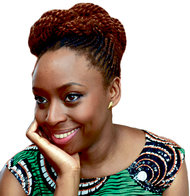 What’s the difference between an African-American and an American-African? From such a distinction springs a deep-seated discussion of race in Chimamanda Ngozi Adichie’s third novel, “Americanah.” Adichie, born in Nigeria but now living both in her homeland and in the United States, is an extraordinarily self-aware thinker and writer, possessing the ability to lambaste society without sneering or patronizing or polemicizing. For her, it seems no great feat to balance high-literary intentions with broad social critique. “Americanah” examines blackness in America, Nigeria and Britain, but it’s also a steady-handed dissection of the universal human experience — a platitude made fresh by the accuracy of Adichie’s observations.
So an African-American is a black person with long generational lines in the United States, most likely with slave ancestors. She might write poetry about “Mother Africa,” but she’s pleased to be from a country that gives international aid rather than from one that receives it. An American-African is an African newly emigrated to the United States. In her native country, she didn’t realize she was black — she fit that description only after she landed in America. In college, the African-American joins the Black Student Union, while the American-African signs up with the African Students Association.
Adichie understands that such fine-grained differentiations don’t penetrate the minds of many Americans. This is why a lot of people here, when thinking of race and class, instinctively speak of “blacks and poor whites,” not “poor blacks and poor whites.” Many of Adichie’s best observations regard nuances of language. When people are reluctant to say “racist,” they say “racially charged.” The phrase “beautiful woman,” when enunciated in certain tones by certain haughty white women, undoubtedly means “ordinary-looking black woman.” Adichie’s characters aren’t, in fact, black. They’re “sable” or “gingerbread” or “caramel.” Sometimes their skin is so dark it has “an undertone of blueberries.”
Plot
As teenagers in a Lagos secondary school, Ifemelu and Obinze fell in love. Their Nigeria is under military dictatorship, and people are leaving the country if they can. Ifemelu departs for the United States to study. Through her experiences in relationships and studies, she struggles with the experience of racism in American culture, and the many varieties of racial distinctions. Obinze, son of a professor, had hoped to join her in the US but he is refused a visa after 9/11. He goes to London, entering illegally, and enters an undocumented life.
Years later, Obinze has returned to Nigeria and become a wealthy man as a property developer in the newly democratic country. Ifemelu gained success staying in the United States, where she became known for her blog about race in America, entitled “Raceteenth or Various Observations About American Blacks (Those Formerly Known as Negroes) by a Non-American Black”. When Ifemelu returns to Nigeria, the two have to make tough decisions after reviving their relationship.
Reception
The book was well-received by critics, who especially noted its range across different societies and reflection of global tensions. The New York Times said, “‘Americanah’ examines blackness in America, Nigeria and Britain, but it’s also a steady-handed dissection of the universal human experience — a platitude made fresh by the accuracy of Adichie’s observations.”] The reviewer concludes, “Americanah” is witheringly trenchant and hugely empathetic, both worldly and geographically precise, a novel that holds the discomfiting realities of our times fearlessly before us. It never feels false.”
Awards:
- Selected as one of the 10 Best Books of 2013 by the editors of the New York Times Book Review.
- 2013 National Book Critics Circle Award(Fiction).
- Shortlisted for the 2014 Baileys Women’s Prize for Fiction of the United Kingdom.
Book Group discussion meeting February 11th, 12:30 p.m. at the Darien Library Discussion Leader: Sunil Saksena
Book Club: A Spy Among Friends: Kim Philby and the Great Betrayal by Ben MacIntyre, January 14, 2015
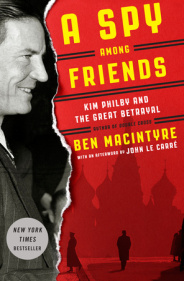 Master storyteller Ben Macintyre’s most ambitious work to date brings to life the twentieth century’s greatest spy story.
Harold ‘Kim’ Philby was the greatest spy in history, a brilliant and charming man who rose to head Britain ’s counterintelligence against the Soviet Union during the height of the Cold War—while he was secretly working for the enemy. And nobody thought he knew Philby like Nicholas Elliott, Philby’s best friend and fellow officer in MI6. The two men had gone to the same schools, belonged to the same exclusive clubs, grown close through the crucible of wartime intelligence work and long nights of drink and revelry. It was madness for one to think the other might be a communist spy, bent on subverting Western values and the power of the free world.
But Philby was secretly betraying his friend. Every word Elliott breathed to Philby was transmitted back to Moscow —and not just Elliott’s words, for in America , Philby had made another powerful friend: James Jesus Angleton, the crafty, paranoid head of CIA counterintelligence. Angleton’s and Elliott’s unwitting disclosures helped Philby sink almost every important Anglo-American spy operation for twenty years, leading countless operatives to their doom. Even as the web of suspicion closed around him, and Philby was driven to greater lies to protect his cover, his two friends never abandoned him—until it was too late. The stunning truth of his betrayal would have devastating consequences on the two men who thought they knew him best, and on the intelligence services he left crippled in his wake.
Told with heart-pounding suspense and keen psychological insight, and based on personal papers and never-before-seen British intelligence files, “A Spy Among Friends” is Ben Macintyre’s best book yet, a high-water mark in Cold War history telling.
The Book Discussion will be held on January 14 at 12:30 p.m. in the Darien Library on the 2nd Floor in the Harris Room.
Copies are available at the Darien Library.
Tom Reifenheiser will lead this book club discussion of “Strange Rebels: 1979 and the Birth of the 21st Century” by Christian Carrel
Review by Isaac Chotiner a senior editor at The New Republic:
If Christian Caryl had set out to write a book about 1968, showing how the many convulsions and uprisings of that astonishing year were connected, his task would have been an easy one. It might be difficult to prove cause and effect between, say, the May events in Paris and the chaos at the Democratic convention in August, but as people might have said at the time, something was in the air. It wasn’t mere coincidence that led to youth revolts all over the world. In the case of 1989, such connections are even more obvious.
Caryl, a contributing editor at Foreign Policy magazine and a former Newsweek correspondent, is faced with a much harder task in “Strange Rebels,” his engrossing new book of five case studies from 1979. This was the year Deng Xiaoping initiated the reforms that would spur the Chinese economy; the year an anxious Soviet Union invaded Afghanistan after its Communist allies faced resistance from local “freedom fighters”; the year Pope John Paul II made his momentous trip to Poland; the year Margaret Thatcher overturned an etiolated Labour government; and the year Iranian revolutionaries overthrew the shah, Our Man in Tehran.
As Caryl writes, in an effort to link stories that don’t, at first glance, hold together: “It was in 1979 that the twin forces of markets and religion, discounted for so long, came back with a vengeance.” Indeed, the power of both markets and religion registered in places beyond those covered in his main narrative. On the religious front, Gen. Muhammad Zia ul-Haq, the Pakistani military dictator who did so much to aid Afghanistan’s rebels, ordered his predecessor to be hanged and sped forward the Islamicization of his country. And as Caryl briefly mentions, the Moral Majority was formed in 1979. The following year saw the election of Thatcher’s ally Ronald Reagan and — compared with what preceded them — the relatively free-market policies in Indira Gandhi’s India.
The problem for Caryl is that concepts like “religion” and “markets” are much too broad. John Paul II may have helped undermine the Communist regime in Poland, and the young religious Muslims of Afghanistan may have forced complacent observers to realize that faith wasn’t going to disappear from the world. (The upheaval in Iran, where a theocracy replaced an autocrat, makes this point even more forcefully.) But it’s difficult to draw comparisons between the forces motivating the Polish pope’s admiring countrymen and Iran’s student revolutionaries.
As for markets, it’s true that Thatcher preached their virtues, and that Deng took advantage of China’s awesome economic capacities. “The forces unleashed in 1979 marked the beginning of the end of the great socialist utopias that had dominated so much of the 20th century,” Caryl writes. But what does he mean by “socialist utopias”? Presumably he’s being ironic, but either way, it makes little sense to compare postwar Labour governments (which were certainly subject to diminishing returns but which also gave birth to a highly successful welfare state) to the pathological murderousness of Mao’s China. Caryl notes that Thatcher’s “belief in individual responsibility and the primacy of personal freedom had its roots in a spiritual stance rather than an economic theory” — an attempt to link the free-market “fundamentalism” of the prime minster with the religiosity on display in some of the book’s other sections. But the men Caryl terms the “religious thinkers” of the Iranian Revolution would hardly be conceptual allies of Margaret Thatcher.
“Strange Rebels” is a well-written and thorough work of history whose elements don’t really cohere. About one thing, however, Caryl is certainly right: “The political experiments of 1979 continue to define our world.” It has become something of a cliché to remark on the consequences of these various events, especially — post‑9/11 — the decision of the Soviet Union to invade the future haven of Osama bin Laden. But sometimes clichés exist for an appropriate reason. Noting that things didn’t have to play out the way they did and recognizing that contingencies are a large part of history, Caryl concedes that “to study 1979 is also to study the tyranny of chance.” The clearest conclusion of this book is that 1979 happened, by chance, to be a monumental year.
 Marc Thorne will lead our DMA book discussion for November of the chosen selection: “Look Me In the Eye” My Life with Asperger’s by John Elder Robison.
The meeting will be held on at the Darien Library in the Harris Room on the 2nd floor beginning at 12:30 p.m.
“Look Me in the Eye” is the moving, darkly funny story of growing up with Asperger’s at a time when the diagnosis simply didn’t exist. A born storyteller, Robison takes you inside the head of a boy whom teachers and other adults regarded as “defective.”
Media Reviews:
Robison succeeds in his goal of helping those who are struggling to grow up or live with Asperger’s to see how it is not a disease but a way of being that needs no cure except understanding and encouragement from others.” – PW.
“John Robison’s book is an immensely affecting account of a life lived according to his gifts rather than his limitations. His story provides ample evidence for my belief that individuals on the autistic spectrum are just as capable of rich and productive lives as anyone else.” – Daniel Tammet, author of Born on a Blue Day: Inside the Extraordinary Mind of an Autistic Savant.
Copies of the book are available in the Book Club section behind the front desk.
 Kent Haydock will lead our DMA book discussion for September. The chosen selection is A Higher Call by Adam Makos.
On December 20, 1943, two enemy pilots met in the skies over Germany—an American, Charlie Brown—and a German, Franz Stigler. What transpired would be called: “WWII’s most incredible aerial encounter.” Now, for the first time, A Higher Call tells the complete story of Charlie and Franz’s WWII experiences, their gritty tales of aerial combat over the African desert, the seas of Sicily, the fog of England, and the ultimate battleground—the frozen skies of Germany. The library will have copies of the book available on or about August 1st.
The meeting will be held on at the Darien Library in the Harris Room on the 2nd floor beginning at 12:30 p.m.
 [From Amazon.com]
Her name was Henrietta Lacks, but scientists know her as HeLa. She was a poor Southern tobacco farmer who worked the same land as her slave ancestors, yet her cells—taken without her knowledge—became one of the most important tools in medicine. The first “immortal” human cells grown in culture, they are still alive today, though she has been dead for more than sixty years. If you could pile all HeLa cells ever grown onto a scale, they’d weigh more than 50 million metric tons—as much as a hundred Empire State Buildings. HeLa cells were vital for developing the polio vaccine; uncovered secrets of cancer, viruses, and the atom bomb’s effects; helped lead to important advances like in vitro fertilization, cloning, and gene mapping; and have been bought and sold by the billions.
Yet Henrietta Lacks remains virtually unknown, buried in an unmarked grave.
Now Rebecca Skloot takes us on an extraordinary journey, from the “colored” ward of Johns Hopkins Hospital in the 1950s to stark white laboratories with freezers full of HeLa cells; from Henrietta’s small, dying hometown of Clover, Virginia—a land of wooden slave quarters, faith healings, and voodoo—to East Baltimore today, where her children and grandchildren live and struggle with the legacy of her cells.
Henrietta’s family did not learn of her “immortality” until more than twenty years after her death, when scientists investigating HeLa began using her husband and children in research without informed consent. And though the cells had launched a multimillion-dollar industry that sells human biological materials, her family never saw any of the profits. As Rebecca Skloot so brilliantly shows, the story of the Lacks family—past and present—is inextricably connected to the dark history of experimentation on African Americans, the birth of bioethics, and the legal battles over whether we control the stuff we are made of.
Over the decade it took to uncover this story, Rebecca became enmeshed in the lives of the Lacks family—especially Henrietta’s daughter Deborah, who was devastated to learn about her mother’s cells. She was consumed with questions: Had scientists cloned her mother? Did it hurt her when researchers infected her cells with viruses and shot them into space? What happened to her sister, Elsie, who died in a mental institution at the age of fifteen? And if her mother was so important to medicine, why couldn’t her children afford health insurance?
Intimate in feeling, astonishing in scope, and impossible to put down, The Immortal Life of Henrietta Lacks captures the beauty and drama of scientific discovery, as well as its human consequences.
 [From Amazon.com]
The acclaimed author of The Sweet Hereafter and Rule of the Bone returns with Lost Memory of Skin, a provocative new novel that illuminates the shadowed edges of contemporary American culture with startling and unforgettable results
Suspended in a strangely modern-day version of limbo, the young man at the center of Russell Banks’s uncompromising and morally complex new novel must create a life for himself in the wake of incarceration. Known in his new identity only as the Kid, and on probation after doing time for a liaison with an underage girl, he is shackled to a GPS monitoring device and forbidden to live within 2,500 feet of anywhere children might gather. With nowhere else to go, the Kid takes up residence under a south Florida causeway, in a makeshift encampment with other convicted sex offenders.
Barely beyond childhood himself, the Kid, despite his crime, is in many ways an innocent, trapped by impulses and foolish choices he himself struggles to comprehend. Enter the Professor, a man who has built his own life on secrets and lies. A university sociologist of enormous size and intellect, he finds in the Kid the perfect subject for his research on homelessness and recidivism among convicted sex offenders. The two men forge a tentative partnership, the Kid remaining wary of the Professor’s motives even as he accepts the counsel and financial assistance of the older man.
When the camp beneath the causeway is raided by the police, and later, when a hurricane all but destroys the settlement, the Professor tries to help the Kid in practical matters while trying to teach his young charge new ways of looking at, and understanding, what he has done. But when the Professor’s past resurfaces and threatens to destroy his carefully constructed world, the balance in the two men’s relationship shifts.
Suddenly, the Kid must reconsider everything he has come to believe, and choose what course of action to take when faced with a new kind of moral decision.
Long one of our most acute and insightful novelists, Russell Banks often examines the indistinct boundaries between our intentions and actions. A mature and masterful work of contemporary fiction from one of our most accomplished storytellers, Lost Memory of Skin unfolds in language both powerful and beautifully lyrical, show-casing Banks at his most compelling, his reckless sense of humor and intense empathy at full bore.
The perfect convergence of writer and subject, Lost Memory of Skin probes the zeitgeist of a troubled society where zero tolerance has erased any hope of subtlety and compassion—a society where isolating the offender has perhaps created a new kind of victim.