Category: Activities (Page 23 of 34)

Activities are gatherings that occur on a regular schedule, usually weekly, to enjoy a specific pastime.

Current Affairs. DNA Privacy. March 21, 2019

Discussion leader: Gary Banks

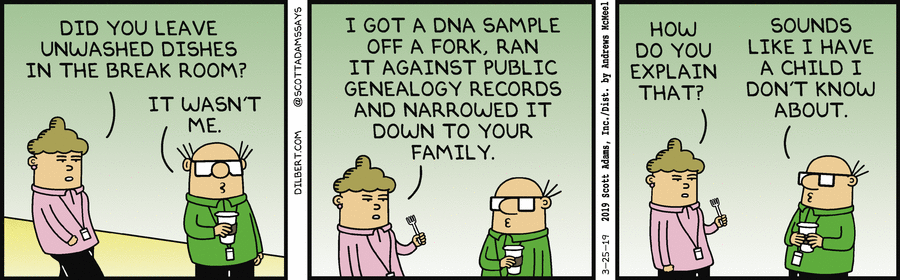
DNA Privacy.  It is now inexpensive to at least partially sequence a person’s genome.  Companies like Ancestry.com, GEDMatch and 23andMe.com have done it for over 20 million people.  There are other databases where people have uploaded their DNA profile insearch of relatives.  There are also growing databases, some public, with individual’s DNA gathered from medical testing or crime events.  Recently, a cold case of rape/murder was solved by taking DNA from the crime scene and quickly identifying the killer’s cousin that then lead to an arrest.  That’s good to solve a horrible crime but there are also risks and concerns.

Certainties:

  1. Almost all of us have, will shortly have, our DNA profile, or that of a close relative, in an on-line database.  It could be from genealogy hobbyists, voluntary samples, medical tests or police actions.  There will be incentives and pressure to be profiled, e.g., Stamford Health will need your DNA profile as part of their standard healthcare program – you may have already consented.  Babies are being tested at  birth.   All those routine blood tests could be stored for medical research.  
  2. The massive DNA databases, along with personal medical history will lead to healthcare breakthroughs for both us personally and the public health overall.    Personalized medicine – both treatments and prevention is the future.
  3. The DNA databases can be searched with a court order, but many are open and companies will be building their own databases.  It easy to picture an offer for a “free” DNA test (like free email or facebook) if you send them a sample.  Police can simply upload a DNA profile and search for relatives.
  4. The predictive value of your DNA profile will improve – or at least people and organizations will believe it is predictive.  Those predictions could involve health,  behavior, intelligence, …
  5. Companies and organizations will figure out a way to monetise and benefit from that data.  

I have a bad feeling this is already out of control:

  1. Companies such as insurance, pharmaceutical, your employer,  police, or schools will exploit your DNA profile.  Given the experience with google and facebook, any sort of opt-in or consent laws will be ineffective.   Think of spam from a pharmaceutical company “Your DNA profile indicates you are at risk of macular degeneration – take our stuff now and save your eyes. ”  Or “Your child’s DNA profile indicates they will not succeed in our most demanding academic program.”  “Your DNA profile indicates you should not own a gun, have a pilot’s license, or be trusted with children.”  Companies would claim they are providing a public service – and say talk to your doctor.  Modern day eugenics.
  2. How about discoveries made from your DNA?  Think of Henrietta Lacks – 17,000 patents derived from her cells without compensation.  A few people survive deadly things – ebola, HIV, cancer, …  Do you deserve compensation if you have some unique and valuable genetic trait that a pharmaceutical company uses?  Legal precedent is you don’t have rights over your bio samples.
  3. Can a dating company require genetic testing to claim they only match people who have compatible genetics?  Should you avoid marrying a person who carries the same deadly recessive gene as you?   
  4. Most of us would not volunteer our fingerprints or consent to have our phone tapped.   Yet we don’t even have to directly have our DNA sequenced to be visible to the government.  It is legal to collect a coffee cup or cigarette butt to get a DNA sample.  Police departments are using desktop machines, under less than rigorous laboratory protocols by people with limited training.   Seems like fishing is inevitable – e.g. browse for local people who “lack empathy”.  Risk of false charges or being brought in for questioning.
  5. Are we capable of responsibly interpreting the data?  The public is not allowed to write their own prescriptions.  Could people have their lives ruined – be filled with anxiety, get dangerous or useless medical treatments, fall prey to quacks, even be driven to suicide by not having a medical professional interpret the data?  Google “headache” to get a scare.   
  6. Already the DNA testing companies warn people they may be upset by what they find.  Your parents and siblings are not biologically who you thought they were.  Sperm donors being identified.  A sibling you didn’t know you had.  There are happy endings for sure – but not always.
  7. Lack of checks and balances.  Without them there will be abuse.    


From The Conversation:

Your genome may have already been hacked. https://theconversation.com/your-genome-may-have-already-been-hacked-95763 

DNA apps promise deeper insights for consumers – but at what cost? https://theconversation.com/dna-apps-promise-deeper-insights-for-consumers-but-at-what-cost-96257

Americans want a say in what happens to their donated blood and tissue in biobanks  Americans want a say in what happens to their donated blood and tissue in biobanks


5 biggest risks of sharing your DNA with consumer genetic-testing companies https://www.cnbc.com/2018/06/16/5-biggest-risks-of-sharing-dna-with-consumer-genetic-testing-companies.html

https://www.nytimes.com/2019/02/21/business/china-xinjiang-uighur-dna-thermo-fisher.html?emc=edit_na_20190221&nl=breaking-news&nlid=57463667ing-news&ref=headline

Genealogists Turn to Cousins’ DNA and Family Trees to Crack Five More Cold Cases https://www.nytimes.com/2018/06/27/science/dna-family-trees-cold-cases.html

https://www.nytimes.com/2019/02/16/health/sperm-donation-dna-testing.html

How your third cousin’s ancestry DNA test could jeopardize your privacy. Public DNA databases can be used to find you — even if you never shared your own DNA. https://www.vox.com/science-and-health/2018/10/12/17957268/science-ancestry-dna-privacy

We will find you: DNA search used to nab Golden State Killer can home in on about 60% of white Americans https://www.sciencemag.org/news/2018/10/we-will-find-you-dna-search-used-nab-golden-state-killer-can-home-about-60-white

How an Unlikely Family History Website Transformed Cold Case Investigations. Fifteen murder and sexual assault cases have been solved since April with a single genealogy website. This is how GEDmatch went from a casual side project to a revolutionary tool. https://www.nytimes.com/2018/10/15/science/gedmatch-genealogy-cold-cases.html

When a DNA Test Reveals Your Daughter Is Not Your Biological Child https://www.theatlantic.com/science/archive/2018/10/dna-test-divorce/571684/

23 and me Privacy Policy. https://www.23andme.com/about/privacy/

Ancestry.com Privacy Statement https://www.ancestry.com/cs/legal/privacystatement

The FBI’s CODIS database: https://www.fbi.gov/services/laboratory/biometric-analysis/codis

Also on CODIS:

An overview of human genetic privacy from the NIH: https://www.ncbi.nlm.nih.gov/pmc/articles/PMC5697154/

https://www.nytimes.com/2019/01/21/science/dna-crime-gene-technology.html

Testing DNA: In her new book, Erin Murphy investigates how the criminal justice system misuses genetic identification

http://www.law.nyu.edu/news/ideas/erin-murphy-forensic-dna

Familial DNA Searches and the Law

https://criminal.findlaw.com/criminal-rights/familial-dna-searches.html

ACLU: The Police Want Your DNA to Prove You’re Innocent. Do You Give it to Them?

https://www.aclu.org/blog/privacy-technology/medical-and-genetic-privacy/police-want-your-dna-prove-youre-innocent-do-you

https://www.nytimes.com/2019/02/04/business/family-tree-dna-fbi.html

https://www.nytimes.com/2019/02/17/us/jerry-westrom-isanti-mn.html

Privacy, Security, and the Legacy of 9/11  – Daniel Klau, UConn Law

https://today.uconn.edu/2015/09/privacy-security-and-the-legacy-of-911/

Electronic Frontier Foundation on Medical Privacy

https://www.eff.org/issues/medical-privacy

Dear Mr. Banks,

Thank you for your inquiry.  Generally, and depending on the test ordered by your physician, blood samples are retained anywhere from 3 days to 2 weeks after the testing is performed, after which they are appropriately discarded.  

Regards,

Todd M. Lieval

Privacy Analyst
 

Current Affairs. Brexit. February 21, 2019

Discussion leader: Bryan Hooper

Opening Notes:

BREXIT: Why should we care?


At a seminar I attended in the UK many years ago each participant was asked to consider the future of their industry or professional group.  When it was his turn to make his forecast, a lawyer stood up and declared that “the legal profession has no future, but it has a long and glorious past stretching in front of it.”  Some might say the same about the United Kingdom of Great Britain and Northern Ireland as it wrestles with the problems created by the vote in June, 2016, to exit the European Union. 


To help answer the question in the title above it might be helpful to have an understanding of some of the history of the UK, the development of the EU, and how the UK came to be in its current situation – if the situation ever becomes clear, that is.


  1. The United Kingdom (UK)


Great Britain was created by the English annexing Wales in 1535 and 1542 and forming a union with Scotland in 1707.  The kingdom of Ireland was added in 1801, and Northern Ireland was formed in 1922 when what became Eire seceded from the kingdom and established an independent country.  The combination of Great Britain and Northern Ireland is the United Kingdom.  All four countries elect members to the UK parliament that sits in Westminster, London, and, in addition, Wales, Scotland and Northern Ireland each has a separate devolved parliament.  The total population of the UK is 66 million, with England at 55.6, Scotland 5.4, Wales 3.1 and Northern Ireland 1.9 million.  Gross domestic product of the UK is the fifth largest in the world at an estimated $2.8 trillion in 2018 out of a world total of $84.8 trillion.  To put this in perspective, the US GDP was $20.5, China $13.5, Japan $5.1 and Germany $4.0 trillion.


  1. The European Union (EU)


It is ironic in today’s discombobulated Brexit climate that in 1946 Winston Churchill, a Conservative statesman, was one of the early advocates of a United States of Europe.  The EU traces its origin to the formation of the European Coal and Steel Community created during the recovery from World War II by the Treaty of Paris in 1951.  The subsequent Treaty of Rome in 1957 led to the establishment of the European Economic Community comprising six countries: West Germany, France, Italy and the Benelux nations.  The UK eventually joined the EEC in 1973 having been rebuffed initially by the French in 1963. 

In 1975 the UK held its first ever nationwide referendum, and it concerned staying in the EEC.  The government recommended the UK should remain in the group, and the electorate voted 67% in favor on a 64% turnout.  In 1993 the Maastricht Treaty came into effect for the 12 countries of the EEC.  That treaty established the EU together with European citizenship, it ensured the free movement of people, goods, services and capital within the market, and enabled the enaction of legislation covering justice, home affairs and trade policies.  It also laid the foundation for the common currency, the euro: the EU now has 28 member countries and 19 of them use the euro.  The population of the EU is 513 million and GDP in 2018 was estimated at $18.8 trillion, approximately 22% of the world’s GDP, compared with the US share of 24%.


  1. The Brexit Referendum


(a) The political timeline

David Cameron, leader of the Conservative Party, won an unexpected victory over the Labour Party in the UK general election in 2010.  The Conservatives did not, however, gain sufficient votes to form a clear majority and they allied with the Liberal Democratic Party to form a coalition government with Cameron as Prime Minister.

-2-


Animosity in the UK toward the EU had gradually increased since the terms of the Maastricht Treaty were enforced in 1993, and the Treaty of Lisbon exacerbated the situation when it was implemented in December, 2009.  This gave increasing power to the EU parliament and also fueled the anti-immigrant feelings in the UK which had been developing and strengthening as the EU expanded its number of member countries and assigned more power to the European Parliament in Brussels.  During and after the world financial crisis in 2008 the resentment intensified with many in the UK objecting to immigrants taking away jobs from the UK population and some allegedly living off the UK by taking advantage of social welfare handouts.  Further dislike of the EU was fostered by the crisis in the Eurozone creating economic uncertainty, and the rise of terrorism that was also blamed on immigrant factions.  Pressure built up to fix the UK economy and react to the growing power arrogated by the EU.  

Cameron called a general election in 2015 during which he promised another referendum on staying in the EU.  The conservatives won enough seats this time to form a majority government (over 326) without the assistance of another party.  In the table below are shown the seats won in 2015 compared with 2010 and also the percentage of the vote won by the main parties:


Party

Members of

Parliament

Share of MPs

(%)

Share of Votes

(%)


2010                        2015

 2010                           2015

 2010                             2015

Conservative

 306                          330

  47.1                            50.8

  36.1                              36.8

Labour

 258                          232

  39.7                            35.7

  29.0                              30.4

Scottish National

     6                            56

    0.9                              8.6

    1.7                                4.7

Liberal Democrats

   57                              8

    8.8                              1.2

  23.0                                7.9

Democratic Unionist

     8                              8

    1.2                              1.2

    0.6                                0.6

UK Independence

     0                              1

    0.0                              0.2

    3.1                              12.6

Speaker

     1                              1

    0.2                              0.2

    0.2                                0.2

Other

   14                           14

    2.1                              2.1

    6.3                                6.8

Total

 650                         650

100.0                         100.0

100.0                           100.0


Note in 2015 the growth of the Scottish National Party (SNP), the decline of the Liberal Democrats, and the share of the vote won by the UK Independence Party (UKIP): 

  • The electorate in Scotland had rejected separating from the UK in a referendum held in September, 2014, voting 55% to stay, with a very high turnout of 85%. However, the whole process of the independence plebiscite stirred nationalist sentiment and that carried over to the UK general election in 2015 as the SNP won 56 of the 59 available seats in Scotland.
  • The Liberal Democrats paid the price for being in coalition with the Conservative Party in the last government, losing 49 of the 57 seats they held previously.
  • The Democrat Unionist Party (DUP) retained 8 of the 18 seats available in Northern Ireland.
  • Labour won 25 of 40 seats in Wales.
  • The Conservative Party took 316 of 533 seats in England.
  • In 2014 UKIP candidates took 27% of the vote in the UK for the European Parliament, ending up with 24 out of the 73 seats assigned to the UK, and greater than the seats won by either of the two major UK parties. In the 2015 UK general election UKIP picked up only one seat, but their 13% share of the total vote was a signal of what was to come in 2016.


-3-


(b) The fateful vote

Prime Minister David Cameron and his government passed the Enabling Act in February, 2016, authorizing the referendum to be held for remaining or leaving the EU, and announced the date of June 23, 2016, for it to occur. 

The government threw its support behind the Remain camp, but Cameron allowed Conservative Party members of parliament (MPs) and members of his Cabinet to make their own decisions on which side to support.  Seven cabinet members joined the Leave faction.  Boris Johnson, former Mayor of London and an MP, plus Michael Gove, Secretary of State for Justice, together with UKIP leader, Nigel Farage, spearheaded the Leave side.  Arguments for Remain were that the UK would risk prosperity, jeopardize national security, lose jobs, delay investment in the UK, and lose influence in world affairs if they left.  The Leave group argued that the EU had a deficit of democracy, it undermined national sovereignty and prevented the UK from making better trade deals.  Leaving would give control of immigration back to the UK and save billions of pounds in membership fees.  The Leave group appeared to take better advantage of social media than the Remain team, spreading the memes that emphasized the potential danger of immigration from Turkey if it became a member, and also trumpeting that leaving the EU would free up £350 million a week ($24 billion annually) to be spent on the UK National Health Service.  Neither of these messages were countered effectively by the Remain side.

The results of the referendum surprised everyone – to say the least.  The overall vote in the UK to leave the EU was 52% versus 48% to remain, and the turnout was 72% of the electorate (compared with a 64% turnout in 1975 when 67% to remain in the EEC).  On a country basis, England voted to leave by 53.4%, and Wales at 52.5% also voted to leave.  In England only Greater London voted to remain, while all other regions opted to leave.  Scotland at 62.0% and Northern Ireland at 55.8% voted to remain in the EU.

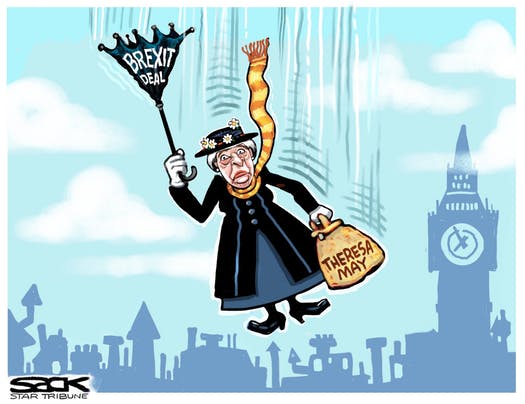
Prime Minister Cameron announced his resignation the next day and Theresa May, the Home Secretary, took over on July 13, 2016.  May was one of the ministers who had supported the Remain campaign.  On March 29, 2017, the UK government invoked Article 50 of the Treaty on European Union to leave the EU by March 29, 2019, and so began the process of planning and negotiating terms of the withdrawal.


(c) The 2017 election

On April 18, 2017, Theresa May called for a general election in order to strengthen her hand in negotiations with the EU, and set the date for June 8th.  Strong support for her government diminished considerably by the time the election occurred, and the Conservative Party lost 13 seats. They ended up 9 short of an overall majority, but continued in power as a minority government with the backing of the 10 votes of the DUP from Northern Ireland.


Party

Members of

Parliament


2015                        2017

Conservative

 330                           317                         

Labour

 232                           262                         

Scottish National

   56                             35

Liberal Democrats

     8                             12

Democratic Unionist

     8                             10

UK Independence

     1                               0

Speaker

     1                               1

Other

   14                             13

Total

 650                           650


-4-


 (d) The draft agreement and the options

May then proceeded to negotiate with the EU with a view to avoid permanent membership of the single market or the customs union and to repeal membership of the EU.  In July 2018, the PM’s cabinet agreed to the Chequers plan which outlined the proposals made by the UK government, and in November, 2018, the draft Agreement on the Withdrawal of the United Kingdom from the European Union as developed between the UK and EU was published – all 585 pages.

The proposal allows for the UK to transition out of the EU over the period March 29, 2019 to December 31, 2020.  In the interim, it will remain in the customs union, continue to pay into the EU budget and apply EU laws while negotiating further with the EU on new trade deals.  The UK will have no representation in making decisions in the EU during the transition.  In case no agreement is reached by the end of 2020 there is a backstop agreement that says the UK will remain in a customs union with the EU, thus avoiding the necessity of setting up a hard border with customs checks between Northern Ireland and Eire, which would avert a potential conflict in this previously troubled area.  This part of the agreement is difficult for Brexit supporters to accept. They have consistently argued that Britain must be able to exit any UK customs union with the EU as and when it wants so as to be able to pursue free-trade deals around the world.  The DUP objects to the backstop since it treats Northern Ireland differently from the rest of the UK and could promote a renewal of talk and action on reunification of Ireland and leaving the UK.

The draft agreement was submitted by the UK government for approval to parliament on January 15, 2019, and went down to defeat by 432 votes to 202, an extraordinary and record margin of 230 for a government loss.  Nonetheless, the Prime Minister survived a vote of no confidence the next day by 19 votes.  Non-binding amendments were then approved by parliament on January 29 that rejected a no-deal Brexit and authorized the Prime Minister to return for talks with the EU to alter the Irish backstop to allow for alternative arrangements. 

The EU negotiators have already stated there will be no changes made to the draft agreement, but meetings are continuing, and Prime Minister May will present revised proposals to parliament later in February.


(e) What will happen?

There are several possibilities:

  • The chaotic solution nobody wants is that a hard Brexit occurs on 3/29/19 with no agreement in place.
  • The UK and EU come to a new arrangement over the Irish backstop, and a more amicable divorce is agreed between the two participants.
  • The UK decides to have another referendum if parliament votes for it. Additionally, Scotland has the right to vote for independence in a second referendum once Brexit terms are decided, and might subsequently apply for membership of the EU.
  • The decision is deferred for a few months, although that could create problems since there are elections in May for the EU parliament and the UK theoretically would still have to vote to fill their EU seats.


  1. Why should we care?


An open question, and one for discussion at our meeting on February 21, 2019.

To get everyone started on their reading of the subject of Brexit I would suggest the article on the Conversation website:  https://theconversation.com/whats-the-deal-or-no-deal-with-brexit-heres-everything-explained-110024

Another excellent source is the BBC news website: https://www.bbc.com/news  

to find “All you need to know about Brexit.”  Enter Brexit in the search box to see a summary of the situation and links to give you greater insight into several subjects.

For those of you interested in delving into more background go into Wikipedia and search for the individual articles on the United Kingdom, the European Union, and Brexit.  More data regarding the EU can be found on their website, Europa.eu 

https://www.nytimes.com/2019/01/17/opinion/sunday/brexit-ireland-empire.html


Current Affairs: Is Social Media Good For Democracy? January 17, 2019

Discussion leader: Jim Phillips

Intelligence Squared Debate   https://www.intelligencesquaredus.org/debates/social-media-good-democracy-0

Hard Questions: What Effect Does Social Media Have on Democracy?https://newsroom.fb.com/news/2018/01/effect-social-media-democracy/

Facebook Says Social Media Can Be Negative For Democracy  https://www.npr.org/sections/thetwo-way/2018/01/22/579732762/facebook-says-social-media-can-be-negative-for-democracy

Guest Post: Is Social Media Good or Bad for Democracy?https://newsroom.fb.com/news/2018/01/vromen-democracy/

Without Transparency, Democracy Dies In The Darkness Of Social Media  https://www.forbes.com/sites/kalevleetaru/2018/01/25/without-transparency-democracy-dies-in-the-darkness-of-social-media/#41017c4a7221

Why social media may not be so good for democracyhttps://theconversation.com/why-social-media-may-not-be-so-good-for-democracy-86285


Book Club: Leonardo Da Vinci by Walter Isaacson, March 13, 2019

He was history’s most creative genius. What secrets can he teach us? The author of the acclaimed bestsellers Steve Jobs, Einstein, and Benjamin Franklin brings Leonardo da Vinci to life in this exciting new biography. Based on thousands of pages from Leonardo’s astonishing notebooks and new discoveries about his life and work, Walter Isaacson weaves a narrative that connects his art to his science. He shows how Leonardo’s genius was based on skills we can improve in ourselves, such as passionate curiosity, careful observation, and an imagination so playful that it flirted with fantasy. He produced the two most famous paintings in history, The Last Supper and the Mona Lisa. But in his own mind, he was just as much a man of science and technology. With a passion that sometimes became obsessive, he pursued innovative studies of anatomy, fossils, birds, the heart, flying machines, botany, geology, and weaponry. His ability to stand at the crossroads of the humanities and the sciences, made iconic by his drawing of Vitruvian Man, made him history’s most creative genius.

Book Club. I Was Told to Come Alone : My Journey Behind the Lines of Jihad by Souad Mekhennet, February 13 2019

The journalist who broke the “Jihadi John” story draws on her personal experience to bridge the gap between the Muslim world and the West and explain the rise of Islamic radicalism Souad Mekhennet has lived her entire life between worlds. The daughter of a Turkish mother and a Moroccan father, she was born and educated in Germany and has worked for several American newspapers. Since the 9/11 attacks she has reported stories among the most dangerous members of her religion; when she is told to come alone to an interview, she never knows what awaits at her destination. In this compelling and evocative book, Mekhennet seeks to answer the question, “What is in the minds of these young jihadists, and how can we understand and defuse it?” She has unique and exclusive access into the world of jihad and sometimes her reporting has put her life in danger. We accompany her from Germany to the heart of the Muslim world — from the Middle East to North Africa, from Sunni Pakistan to Shia Iran, and the Turkish/ Syrian border region where ISIS is a daily presence. She then returns to Europe, first in London, where she uncovers the identity of the notorious ISIS executioner “Jihadi John,” and then in Paris and Brussels, where terror has come to the heart of Western civilization. Too often we find ourselves unable to see the human stories behind the headlines, and so Mekhennet – with a foot in many different camps – is the ideal guide to take us where no Western reporter can go. Her story is a journey that changes her life and will have a deep impact on us as well

Wander Lower East Side, November 27, 2018

Happy Wanderers Lower East Side Wandering is on for Tuesday
November 27, 2018

The Wanderers will be exploring the Lower East Side of New York City on
Tuesday, November 27, 2018. Included in this wandering will be libations
at the dive Bar Milano’s, a tour of the Tenement Museum and Lunch at
Katz Delicatessen.Its expected to be a windy and chilly day so be warmly
attired.
Board the 8.36 am train to Grand Central from Darien or the 8.39 am train
from Noroton Heights.Upon arrival at Grand Central, congregate at the
Information booth in the center of its Great Hall.
Contact: Sunil Saksena, 203-561-8601 ssaksena44@gmail.com

HIKING MIANUS RIVER PARK, STAMFORD THURSDAY, November 8, 2018 10.00 am

HIKING MIANUS RIVER PARK, STAMFORD
THURSDAY, November 8, 2018
10.00 am
Mianus River Park is a 400 acre urban forest which straddles the towns of Stamford and
Greenwich and is owned jointly by them.At this time of the year the park is at its beautiful best.
While the hiking here is not difficult, the trails are strewn with leaves and roots and occasional
rocks, so you need sturdy shoes and a good sense of balance. We will hike approximately 4
miles and, starting at 10am, be done by about 12.30 pm. As usual, participation from spouses,
significant others and friends is welcome.

The hike will be followed by lunch at the Madonia Restaurant at 1297 Long Ridge Road, Stamford.

Directions
We will be meeting at 10 am at the Stamford entrance of the Mianus River Park which is near 68
Merriebrook Lane, Stamford. Do not go to the Greenwich entrance which is on Cognewagh
Road. Best directions can be had by googling 68 Merriebrook Lane, Stamford. There is a
parking lot on th right just across the street from mailbox for 68 Merriebrook.
Contact: Sunil Saksena
ssaksena44@gmail.com
203-561-8601 cell

Wander East River Water Ferry, October 16, 2018

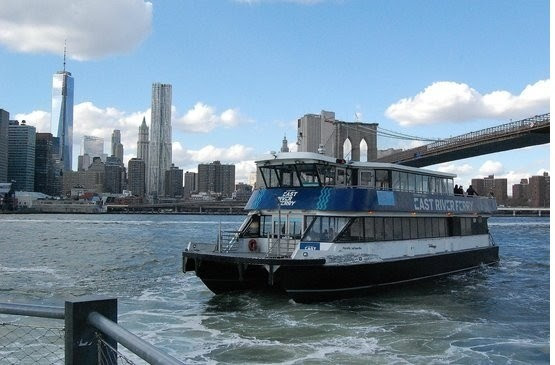
This year saw the re-emergence of water transportation on the East River linking Manhattan to Brooklyn and Queens.

We thought it would be interesting to retrace the history of water ferries by picking one of the more vibrant destinations known as Brooklyn’s DUMBO for Down Under Manhattan Bridge Overpass.

To start out, we will take the train leaving Darien at 8:35 a.m. and Noroton at 8:38 a.m. and gather at the Grand Central Station Information Booth on the upper level.

From there, we will take the Lexington Avenue subway to 34th St. and walk east to the 34th St. ferry terminal to purchase tickets for the East River route, boarding either the 10 a.m. or 10:40 a.m. ferry to DUMBO.

We will then proceed to the Fulton ferry landing and go to the Brooklyn Historical Society Museum to watch an eight-minute film on the history of the area. Our wandering will include a beverage stop and later lunch at the Sugarcane raw bar.

For the return trip, there are ferries at 2:29 p.m. and 2:59 p.m. going back to the 34th St. ferry terminal, where we will retrace our steps to Grand Central in time for the 4:08 p.m. or 4:33 p.m. train home.

Contact: Mark Shakley, cell 203.945.9624, mshakley@aol.com

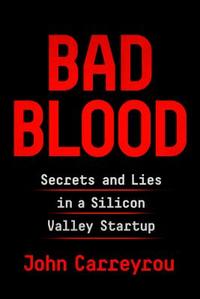
Book Club: Bad Blood : Secrets and Lies in a Silicon Valley Startup John Carreyrou, Jan 9, 2019

The full inside story of the breathtaking rise and shocking collapse of Theranos–the Enron of Silicon Valley–by the prize-winning journalist who first broke the story and pursued it to the end in the face of pressure and threats from the CEO and her lawyers. In 2014, Theranos founder and CEO Elizabeth Holmes was widely seen as the female Steve Jobs: a brilliant Stanford dropout whose startup “unicorn” promised to revolutionize the medical industry with a machine that would make blood tests significantly faster and easier. Backed by investors such as Larry Ellison and Tim Draper, Theranos sold shares in an early fundraising round that valued the company at $9 billion, putting Holmes’s worth at an estimated $4.7 billion. There was just one problem: the technology didn’t work. For years, Holmes had been misleading investors, FDA officials, and her own employees. When Carreyrou, working at the Wall Street Journal, got a tip from a former Theranos employee and started asking questions, both Carreyrou and the Journal were threatened with lawsuits. Undaunted, the newspaper ran the first of dozens of Theranos articles in late 2015. By early 2017, the company’s value was zero and Holmes faced potential legal action from the government and her investors. Here is the riveting story of the biggest corporate fraud since Enron, a disturbing cautionary tale set amid the bold promises and gold-rush frenzy of Silicon Valley

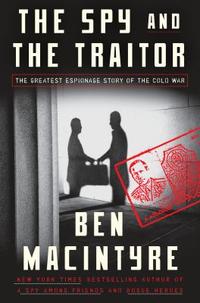
Book Club:The Spy and the Traitor : the Greatest Espionage Story of the Cold War by Ben Macintyre, Dec 12, 2018

Oleg Gordievsky was a spy like no other. The product of a KGB family and the best Soviet institutions, the savvy Russian eventually saw the lies and terrors of the regime for what they were, a realization that turned him irretrievably toward the West. His career eventually brought him to the highest post in the KGB’s London station-but throughout that time he was secretly working for MI6, the British intelligence service”-

Current Affairs: Single Payer Healthcare, Nov 15, 2018

Discussion leader: Charlie Goodyear

Summary :

SINGLE PAYER HEALTHCARE SYSTEMS
USA Healthcare System
-17% of GDP (was 7% in 1971) vs. 9% Canada,10% UK, 10% Germany
-Coverage :
+50% Employer (155 million people, cost $20,000/family, employee pays
$5000)
+14% Medicare (+/- 55 million people)
+12% Medicaid, Veterans, Native Americans (+/- 50 million people)
+ 7% ACA purchased (+/- 20 million people)
+ 8% Emergency Room, Other
+ 9% Uninsured (+/- 30 million people)- 80% US citizens
-Drug costs : $1000/per person/year vs. OECD $500
-Estimated 100-130 million people have “pre-exsisting conditions”
-Life expectancy below OECD countries, Infant mortality higher
-Reasons for higher costs vs OECD countries :
+ Technology and drugs ( eg more MRIs per capita, no drug price controls)
+ Obesity (35% vs 19% OECD) and chronic illnesses (32% of Medicare costs
cover the last two years of life)
+ Much higher administrative costs (4% of GDP), double the staffing vs Canada
-Healthcare costs a major factor in personal bankruptsy( !0 million have bills they can’t
pay )
Canada Healthcare System
-Single payer system covering 100% of the population -no co-pays or deductables
-Doctors and hospitals privately owned and managed within system rules
-Managed by Provincial governments who pay all doctor and hospital charges
-System funded 50/50 with Federal government
-Provinces set prices and proceedures that comply with Federal requirements
-No private insurance allowed except for drugs and dental not covered by System
-Heavy involvement in drug pricing and approval, cost benefit analysis
-Essentially no US type media drug advertising
-Doctors earn about 2/3 of what US doctors earn/year
-Lower availability of medical devices (eg. 75% fewer MRIs per capita than US)
-Open heart and transplant surgery restricted
– Major problems: waiting times for referral to specialists (+/- 16 weeks ), doctor
choice limited, long delays for elective surgery
United Kingdom Healthcare System
-Single payer system covering 100% of the population-no co-pays or deductables
-Doctors are government employees and hospitals are government owned
-Managed by major regional authorities (ie Britain, Wales,Scotland, etc)
-Drug prices controlled by the government, strict cost/benefit analysis. No US
type media drug advertising
-Drug prescriptions cost about $12/ each, free for children.

– No dental coverage for adults
– Doctors earn about 2/3 of what US doctors earn
– Individuals may purchase insurance coverage with doctors in private practice
– Major problems: Long wait times (+/- 10 weeks for general surgery), limited availabiliy
of new(expensive) or experimental treatments, cost/benefit analysis, lack of mental
health services, very long delays for elective surgery
-Per capita costs $4K/year vs US $10K/year
-Many say “Underfunded but not broken “
Germany Healthcare System ( An alternative to “single payer” ??)
-An insurance based system with non profit and for profit insurers
-Covers 90% of population- required participation for all but highest earners
-Funded by 50/50 contribution by employers and employees -15% of earnings
up to about $70K/year (2014 data)
-Private doctors and hospitals but highly regulated
-No deductables and low co-pays -children are free
-Managed by regional authorities via “sickness funds” that are used to control
total costs
– Drug prices are controlled, cost/benefit analysis, no US type public advertising
– Doctors earn about 2/3 of US doctors/year
– Per capita costs less than 1/2 of US
– Surveys indicate significantly higher public satisfaction with the system vs US,
Canada or UK
( The relationship between the insurance companies, doctors, hospitals ,employers,
employees individuals and the regional government bodies is unclear and needs
further analysis and understanding)

Comparisons of Health Care Systems in the United States, Germany and Canada

https://dpeaflcio.org/programs-publications/issue-fact-sheets/the-u-s-health-care-system-an-international-perspective/

https://theconversation.com/why-market-competition-has-not-brought-down-health-care-costs-78971

https://theconversation.com/medicare-for-all-could-be-cheaper-than-you-think-81883

Single Payer Healthcare

Universal Coverage

The article below on drug cost shows how complicated healthcare is to understand, much less manage.  Factors such as age of population, availability of new drugs, the number of insured, etc. all interact.

Still, negotiation is an important factor.  The article states that many western countries (all government run healthcare) will only pay for improved outcomes.
But it’s not purely rational.  If some exotic drug will save your life, it’s worth a lot to you but maybe not so much to society if it starves other healthcare services.  The payers are subject to political pressure from interest groups.  Not simple.

The False Promise of ‘Medicare for All’

Cost is only part of the problem. Single-payer systems create long waits and delays on new drugs.


Wander Roosevelt Island, Astoria Queens, October 2, 2018

Tuesday, October 2, is the first Wandering of the 2018-2019 program year.

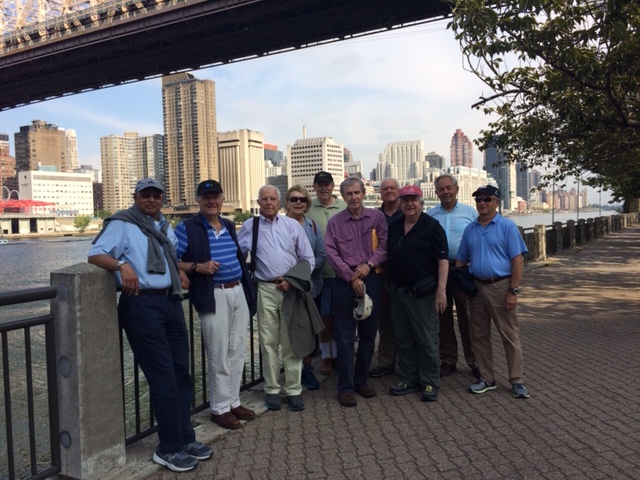
The Wanderers will journey to Roosevelt Island in the East River and to Astoria, Queens.

We will take the 8:35am train out of Darien and the 8:38am out of Noroton Heights.  The group will gather in Grand Central Station at the information booth on the upper level.


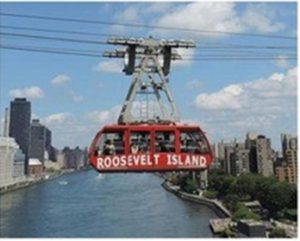
We will take the subway to the 59th Street station for the Roosevelt Island tram, cross to the Island and walk through Four Freedoms Park and the FDR Memorial sculpture display.


Then, via the East River Ferry, we’ll go to Astoria, Queens.  We will walk by many of the local landmarks associated with the earliest days of the motion picture industry in the United States, through Socrates Sculpture Park and several other sights, and finally have lunch.

We will return by subway in the afternoon to Grand Central for the train ride home.

If it rains Tuesday, we will not go.  A new date will be announced at our regular weekly meeting the next day,

Contact: Joe Spain

« Older posts Newer posts »