
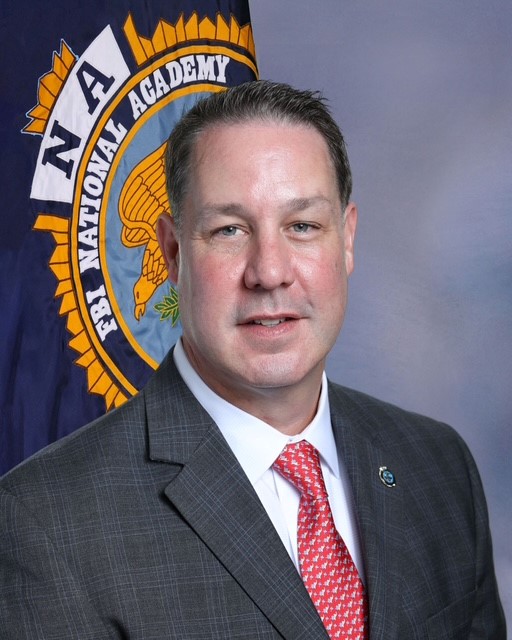
 Darien Police Chief Jeremiah P. Marron, Jr. will discuss how policing today involves navigating possible conflicts between state law and federal policy. For example, what would the Darien Police Department do if ICE apprehended a suspected illegal alien in town when the state may oppose it while federal law requires it? He will also help unpack many of the issues facing policing in America today such as how police departments seek to maintain high community trust at a time of shrunken trust in many institutions in the nation, recruitment and retention of sworn staff, the emotional well-being of men and women in law enforcement, what role technology has in assisting policing such as the use of A.I., unmanned aerial vehicles (drones), and license plate readers and how alternative response programs work such as sending mental health professionals to situations involving individuals in crisis.
Chief Marron will also discuss how the Darien Police Department, like many other police departments, plans so-called “Table Top” exercises for emergencies including a possible terrorist incident, active intruder incidents, and weather disasters.
Jerry Marron became Chief of Police of the Darien Police Department in April 2024. After graduating from the Connecticut Police Academy in 1996, Chief Marron served the department with distinction in both the Detective Division and Field Services Bureau as both an officer and supervisor. He was appointed as a Patrol Officer in 1996, Sergeant in 2006 and Lieutenant in 2017. He served on the Southwest Regional Emergency Response Team for 9 years and was a Field Training Officer for 6 years. He was also one of the Department’s Public Information Officers and was a member of the SCUBA Team, serving as a rescue diver.
Chief Marron is a 2016 recipient of the United States Attorney’s Award and holds a B.A. in Criminal Justice from Sacred Heart University. In addition, he is a graduate of both the Roger Williams University First Line Supervisor and Police Mid-Management Schools, a 2012 graduate of the University of New Haven Center for Advanced Policing, Innovation in Police Management Program and the 2019 Police Leadership Institute program at Sacred Heart University. He attended the Performance Executive Research Forum’s Senior Management Institute for Police program in 2021.
In 2022, Chief Marron graduated from the 283rd session of the FBI National Academy which is located in Quantico, VA. Chief Marron became the 16th officer in Darien Police Department history to complete this prestigious program, joining his father, the late Jeremiah P. Marron, Sr., who attended the National Academy in 1985 and who served the Town of Darien with honor and distinction from 1967 to 1989.
Presentation summary:
Chief Marron provided a candid picture of policing in Darien today. He explained how a proud tradition, high training standards and strong funding and community support counter national headwinds affecting recruitment and retention. A 1996 hire and the town’s 12th chief, Marron described how Connecticut’s rigorous training and Darien’s culture let the department hire selectively, keeping vacancies low. He emphasized the department’s participation in readiness training such as recent statewide “tabletop exercises” covering scenarios such as drought, wildfire, public health challenges, and alerts), joint active intruder exercises with fire and EMS officials using role players and simulation, and regional mutual-aid via the “Blue Plan” among neighboring towns and cities.
Transparency and trust are central: Darien equips all officers with body-worn cameras, maintains an active public-information program, and runs outreach ranging from “Coffee with a Cop,” a Citizens Police Academy, and programs to address youth, mental health and domestic abuse issues. On immigration, Marron discussed Connecticut’s Trust Act which limits local police cooperation with federal ICE agents while stressing compliance with all laws and a focus on violent offenders.
Property crime remains challenging in light of state laws restricting police pursuit for property crimes. To succeed in this environment, the department leans on technology, such as one mobile and 12 fixed license-plate readers, which have already aided dozens of cases and regional investigations; and drones that support crash reconstruction, searches, and officer security. He discussed wellness support of sworn staff members designed to address the profession’s unique exposure to trauma. That support entails counseling, peer support networks, partial reimbursement of physical training expenses and five-year psychological testing.
Darien’s officers are trained to handle public reports of events related to mental health issues. These types of calls are rising; while the department has no in-house social worker, most staff are crisis-intervention trained, with hostage negotiators covering all shifts, and 211 calls are fielded from members of the public seeking health and human service programs.
In a wide-ranging question & answer session, Chief Marron said that foot patrols are being reconsidered through a “Park, Walk and Talk” model. He assured a questioner that the long-running Officer Kenneth Bateman case remains open. He addressed 911 call routing quirks, which stem from telecom infrastructure. He explained how arrests result from meticulous follow-up rather than from immediate pursuit. He addressed a question about efforts to enhance school safety through constant collaboration with the school system, including School Resource Officers (all retired law enforcement officers) and doing security assessments. Regarding the rise of E-bikes and scooters, the town favors education of users and parents to reinforce need to follow rules of the road, rather than ticketing. Digital crime and identity theft are daily realities, with detectives pursuing cases and coordinating with federal partners. Firearm permit applications are steady. Some traffic solutions, such as adjusting signal timing, are continually implemented, while others, such as speed cameras and “Don’t Block the Box” intersection markings, are under study but are currently not considered desirable or practical. Marron closed by inviting ongoing dialogue, noting that neighborhood initiatives and everyday cooperation remain powerful crime deterrents.