
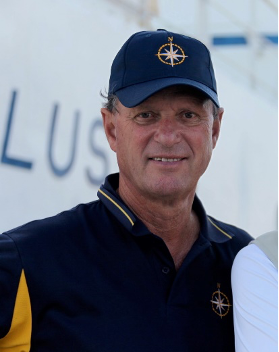
 Dr. Robert Ballard is one of the world’s most famous oceanographers. He is best known for his 1985 discovery of the legendary RMS Titanic, which captured the world’s attention. Dr. Ballard also has succeeded in tracking down numerous other significant shipwrecks, including the German battleship Bismarck, the lost fleet at Guadalcanal, the U.S. aircraft carrier Yorktown (sunk in the World War II Battle of Midway) and John F. Kennedy’s boat, PT-109.
While those discoveries have captured the imagination of the global public, Dr. Ballard believes his most important discoveries were, in fact, of hydrothermal vents and “black smokers” in the Galapagos Rift and East Pacific Rise in 1977 and 1979, along with their exotic life forms living off the energy of the earth through a process called chemosynthesis. Fifty years ago, the deep sea was terra incognito. We knew next to nothing about what lay underneath the waters that cover 70% of the earth’s surface. Fifty years later, in vast areas supposedly devoid of life, scientists found large ecosystems teeming with life, including non-photosynthetic life forms that biologists thought were impossible.
His discoveries also include sunken remains of ships along ancient trade routes in the Mediterranean Sea; two ancient Phoenician ships off Israel, the oldest shipwrecks ever found in deep water; and four 1,500-year-old wooden ships, one almost perfectly preserved in the Black Sea. Dr. Ballard’s Black Sea project seeks evidence of a great flood that may have struck the region thousands of years ago.
Arranged by David Earle
Summary of Robert Ballard’s Presentation to DMA on 1/7/26
Robert D. Ballard, Ph.D., one of the world’s most famous oceanographers, reflected on his young life which was shaped by curiosity and a lifelong fascination with exploration. Born in Kansas and raised amid the aerospace world of Southern California, he fell in love with the ocean after his family moved to San Diego. A childhood viewing of 20,000 Leagues Under the Sea ignited his dream of becoming “Captain Nemo,” a dream that evolved into oceanography and undersea exploration.
Ballard’s career became a rare fusion of science and military service. Trained initially as an Army officer during the Vietnam War era, he was later transferred to the Navy and assigned to the Woods Hole Oceanographic Institution, where he worked on deep-submergence submarines, often in classified operations. This dual background led him to study the ocean floor as complex terrain, revealing the immense scale of mid-ocean ridges and helping confirm plate tectonics as a unifying theory of Earth science.
He is best known for his discovery of the RMS Titanic in 1985, which immediately captured the world’s attention. He also has succeeded in finding numerous other important shipwrecks, including the German battleship Bismarck, the lost fleet at Guadalcanal, the U.S. aircraft carrier Yorktown (sunk in the World War II Battle of Midway), and John F. Kennedy’s boat, PT-109.
While those discoveries of historic ships have fueled the imagination of the global public, Ballard believes that his most important discoveries were of hydrothermal vents — “black smokers,” which caused the rewriting of geology, chemistry and biology textbooks. These vents have proven to be a key mechanism for cycling the ocean’s chemistry throughout the Earth. They are part of ecosystems powered not by sunlight and photosynthesis, but rather by chemosynthesis in waters that are not penetrated by sunlight. The discovery reshaped ideas about the origin of life on Earth and strengthened the case that life could exist elsewhere in the universe, though Ballard emphasized there is “no Planet B” in our solar system or any other on which humanity can live meaningfully.
Seeking to escape the physical limits of human diving, Ballard pioneered tele-presence exploration: robotic vehicles, real-time data and global expert networks that allow scientists to explore the undersea world remotely. This technology enabled both open scientific discovery and secret Cold War missions, including the classified work that ultimately led to the discovery of the RMS Titanic. That success sparked decades of underwater archaeology, from World War II wrecks to exquisitely preserved ancient ships in the oxygen-limited Black Sea.
Ballard expressed deep concern about artificial intelligence, particularly in military contexts, calling it transformative but dangerous if uncontrolled. Regarding climate change, he stressed evidence over ideology, noting risks to our planet deriving from a warming climate, methane release, and intensified storms. He also outlined a vision for a “blue economy,” which would include carefully targeted deep-sea mining and ocean-based food systems that minimize environmental harm. Throughout, Ballard framed his work as being in service to future generations, urging curiosity, courage and responsibility in an increasingly uncertain world.