Month: July 2020

Golf Sterling Farms, Aug 25, 2020

Gents,

We have some times reserved for a golf outing at Sterling Farms.  The date is  Tuesday 25 August at 11am.  Cost will be $51 with a cart (single occupant).  Before fully securing this reservation, I want to get a sense for the number of you who are likely to play.

If you are interested, please respond to me directly:  picarnes@gmail.com.   This is just an indication for planning purposes.  Once we reach a critical mass, I will contact you again with an official invitation.

Peter Carnes

Current Affairs: Income Inequality, Sept 17, 2020, 11:00

Your Host: Bob Baker

Discussion Leader: David Mace

Our current affairs group will talk about income inequality in America and what we should do about it.


Pew Survey – CA Sep 2020

The Black-White Wage Gap Is as Big as It Was in 1950

https://www.nytimes.com/2020/06/25/opinion/sunday/race-wage-gap.html?referringSource=articleShare

https://en.wikipedia.org/wiki/List_of_countries_by_income_equality

Racism’s Hidden Toll

https://www.nytimes.com/interactive/2020/08/11/opinion/us-coronavirus-black-mortality.html?referringSource=articleShare

How does income inequality affect our lives

Video recording of the discussion: https://youtu.be/8x4ej7hyeA4


Michael Poler, 1935-2020

Michael Avery Poler
Michael Avery Poler passed away peacefully at his home in Norwalk, Connecticut on July 1, 2020, surrounded by family, including his wife of 42 years Petrea. Michael was born on September 23, 1935 in Huntington, New York to parents Helen M. (Saylor) and Emmons Edson Poler. Michael attended the Kent School in Kent, Connecticut (Class of 1954) and Babson College in Wellesley Hills, MA (Class of 1957). He also served in the United States Army Reserves from 1954 to 1962, attaining the rank of staff sergeant.
From a young age, Michael would never be far from the water. From the ages of nine through thirteen, he spent the summers at Camp Dudley on shores of Lake Champlain. As a student at the Kent School, he served as coxswain for a crew in the Henley Royal Regatta on the River Thames in 1953. Upon moving to Rowayton in 1960, Michael crewed various amateur fishing vessels, some ill-fated, before taking the helm of White Bear, which he faithfully captained for 43 years. For decades, Michael shuttled children and grandchildren to Jones Beach in Wantagh, New York. Most often, though, Michael could be found on the porch of their home overlooking Chasmars Pond, where he and Petrea would entertain friends and family or, on the rare occasion that their house was empty, enjoy some peace, quiet and a few rounds of dominoes.
Michael was a devoted member of the United Church of Rowayton where he sang in the choir for 58 years. Additionally, Michael acted as a Lay Leader and Deacon in the Church, held various chairmanships, and served as treasurer for the Church’s Memorial Garden. A lifelong choirboy, Michael also sang for Christ Church in Bronxville, New York and the Choir and Glee Club at the Kent School.
Michael worked for ITT Rayonier Inc. for 42 years, before he “retired” in 1990 and founded MAP International Inc., where he served as president until his death. Michael also served as treasurer for Five Mile River Recitals and the Emig Foundation. He was a member of the Darien Senior Men’s Association and the Union League Club in New York City.
Michael also leaves behind eight children – Christine P. Fleming, Theodore A. Poler, Kimberly P. Albanese, Timothy E. Poler, Peter A. Sweeney, Christine C. Sweeny, Catherine M. Sweeny, and J. David Sweeny; fifteen grandchildren; his younger sister, Margaretta E. Poler; sister-in-law Gail M. Poler; and four nieces and nephews. A skilled craftsman, Michael also leaves behind a meticulously organized workshop, where several sons-in-law and grandchildren learned the proper way to carve a turkey under his impatient supervision. Michael is predeceased by his parents, his younger brother Henry S. Poler, and his granddaughter Jae Ling Sweeny.
Finally, in the estimation of the author, Michael was a truly great grandfather/grumpa/far far. He will be missed dearly by all who knew him, but his absence is sure to be felt most acutely in the ice cream industry.
A public memorial service for Michael will take place in September, circumstances permitting. In the meantime, Michael asked that anyone so-inclined make a donation in his memory to Camp Dudley, Westport, NY and The United Church of Rowayton.


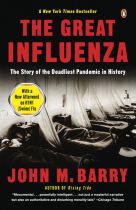
Book Club: THE GREAT INFLUENZA,
THE EPIC STORY OF THE DEADLIEST PLAGUE IN HISTORY
BY JOHN M. BARRY
Sept 9, 2020

Sept 9, 2020, 12:00

THE GREAT INFLUENZA
THE EPIC STORY OF THE DEADLIEST PLAGUE IN HISTORY
BY JOHN M. BARRY

A keen recounting of the 1918–20 pandemic.

This deadly global flu outbreak has gotten hazy in the public memory, and its origins and character were unclear from the beginning, writes popular historian Barry (Rising Tide, 1997, etc.). But influenza tore apart the world’s social fabric for two long years, and it would be a mistake to forget its lessons. (It also tore apart the American medical establishment—but that was for the good.) With the same terrorizing flair of Richard Preston’s Hot Zone, the author follows the disease in the way he might shadow a mugger, presenting us with the vivid aftereffects as if from Weegee’s camera: “Influenza killed more people in a year than the Black Death of the Middle Ages killed in a century; it killed more people in twenty-four weeks than AIDS has killed in twenty-four years.” But Barry is not interested simply in hugely disturbing numbers. He charts how the pandemic brought a measure of scientific maturity to the medical world and profiles such important personalities as Paul Lewis and William Henry Welch, institutions like Johns Hopkins, the Rockefeller Institute, and the Red Cross. He covers with an easy touch the evolution in our understanding of viral disease and the strides that have been made to counter its effects, such as vaccines. He watches the flu spread until there aren’t enough coffins to house the bodies, and he watches as the military fails to alert the general public because the brass feared it would hurt wartime morale. Influenza appears to have spread like a prairie fire from a military base in Kansas throughout the world, thanks to WWI troop deployment and the disease’s highly contagious nature. There was nowhere to hide, Barry chillingly explains: “It now seemed as if there had never been life before the epidemic. The disease informed every action of every person.” Emerging viruses, including new strains of flu, will likely visit us again.

Majestic, spellbinding treatment of a mass killer.


From Charles Salmans:
There are several recent interviews on YouTube of John Barry, author of The Great Influenza, the book we are next discussing. I have watched two of these in full.
I thought the better one was this podcast on MSNBC. It’s 46 minutes. One annoying thing: 7 ads you have to skip past.
Barry was also interviewed for 55 minutes on the Great Courses link (see below). In my opinion the interviewer is not as good, but at the 12 minute mark she asks about the similarities and differences between the 1918 flu and Covid.
In short, Barry says that the 1918 flu was a lot more lethal than what we are seeing today, but Covid 19 is a lot more contagious because you can be unaware you are a carrier. Covid 19 is stealthy.
1) In 1918 you got sick and it was obvious. In many cases people were dead within a day of showing symptoms, and sometimes in as little as 4 hours. As those of you have read the book know, it  contains horrifying descriptions of people severely ill, bleeding from the eyes and ears, turning so blue their race was indeterminate.
2) Today people who are sick carry the transmittable virus for a longer period, up to 14 days, and may be asymptomatic. It is taking a much longer time for Covid 19 to move through a community, making lockdowns longer and harder to contain. In 1918 a wave swept through a community in six to ten weeks and then was gone.
What is similar:
1) Importance of informing the public and being honest. Using the war and patriotism as an excuse, there was a lot of disinformation and denial in 1918. There continues to be denial today from the White House and some Governors. Today if we can achieve vigorous testing and contact tracing, we can control Covid 19, but we seem still to struggle with as effective a response as in some other countries.
2) In 1918 they recognized the importance of social distancing, just as we do now. In that regard, at least so far, that’s the most effective means of disease control. So nothing has changed in 100 years!
Here’s the interview in which John Barry compares the 1918 pandemic to Covid 19 (12 minutes into this 55 minute interview).
From Bert:
A Warning for the United States From the Author of ‘The Great Influenza

Video of the discussion:  https://youtu.be/KWeThH_yStQ