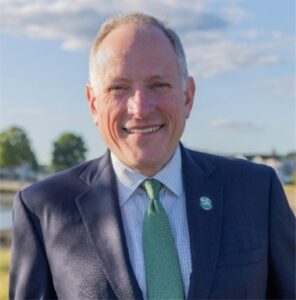
 Dr. Eric Byrne was appointed the new superintendent of Darien’s schools in November 2025 and will discuss the changes in public school education today, with particular focus on Darien. Most senior citizens went to school in the 1950’s–1970s, a period of minimal technology, stricter discipline and more uniform curriculum. Today’s schools are far more tech-driven, individualized, regulated and influenced by AI. Key differences from 60 years ago include:
- Technology: Chalkboards morphed into smartboards; slide rules to Chromebooks; libraries to Google and AI; today’s inescapable social media.
- Curriculum: More emphasis today on STEM (science, technology, engineering and mathematics), coding, global history, environmental science and social-emotional learning.
- College expectations: A high school diploma once sufficed; today’s students face stronger pressure to attend elite colleges. Some colleges seek to “engineer” their peer rankings, and some observers question why a liberal arts education is needed at all because many jobs are changing from being knowledge-based to skill-based.
- Fiscal Challenges: There are numerous state-imposed mandates on schools today as well as transportation challenges and requirements for Special Education, that are now big budget drivers.
- Mental Health: Schools must now grapple with the challenges of student anxiety, depression, substance-abuse and other mental health concerns.
Many senior citizens feel that civic literacy and respect for institutions are declining. Schools now struggle to balance traditional civics with polarized political climates. There used to be a strong focus on U.S. history, the Constitution and traditional narratives of patriotism; but there are now more debate-based civics lessons, polarized social media forms, communications outlets and exploration of multiple perspectives on historical events.
Pertinent questions will be discussed, including which changes have strengthened education, which changes feel like losses and how Darien students experience school differently than seniors citizens did. Dr. Byrne will also discuss how should we teach young people about democracy today, and whether they know enough about American history and government.
Dr. Byrne previously served as superintendent of the Rye City Schools District from 2017 until starting in Darien. He holds an Ed.D. in educational leadership and administration from Fordham University. He is a product of New York City public schools, beginning his career in education in New York City before transitioning to Westchester County and Fairfield County. Prior to his superintendency, Dr. Byrne served as an assistant superintendent for curriculum and instruction, elementary school principal, assistant principal and high school science teacher. He believes that schools must work to develop critical thinkers, effective communicators, collaborators, creative problem solvers, and caring individuals
Video Presentation
Summary of Presentation by Dr. Eric Byrne on Feb. 25, 2026
Dr. Eric Byrne, newly appointed Superintendent of Darien Public Schools, introduced himself by reflecting on how dramatically education has evolved since the 1950s, 60s, and 70s. Drawing on his own upbringing in New York City public schools and his career spanning being a teacher, a principal, and a superintendent, he framed modern education as a system navigating profound technological, societal and economic change.
Dr. Byrne described how schools once mirrored the industrial era — rows of desks, chalkboards, minimal technology and standardized expectations. Today’s classrooms are collaborative, flexible spaces equipped with laptops, interactive flat panels and AI-driven tools. Students now carry devices more powerful than any computer available a generation ago. Yet with these advancements come challenges: screen-time concerns, social media impacts and the need to regulate emerging technologies such as artificial intelligence.
He emphasized that academic pressure has intensified, particularly in affluent communities like Darien. College admissions have become increasingly competitive due to online applications, test-optional policies and national ranking systems. Students now apply to many more schools, competing for limited seats at elite institutions. This has heightened stress and anxiety, which in turn contributes to growing mental health concerns among adolescents.
Financial pressures on school systems have also grown. Rising healthcare costs, extensive state mandates, increasing special education expenses and mental health support strain local budgets, especially in towns that receive limited state funding. Meanwhile, schools must address evolving safety realities, including active shooter drills — an unimaginable circumstance during earlier generations’ education.
Throughout the discussion, Dr. Byrne underscored the enduring mission of public education: preparing students not only for careers and college but also for citizenship in a democratic society. He affirmed the continued importance of civics, humanities and leadership development alongside STEM and career pathways.
In closing, he acknowledged uncertainty about whether the traditional “American Dream” formula — education plus hard work equals stability — feels as attainable for today’s students. Schools, he suggested, must continue adapting to ensure opportunity, resilience and thoughtful citizenship in an increasingly complex world.

 May 2026

 Darien is undergoing one of the most significant transformations in its history. With historic levels of new development underway, some residents are concerned about how the town’s character — and its hometown “feel” — may change.
 . What should worry us all is that the pattern of recent times is that whenever Frank takes a break from bowling, he comes back and bowls even better than when he left – so watch out. Tom had a rough start, struggling with the oily lane conditions. In game two, he began to find a better line, and by game three, he managed the day’s high game of 214 for a 552 series. John also got off to a rough start, including six splits in game one (see
  photo) but finished with two strong games and his season high series of 360 (+57). Also, Dave Smith had a nice series of +16.
 )!
)! 

 . Third we had a lot of excellent bowling, including some individual milestones.
 . That said, let’s hope we have similar excitement next week.