Author: Webmaster (Page 95 of 97)
NATIONAL BOOK AWARD FINALIST. From the highly acclaimed, multiple award-winning Anthony Doerr, the beautiful, stunningly ambitious work about a blind French girl and a German boy whose paths collide in occupied France as both try to survive the devastation of World War II. ( 25 weeks on the New York Times bestseller list)
Discussion Leader: John Podkowsky. A list of discussion questions was previously circulated.
DMA May selection: AGENT STORM by Morten Storm, Paul Cruickshank, and Tim Lister
Agent Storm is the remarkable memoir of a Danish convert-turned-extremist who managed not only to infiltrate al Qaeda’s ranks but would later become one of West’s most valued human intelligence assets in the war on terrorism. As a true spy-story, this book brings you incredibly close to what it actually takes to be an extremist and get into a terrorist group while balancing loyalty and treachery in the world of intelligence. Essential reading for everyone interested in how the war on terrorism is actually fought in the shadows.”
“Agent Storm opens a unique window onto bleak interlocking landscapes—the radicalization of European Muslims that has now been energized by the Syrian civil war, the leadership and organization of global jihad, and the twilight struggle waged by western intelligence agencies against an elusive and implacable enemy.”
Discussion Leader: John Podkowsky
Book available at the Darien Library the second week of April; Discussion date: May 13.
Stuart is a PGA Professional The PGA of America that comprises 27,000 men and women professionals with one singular goal in mind – to make the game of golf more enjoyable for you.
Stuart was born in Nyack, New York and raised in New City, NY where he graduated from Clarkstown School district. Played high school and college golf and was Captain of University of Rhode Island Golf Team and graduated in 1987 with a B.S. in Finance.
Caddied Dellwood Country Club, New City, NY 1977-1987 and was 1st Assistant Blue Hill Golf Course, municipal golf course in Pearl River, NY from 1987-1989 and 1st Assistant Woodway Country Club, Darien, CT from 1990-1998 and Head Golf Professional Silvermine Golf Club from 1998-present. Currently, Head Golf Coach of Wilton High School Girl’s Golf Team.
Awards and leadership positions: 2007 MET PGA Junior Golf Leadership Award, 2013 MET PGA Junior Golf Leadership Award. A member of MET PGA Board of Directors from 2009-2015, 2011-2013 MET PGA Secretary and MET PGA Vice President from 2014-2015.
Arranged by Alex Garnett.
The issues facing franchisees today include the sharing of rising costs, profit split, lifespan of franchise concepts, chasing trends and who carries the risk. Current regulatory environment affects franchise on several levels. Managing real estate cost and franchising business models.
McDonald’s Specific Issues include product perception, profit split due to unique real estate partnership, labor force challenges, doing business in NYC, and advertising–structure.
Jim Lewis has been in the McDonald’s system since 1986 and as an Owner/Operator since 1993. He currently owns 17 Restaurants in Manhattan and Queens including the famous Times Square and 42nd St McDonald’s. Prior to his involvement in McDonald’s he worked as a Sales Manager for AT&T in Southfield, Michigan. Jim began his career as an Account Executive with Michigan Bell Telephone in 1981.
Jim is currently on the Board of Directors for the New York Metro Marketing Cooperative and has served as President of that Board in the past. He is currently the Co-Chairman of the Marketing Strategy Committee for New York. Jim has served on many National and Divisional teams for the McDonald’s system during his tenure.
Arranged by Tom Lom.
Tara Contractor, the Kress Interpretive Fellow at the Bruce Museum, will present the highlights of the current exhibition, Northern Baroque Splendor: The HOHENBUCHAU COLLECTION From LIECHTENSTEIN. This collection consists of 64 paintings and displays the Golden Age of Dutch and Flemish art between the late 16th and early 18th centuries.
The paintings cover a wide range of subjects to illustrate everyday life of that time. The show, the Bruce’s largest ever, is roughly arranged chronologically and exhibits beautiful and alluring still-life pictures of fruits, intricate goblets and detailed tapestries; landscapes of rural scenes, turbulent seas and tranquil rivers, and portraits of an assortment of characters and emotions. The artists are also numerous and include such well-known names Gerard Dou and Peter Paul Rubens.
Contractor is a graduate of Scripps College and Courtauld Institute of Art, U. of London and has worked directly with the museum’s director in organizing this outstanding exhibit.
Arranged by Frank Johnson.
The Battle of the Bulge (16 December 1944 – 25 January 1945) was a major German offensive campaign launched through the densely forested Ardennes region of Wallonia in Belgium, France and Luxembourg on the Western Front toward the end of World War II in Europe. Hitler planned the offensive with the primary goal to recapture the important harbor of Antwerp. The surprise attack caught the Allied forces completely off guard. United States forces bore the brunt of the attack and incurred the highest casualties for any operation during the war. The battle also severely depleted Germany’s war-making resources.
The battle was known by different names. The Germans referred to it as Unternehmen Wacht am Rhein (“Operation Watch on the Rhine”), while the French named it the Bataille des Ardennes (“Battle of the Ardennes”). The Allies called it the Ardennes Counteroffensive. The phrase “Battle of the Bulge” was coined by contemporary press to describe the way the Allied front line bulged inward on wartime news maps and became the best known name for the battle.
The German offensive was supported by several subordinate operations known as Unternehmen Bodenplatte, Greif, and Währung. As well as stopping Allied transport over the channel to the harbor of Antwerp, these operations were intended to split the British and American Allied line in half, so the Germans could then proceed to encircle and destroy four Allied armies, forcing the Western Allies to negotiate a peace treaty in the Axis Powers’ favor. Once that was accomplished, Hitler could fully concentrate on the eastern theatre of war.
The offensive was planned by the German forces with utmost secrecy, minimizing radio traffic and moving troops and equipment under cover of darkness. Despite their efforts to keep it secret, the Third U.S. Army’s intelligence staff predicted a major German offensive, and Ultra indicated that a “substantial and offensive” operation was expected or “in the wind”, although a precise date or point of attack could not be given. Aircraft movement from the Russian Front and transport of forces by rail, both to the Ardennes, was noticed but not acted upon, according to a report later written by Peter Calvocoressi and F. L. Lucas at the code-breaking centre Bletchley Park.
Near-complete surprise was achieved by a combination of Allied overconfidence, preoccupation with Allied offensive plans, and poor aerial reconnaissance. The Germans attacked a weakly defended section of the Allied line, taking advantage of heavily overcast weather conditions, which grounded the Allies’ overwhelmingly superior air forces. Fierce resistance on the northern shoulder of the offensive around Elsenborn Ridge and in the south around Bastogne blocked German access to key roads to the northwest and west that they counted on for success; columns that were supposed to advance along parallel routes found themselves on the same roads. This and terrain that favored the defenders threw the German advance behind schedule and allowed the Allies to reinforce the thinly placed troops. Improved weather conditions permitted air attacks on German forces and supply lines, which sealed the failure of the offensive. In the wake of the defeat, many experienced German units were left severely depleted of men and equipment, as survivors retreated to the defenses of the Siegfried Line.
About 610,000 American forces were involved in the battle, and 89,000 were casualties, including 19,000 killed. It was the largest and bloodiest battle fought by the United States in World War II.
Art Gottlieb is a local historian on subjects of political and military history. He was formerly a professional curator of naval history and the Technical Director of Exhibits at the Intrepid Sea-Air-Space Museum in New York City. In these roles, Mr. Gottlieb worked regularly with veterans of all services towards the creation of exhibits accurately illustrating the history of 20th century warfare.
From 1989 through 1997, Mr. Gottlieb coordinated with all branches of the armed services and National Guard towards the preservation of historic ships, aircraft and armor from around the world, and has facilitated the recovery of scores of artifacts from warships slated for demolition from reserve fleets.
For the past 10 years Mr. Gottlieb has refocused his professional efforts towards reaching out and addressing the growing needs of aging veterans and their families. In addition to maintaining a private practice as a Counselor and Certified Senior Advisor in Norwalk, CT, he is a field instructor for Sacred Heart University. Mr. Gottlieb offers Pro Bono counseling services to soldiers returning from Iraq and Afghanistan.
Mr. Gottlieb served as an Auxiliary Officer of the United States Coast Guard for 17 years and for 4 years was Commander of Flotilla 7-2, Division 1 (Southern Region), Sector Long Island Sound North.
Arranged by Alex Garnett
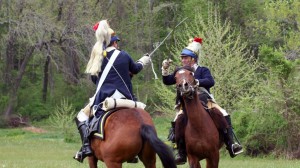
Many people are unaware that the first commissioned cavalry in the history of the United States, one of four congressionally commissioned dragoon regiments, was formed in and consisted largely of men from Connecticut.
In addition to being the first commissioned cavalry, Sheldon’s Horse formed the first pony express; constituted part of the first organized spy ring under General Washington; executed the first cavalry charge by US forces on American soil; counted twenty of its members as part of Washington’s official entourage and who were with him at the Siege of Yorktown; was the only force to achieve victories on foot, on horse, and at sea; included one of the first recipients of the Order of Merit – the Purple Heart – for bravery in action against the enemy.
Commissioned December 12, 1776, the regiment operated extensively in the Hudson River Valley, the Mohawk Valley, lower New England and across Long Island Sound until its return to state control in 1783.
Sheldon’s Horse is credited with playing a significant part in winning the American War for Independence and a key role in unwinding the Arnold-Andre affair.
Eric Chandler is a resident of Norwalk, CT and has been involved in American Revolutionary War Living History since 1974. He has been a member of Sheldon’s Horse since 1996 and serves as the regimental adjutant. He has portrayed infantry, light infantry, whale-boat raider and both mounted and dismounted dragoons. He may also have been a spy. Come and find out.
Arranged by Andre Guilbert
It was a scary time in America – commies under your bed and the McCarthy hearings, UFO sightings, the Cold War nuclear threat, and worst of all – the polio epidemic sweeping the country. Parents were terrified their kids would get it and end up in an Iron Lung. When Jonas Salk and his polio vaccine saved the day he was treated by a euphoric country almost like a god. But there is a largely unknown story behind this story that spoils this stirring narrative. In the intense rivalry between Salk and Sabin, with different vaccines, Salk failed to properly credit his co-workers who did much of the work, a no-no in science. Very few people ever got polio, despite the extreme media frenzy about it, and by the time the Salk vaccine was introduced the polio “epidemic” was largely over. Screw-ups like the Cutter Labs vaccine disaster actually gave people polio. 90 million Americans were given vaccine shots that contained a monkey virus that causes various cancers. And so on. This talk will explore this complex and messy picture and also address today’s vaccination controversies.
Dave Shafer has spent the last 49 years designing camera lenses, telescopes and microscopes and has had a one-man optical design and consulting company since 1980. The Cassini spacecraft took one of his unusual telescopes to Saturn a few years ago. Later a separate spacecraft took close-up photos of the asteroid Vesta and now a third spacecraft is using his telescope to help land on a comet. All of today’s state of the art computer chips for cell phones, tablets, and computers are made using a unique optical system that Dave invented about 10 years ago. He has over 125 patents for optical designs. Dave once designed an unusual stereo viewing device for Salvador Dali.
Arranged by Andre Guilbert
The Invasion of Normandy was the invasion by and establishment of Western Allied forces in Normandy, during Operation Overlord in 1944 during World War II; the largest amphibious invasion to ever take place.
D-Day, the day of the initial assaults, was Tuesday 6 June 1944. Allied land forces that saw combat in Normandy on that day came from Canada, the Free French forces, the United Kingdom, and the United States. In the weeks following the invasion, Polish forces also participated, as well as contingents from Belgium, Czechoslovakia, Greece, and the Netherlands. Most of the above countries also provided air and naval support, as did the Royal Australian Air Force, the Royal New Zealand Air Force, and the Royal Norwegian Navy.
The Normandy invasion began with overnight parachute and glider landings, massive air attacks and naval bombardments. In the early morning, amphibious landings on five beaches codenamed Juno, Gold, Omaha, Utah, and Sword began and during the evening the remaining elements of the parachute divisions landed. Land forces used on D-Day deployed from bases along the south coast of England, the most important of these being Portsmouth.
Art Gottlieb is a local historian on subjects of political and military history. He was formerly a professional curator of naval history and the Technical Director of Exhibits at the Intrepid Sea-Air-Space Museum in New York City. In these roles, Mr. Gottlieb worked regularly with veterans of all services towards the creation of exhibits accurately illustrating the history of 20th century warfare.
From 1989 through 1997, Mr. Gottlieb coordinated with all branches of the armed services and National Guard towards the preservation of historic ships, aircraft and armor from around the world, and has facilitated the recovery of scores of artifacts from warships slated for demolition from reserve fleets.
For the past 10 years Mr. Gottlieb has refocused his professional efforts towards reaching out and addressing the growing needs of aging veterans and their families. In addition to maintaining a private practice as a Counselor and Certified Senior Advisor in Norwalk, CT, he is a field instructor for Sacred Heart University. Mr. Gottlieb offers Pro Bono counseling services to soldiers returning from Iraq and Afghanistan.
Mr. Gottlieb served as an Auxiliary Officer of the United States Coast Guard for 17 years and for 4 years was Commander of Flotilla 7-2, Division 1 (Southern Region), Sector Long Island Sound North.
Arranged by Alex Garnett

What’s the difference between an African-American and an American-African? From such a distinction springs a deep-seated discussion of race in Chimamanda Ngozi Adichie’s third novel, “Americanah.” Adichie, born in Nigeria but now living both in her homeland and in the United States, is an extraordinarily self-aware thinker and writer, possessing the ability to lambaste society without sneering or patronizing or polemicizing. For her, it seems no great feat to balance high-literary intentions with broad social critique. “Americanah” examines blackness in America, Nigeria and Britain, but it’s also a steady-handed dissection of the universal human experience — a platitude made fresh by the accuracy of Adichie’s observations.
So an African-American is a black person with long generational lines in the United States, most likely with slave ancestors. She might write poetry about “Mother Africa,” but she’s pleased to be from a country that gives international aid rather than from one that receives it. An American-African is an African newly emigrated to the United States. In her native country, she didn’t realize she was black — she fit that description only after she landed in America. In college, the African-American joins the Black Student Union, while the American-African signs up with the African Students Association.
Adichie understands that such fine-grained differentiations don’t penetrate the minds of many Americans. This is why a lot of people here, when thinking of race and class, instinctively speak of “blacks and poor whites,” not “poor blacks and poor whites.” Many of Adichie’s best observations regard nuances of language. When people are reluctant to say “racist,” they say “racially charged.” The phrase “beautiful woman,” when enunciated in certain tones by certain haughty white women, undoubtedly means “ordinary-looking black woman.” Adichie’s characters aren’t, in fact, black. They’re “sable” or “gingerbread” or “caramel.” Sometimes their skin is so dark it has “an undertone of blueberries.”
Plot
As teenagers in a Lagos secondary school, Ifemelu and Obinze fell in love. Their Nigeria is under military dictatorship, and people are leaving the country if they can. Ifemelu departs for the United States to study. Through her experiences in relationships and studies, she struggles with the experience of racism in American culture, and the many varieties of racial distinctions. Obinze, son of a professor, had hoped to join her in the US but he is refused a visa after 9/11. He goes to London, entering illegally, and enters an undocumented life.
Years later, Obinze has returned to Nigeria and become a wealthy man as a property developer in the newly democratic country. Ifemelu gained success staying in the United States, where she became known for her blog about race in America, entitled “Raceteenth or Various Observations About American Blacks (Those Formerly Known as Negroes) by a Non-American Black”. When Ifemelu returns to Nigeria, the two have to make tough decisions after reviving their relationship.
Reception
The book was well-received by critics, who especially noted its range across different societies and reflection of global tensions. The New York Times said, “‘Americanah’ examines blackness in America, Nigeria and Britain, but it’s also a steady-handed dissection of the universal human experience — a platitude made fresh by the accuracy of Adichie’s observations.”] The reviewer concludes, “Americanah” is witheringly trenchant and hugely empathetic, both worldly and geographically precise, a novel that holds the discomfiting realities of our times fearlessly before us. It never feels false.”
Awards:
- Selected as one of the 10 Best Books of 2013 by the editors of the New York Times Book Review.
- 2013 National Book Critics Circle Award(Fiction).
- Shortlisted for the 2014 Baileys Women’s Prize for Fiction of the United Kingdom.
Book Group discussion meeting February 11th, 12:30 p.m. at the Darien Library Discussion Leader: Sunil Saksena
Mark currently serves as the Chief Investment Strategist for Janney Montgomery Scott LLC. In this capacity he is responsible for establishing the firm’s broad outlook relating to conditions in the capital markets and the economy and to develop investment strategies best suited to satisfy the goals and objectives of individual and institutional clients. He also establishes the firm’s asset allocation models used for portfolio construction and financial planning. Additionally, he directs Parker/Hunter Asset Management, the firm’s discretionary investment management division.
Under his leadership, Janney Capital Management has delivered competitive investment results across multiple strategies. The total assets under management has grown to more than $3 billion, with approximately $2 billion in traditional equity and fixed income assets, and over $1 billion in various strategic and tactical asset allocation strategies utilizing exchange-traded products and mutual funds.
He is a member of the Janney Wealth Management Department’s Mutual Fund and Alternative Investment Committees. In Janney Capital Management, Mark chairs the Investment Committee which sets asset class and sector policy and directly participates in managing the equity, fixed income and asset allocation strategies under its advisory.
Mark has spent more than twenty-five years in the investment industry interfacing with both current and prospective clients. He utilizes that experience to speak on topics related to investment planning and asset management at seminars and conferences.
His comments and written articles have been circulated in numerous publications ranging from the Pittsburgh Post-Gazette and the Philadelphia Inquirer to the New York Times, Barron’s, USA Today, Financial Times, Wall Street Journal, Money magazine and Worth. He has appeared in various media outlets including CNBC, Bloomberg Television, CNN, Fox Business News and PBS’s Nightly Business Report. He is a Trustee for Janney Montgomery Scott’s Pension & Profit Sharing Plan.
Arranged by Alex Garnett