The #1 New York Times bestselling author of The Devil in the White City and Dead Wake delivers a fresh and compelling portrait of Winston Churchill and London during the Blitz On Winston Churchill’s first day as prime minister, Hitler invaded Holland and Belgium. Poland and Czechoslovakia had already fallen, and the Dunkirk evacuation was just two weeks away. For the next twelve months, Hitler would wage a relentless bombing campaign, killing 45,000 Britons. It was up to Churchill to hold the country together and persuade President Franklin Roosevelt that Britain was a worthy ally-and willing to fight to the end. In The Splendid and the Vile, Erik Larson shows, in cinematic detail, how Churchill taught the British people “the art of being fearless.” It is a story of political brinkmanship, but it’s also an intimate domestic drama set against the backdrop of Churchill’s prime-ministerial country home, Chequers; his wartime retreat, Ditchley, where he and his entourage go when the moon is brightest and the bombing threat is highest; and of course 10 Downing Street in London. Drawing on diaries, original archival documents, and once-secret intelligence reports-some released only recently-Larson provides a new lens on London’s darkest year through the day-to-day experience of Churchill and his family: his wife, Clementine; their youngest daughter, Mary, who chafes against her parents’ wartime protectiveness; their son, Randolph, and his beautiful, unhappy wife, Pamela; Pamela’s illicit lover, a dashing American emissary; and the cadre of close advisers who comprised Churchill’s “Secret Circle,” including his lovestruck private secretary, John Colville; newspaper baron Lord Beaverbrook; and the Rasputin-like Frederick Lindemann. The Splendid and the Vile takes readers out of today’s political dysfunction and back to a time of true leadership, when-in the face of unrelenting horror-Churchill’s eloquence, courage, and perseverance bound a country, and a family, together.
Category: Activities (Page 21 of 36)
Activities are gatherings that occur on a regular schedule, usually weekly, to enjoy a specific pastime.
THE RUSSIAN JOB by Douglas Smith |
Kirkus Reviews
The hair-raising account of a great humanitarian act in which the United States provided vital assistance to the Soviet Union. Historian and translator Smith (Rasputin: Faith, Power, and the Twilight of the Romanovs, 2016) reminds readers that World War I and civil war devastated Russian agriculture because the fighting armies lived off the land. By 1920, the Bolsheviks had largely won, but the government continued to forcibly extract grain from the peasants. Then the rains stopped. At first, Lenin “welcomed the famine, since he believed it would destroy the people’s faith in God and the tsar. Revolution, not charity, would save the peasants, he said.” By the summer, faced with mass starvation and violence, he changed his mind. Many philanthropists and international charities responded to pleas for help, but only one organization had the immense resources required: the American Relief Administration, led by Herbert Hoover, who had already impressed the world with his relief of mass starvation in Belgium and northern France during WWI and then again in Europe after the armistice. A successful businessman, Hoover employed the same talents to organize a vast enterprise led by loyal underlings who oversaw the distribution chain, from docks to warehouses to transportation to the soup kitchens. A few Soviet leaders were congenial, but most believed that the ARA was a nefarious capitalist plot. Secret police harassed the Americans and arrested Russian employees but sometimes, unpredictably, helped by cutting through red tape. Local officials were usually grateful. Infrastructure, housing, sanitation, and disease were terrible, far worse than in Europe. In an often agonizing but necessary book, the author includes letters and anecdotes by participants as well as often horrific photographs, all of which tell a grim story. Starving people do not overthrow governments, so it’s unlikely American aid saved the Soviet Union, but it was a magnificent achievement—and Smith adeptly navigates all elements of the story. Except for Hoover biographers, American scholars pay little attention to this episode; it quickly vanished from Russian history. Although the catastrophic Russian famine and American relief efforts are not completely forgotten,
this expert account deserves a large readership.
8:30am, Lilian Gade Room at the DCA.
Cliff van Voorhees and Carolyn Bayne will discuss the challenges of recycling in Darien.
Introductory slide show.
Examples of what should and should not be in single stream recycling:
Click below to see what’s allowed and not allowed in Darien Single Stream. Just because it isn’t listed here, doesn’t mean it can’t be recycled – there are separate areas for paint, lightbulbs, batteries, electronics, tires, appliances, food waste, metal, large plastic, yard waste, mattresses, clothes, corrugated, plastic bags, construction debris, … And the Swap Shop is a way to recycle usable stuff. (Or gain more clutter you don’t really want.) You can also pick up shredded mulch, leaf compost, and sometimes food compost.
2019_Darien_Single_Stream_Recycling_(Full_List)
A tour of City Carting Recycling Center. (hover over picture to stop scrolling)
Commercial Haulers
The haulers separate trash from SSR, even though many people seem to think they do not. I believe they do for two main reasons:
- it’s the law and their licenses could be revoked if they are found in violation;
- Darien charges haulers to tip MSW but not SSR. Free tipping of SSR is an incentive to separate – and recycle – SSR. We are one of the few remaining municipalities that continues to get paid for SSR, but that could change when our contract is renegotiated.
It’s also worth noting that the haulers are only required to recycle what goes in the blue bin (ie our SSR list); many of the other items we recycle (ie batteries, light bulbs, e-waste, paint, etc.) must be brought to our facility. We ALWAYS recommend that residents who employ a hauler also get a dump sticker so that they can recycle these additional materials; their permits are priced much lower to account for the fact that they are primarily bringing recyclables and not regular household trash. Note that Seniors can get a free permit.
CT’s problem with waste from “Hartford Current:”
https://www.courant.com/news/connecticut/hc-news-ct-outofstate-trash-disposal-20191228-hprk52k2hjbzlj7xz2lztug74q-story.html
Economics and Science of Recycling from “Popular Mechanics” (note date is 2008 before China’s ban on imports):
https://www.popularmechanics.com/science/environment/a3752/4291566/
Problems with Recycling in Asia from the “Financial Times:”
https://www.ft.com/content/360e2524-d71a-11e8-a854-33d6f82e62f8
Micro-plastics and their effects on humans from “The Conversation:”
https://theconversation.com/we-are-guinea-pigs-in-a-worldwide-experiment-on-microplastics-97514
Recycling facts from Recycle Across America:
https://www.recycleacrossamerica.org/recycling-facts
CT’s Policies from the CT Mirror.
https://ctmirror.org/2020/02/17/is-connecticuts-outdated-recycling-system-in-line-for-an-overhaul/?utm_source=Connecticut+Mirror+Mailing+List&utm_campaign=b6d6010e90-DAILY_BRIEFING_MORNING&utm_medium=email&utm_term=0_571d22f8e4-b6d6010e90-68155097
Access Code: 132-263-437
Please join my meeting from your computer, tablet or smartphone.
https://www.gotomeet.me/
Business Roundtable—Purpose of a Corporation
Pre- August 2019 Maximize Shareholder Value
Corporate Responsibility per Milton Friedman
1970 essay- Maximize Returns to Shareholder
Friedman’s thesis: Corporations are not to make contributions for
“social causes”, shareholders can choose what to give.
Further- Corporations are to obey all laws and regulations.
If corporations make “contributions”, the directors must
conclude such donations create good will and enhance sales.
Current example: Orvis gives 5% of pretax profits for “environmental
causes”. (Could they give 15%?
Comments from Harvard Law School Forum
Re: Business Roundtable Statement on Corporate Mission
Corporate Directors have a fiduciary duty to act in shareholder interest
Thus, decisions not in shareholder interest are illegal
Actions taken by directors will be presumed to be in shareholder interest or they would not be taken.
Directors must adhere to the law so that new Legislative mandates may promote or presume to benefit other stakeholders, but at a cost to shareholders.
Overall question: To what extent do we desire the government to impose
rules that will decrease business profits in order to strive for other benefits
What does the Business Roundtable expect or hope to change with revised statement of purpose?
Former “purpose”: “Maximize shareholder Value”
New “purpose”: “Act to benefit all stakeholders”
Stakeholders: customers, employees, suppliers, communities, and shareholders
Possible intentions:
Change corporate reporting on selective topics?
Motivate investments into areas not directly in shareholder interest?
Motivate shareholder resolutions on new corporate action
Bring about new government rules on business actions
Potential areas of Government mandates: ESG
(Environment, Social, Government)
Action regarding global warming;
Other environment improvement measures
Reduction of income inequality
Increase diversity in management personnel
Impose unnecessary costs for named investments
Establish more “days off” for employees
From the WSJ. Financial Advisers Turn to ESG, Warily – WSJ
IEA warns oil companies doing nothing on emissions is not an option
https://eresearch.fidelity.com/eresearch/goto/evaluate/news/basicNewsStory.jhtml?symbols=XOM&storyid=202001191929RTRSNEWSCOMBINED_KBN1ZJ005-OUSBS_1
Capitalism, Alone’ Review: Inclined Toward Inequality
Capitalism Alone
https://lucidmanager.org/milton-friedman-corporate-social-responsibility/
https://corpgov.law.harvard.edu/2019/09/26/analysis-of-the-business-roundtable-statement/
https://www.coursehero.com/file/8478280/Purpose-of-the-Corporation/
The Davos Crowd Embraces Big Global Government – WSJ
The Great Hurricane of 1938
Mystery writer Scotti (The Hammer’s Eye, 1988, etc.) applies her suspense-building skills to the story of a murderous storm that capped a punishing decade.
It’s hard to go wrong with the raw material provided by the Great Hurricane of 1938. The narrative follows the storm as it made landfall in Florida, pushed up the coast, and raced from Cape Hatteras to Long Island in a mere seven hours. Where appropriate, Scotti adds brief background material on the nature of hurricanes, the quality of weather forecasting at the time, and the histories of the towns hardest hit, particularly in Rhode Island; she also compares the 1938 storm to others in the past. But she saves her most powerful writing for the hurricane itself, describing the storm watch and the havoc wrought when it reached land with the help of a wide sampling of firsthand accounts. “The scene around us in the attic was unbelievable,” recalls a woman who was ten at the time. “The waves, at the level of the attic floor, beat unceasingly against the house, which trembled and shook.” Scotti matches the wild images of the eyewitness accounts with her own flair for descriptive narrative: “The ocean banged on doors and windows . . . then it went upstairs into the bedrooms where families sought refuge, and chased them higher yet, into third floors and attics, onto rooftops, until there was no place to go but into the sea.” Almost 700 people died, 433 of them in Rhode Island, where the storm surge buried Providence under 12 feet of water and where Scotti concentrates her story. With power and phone lines down, it was days before people understood the full extent of the devastation, which along the shoreline in particular was complete: “What they eye saw, the mind could not process and the heart refused to accept.”
A darkly intense portrait. (16 pp. b&w photos, not seen, 4 maps)
Kirkus
Midnight in Chernobyl: The untold story of the world’s greatest nuclear disaster
by Adam Higginbotham
The full story of the Chernobyl catastrophe.
In April 1986, a massive accident destroyed a reactor at the Chernobyl Atomic Energy Station near the town of Pripyat, now a ghost-town tourist destination, in Ukraine. The disaster sent a radioactive cloud across the Soviet Union and Europe, triggered pandemonium and coverups, involved thousands of cleanup workers, and played out at a cost of $128 billion against the secrecy and paranoia of Soviet life at the time. In this vivid and exhaustive account, Higginbotham (A Thousand Pounds of Dynamite, 2014), a contributor to the New Yorker, Wired, GQ, and other publications, masterfully re-creates the emotions, intrigue, and denials and disbelief of Communist Party officials, workers, engineers, and others at every stage. He takes readers directly to the scene: the radioactive blaze, the delayed evacuation of residents from the apartment buildings in “workers’ paradise” Pripyat, the treatment of the injured, and the subsequent investigation and “show trial” of scapegoats in a tragedy caused by both reactor failings and operator errors. Drawing on interviews, reports, and once-classified archives, the author shows how the crash program of Soviet reactor building involved design defects, shoddy workmanship, and safety flaws—but made “sanctified icons” of arrogant nuclear scientists. Higginbotham offers incisive snapshots of those caught up in the nightmare, including politicians ignorant of nuclear physics, scientists “paralyzed by indecision,” doctors treating radiation sickness, and refugees shunned by countrymen. We experience the “bewildered stupor” of the self-assured power plant director, who asked repeatedly, “What happened? What happened?” and watch incredulously as uninformed citizens hold a parade under a radioactive cloud in Kiev. At every turn, Higginbotham unveils revealing aspects of Communist life, from the lack of proscribed photocopiers to make maps for responders to the threats (shooting, relief of Party card) for failure to obey orders.
Written with authority, this superb book reads like a classic disaster story and reveals a Soviet empire on the brink.
Kirkus – one of 2019 best books
Tom Igoe’s notes: Notes on Midnight in Chernobyl
Harris Hester and Tom Igoe have scheduled a virtual meeting for Wednesday, March 18 at 10:00 AM to discuss Midnight in Chernobyl. Rick Agresta is setting up an audio/video link using Zoom. All he needs is your email, which if you replied to me in the last few days, you should be on the list below. If you are not on the list and would like to participate please email him directly – richard.agresta@gmail.com.
Club captain: Charles Goodyear
Good intro video: https://www.youtube.com/watch?v=mtBnu-YtibA
“HIKING” GREENWICH POINT PARK
6 TOD’S DRIFTWAY
OLD GREENWICH
Greenwich Point is a beautiful peninsula surrounded by Long Island Sound and Greenwich Cove. The walking trails are flat and well maintained which is a bonus because the scenery is just spectacular. For half of the hike the skyline of New York is clearly visible and the Greenwich shoreline and magnificent water views complete the circuit. This has always been our most popular hike of about 2.5 miles which should take us no more than one and a half to two hours. An optional lunch will follow at Applausi Osteria Toscana at 199 Sound beach Avenue in Old Greenwich, a hit with past hikers.
DIRECTIONS: GOOGLE GREENWICH POINT
Take Exit 5 off southbound I-95 and make a sharp right onto US 1 north. At the first traffic light make a right onto Sound Beach Avenue. Follow Sound Beach through Old Greenwich for 1.8 miles and turn right onto Shore Road at the T intersection. Shore Road becomes Tods Driftway and enters the park past the guard house. Park in the first lot on the right where we will meet at 10:30. Spouses and guests are invited and dogs on a leash are permitted in the park after December 1.
ATTIRE; It will likely be quite windy and cool on this exposed sprit of land so layer up!
CONTACT: David McCollum
Write up:
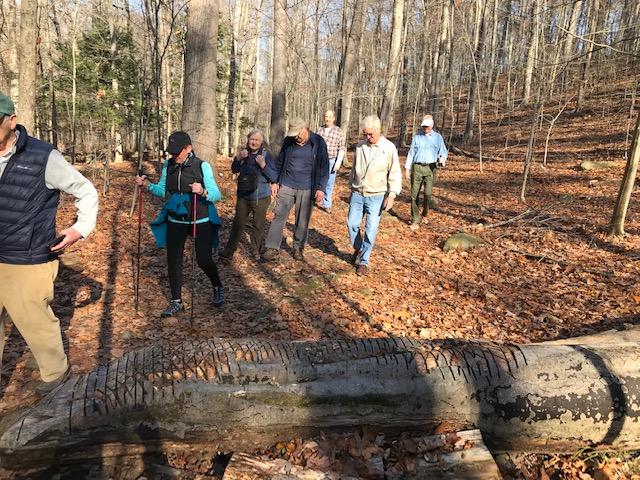
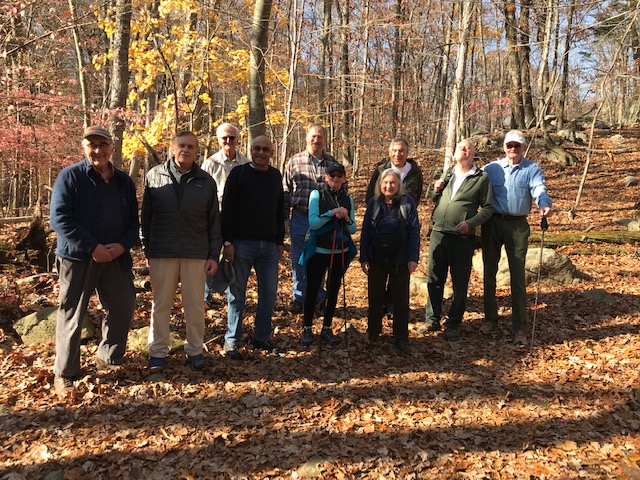
The US Postal Service has nothing on the DMA hikers—“neither rain nor snow…” oh, wait a minute, the day did not turn out badly after all! The overnight snow was still evident at 10:30 in the morning but not a footing issue and the sun came out later on the hike. A good size group of 17 including three spouses walked just short of 3 miles in an hour and a half around the spectacular property. It’s easy to see why Greenwich keeps it pretty much to residents for most of the year!
About half the group stayed on for a delicious lunch at the Beach House Café in Old Greenwich.
Again this hike, as others, give us DMAers a chance to walk and talk in some really nice places!
Next hike—Sherwood Island Park in Westport Thursday, January 12 at 10:00 AM
Dave McCollum
Bob Plunkett
KIRKUS REVIEW
The celebrated New York Times columnist diagnoses this unprecedented historical moment and suggests strategies for “resilience and propulsion” that will help us adapt.
“Are things just getting too damned fast?” Friedman (Hot, Flat, and Crowded: Why We Need a Green Revolution—and How It Can Renew America, 2008, etc.) cites 2007 as the year we reached a technological inflection point. Combined with increasingly fast-paced globalization (financial goods and services, information, ideas, innovation) and the subsequent speedy shocks to our planet’s natural system (climate change, biodiversity loss, deforestation, geochemical flows), we’ve entered an “age of accelerations” that promises to transform “almost every aspect of modern life.” The three-time Pulitzer winner puts his familiar methodology—extensive travel, thorough reporting, interviews with the high-placed movers and shakers, conversations with the lowly moved and shaken—to especially good use here, beginning with a wonderfully Friedman-esque encounter with a parking attendant during which he explains the philosophy and technique underlying his columns and books. The author closes with a return to his Minnesota hometown to reconnect with and explore some effective habits of democratic citizenship. In between, he discusses topics as varied as how garbage cans got smart, how the exponential growth in computational power has resulted in a “supernova” of creative energy, how the computer Watson won Jeopardy, and how, without owning a single property, Airbnb rents out more rooms than all the major hotel chains combined. To meet these and other dizzying accelerations, Friedman advises developing a “dynamic stability,” and he prescribes nothing less than a redesign of our workplaces, politics, geopolitics, ethics, and communities. Drawing lessons from Mother Nature about adaptability, sustainability, and interdependence, he never underestimates the challenges ahead. However, he’s optimistic about our chances as he seeks out these strategies in action, ranging from how AT&T trains its workers to how Tunisia survived the Arab Spring to how chickens can alleviate African poverty.
Required reading for a generation that’s “going to be asked to dance in a hurricane.”
Powers’ (Orfeo, 2014, etc.) 12th novel is a masterpiece of operatic proportions, involving nine central characters and more than half a century of American life.
In this work, Powers takes on the subject of nature, or our relationship to nature, as filtered through the lens of environmental activism, although at its heart the book is after more existential concerns. As is the case with much of Powers’ fiction, it takes shape slowly—first in a pastiche of narratives establishing the characters (a psychologist, an undergraduate who died briefly but was revived, a paraplegic computer game designer, a homeless vet), and then in the kaleidoscopic ways these individuals come together and break apart. “We all travel the Milky Way together, trees and men,” Powers writes, quoting the naturalist John Muir. “In every walk with nature one receives far more than he seeks.” The idea is important because what Powers means to explore is a sense of how we become who we are, individually and collectively, and our responsibility to the planet and to ourselves. Nick, for instance, continues a project begun by his grandfather to take repeated photographs of a single chestnut tree, “one a month for seventy-six years.” Pat, a visionary botanist, discovers how trees communicate with one another only to be discredited and then, a generation later, reaffirmed. What links the characters is survival—the survival of both trees and human beings. The bulk of the action unfolds during the timber wars of the late 1990s, as the characters coalesce on the Pacific coast to save old-growth sequoia from logging concerns. For Powers, however, political or environmental activism becomes a filter through which to consider the connectedness of all things—not only the human lives he portrays in often painfully intricate dimensions, but also the biosphere, both virtual and natural. “The world starts here,” Powers insists. “This is the merest beginning. Life can do anything. You have no idea.”
A magnificent achievement: a novel that is, by turns, both optimistic and fatalistic, idealistic without being naïve.

TUESDAY NOVEMBER 19, 2019
HIKING POMERANCE/MONTGOMERY PINETUM PARK
GREENWICH 10:00 AM
This 100 acre property is now owned by the town of Greenwich but was originally the estate of Ernest Seaton and later the home of financier Maurice Wertheim. The estate house was demolished by the town after falling into disrepair but the stone walls remain. Mr. Seaton is credited with starting a boys group called “The League of Woodcraft Indians” which evolved into the Boy Scouts. Wertheim’s daughter, Barbara Tuchman, lived on the property and wrote the Pulitzer Prize winning book “The Guns of August” there.
This hike is really more of a walk in the woods as the trails are wide, relatively flat and well maintained. It is a very scenic property with mature trees, rock outcroppings and moving water in addition to the historical features. As the property is relatively small, our hike will take approximately 2 hours after which we will enjoy an optional lunch at Louie’s Restaurant (136 River Road Ext.) nearby in Cos Cob.
DIRECTIONS: On Google Maps, enter Montgomery Pinetum on Bible Street in Cos Cob. There is another entrance to the park but parking there is limited. Go to the Bible Street entrance. We will gather in front of the Greenhouse building at 10:00 AM.
Take I-95 south to Exit 5 and stay in left lane on the ramp to turn left at the light onto US 1 south. Proceed .8 miles across the Mianus River Bridge and turn right into Nassau Street and then a quick left onto Valley Road. After .2 miles turn right into Orchard Street and then a quick right onto Bible Street. Drive .8 miles to a left turn into Montgomery-Pinetum Park. 15-20 minutes from Darien with average traffic.
Contact: David McCollum