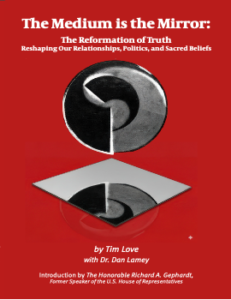
The Medium is the Mirror
Congressman Dick Gephardt’s Presentation
Congressman Dick Gephardt opened his presentation with an optimistic view of America’s future, which he rooted in his decades of interaction with everyday citizens. He reflected on his 35-year career in public service—knocking on doors in St. Louis, hosting weekly town halls, and campaigning across all 50 states during his two presidential bids—concluding that the vast majority of Americans were fundamentally good people. This foundational civic health, he argued, was what had sustained the radical 1789 founding experiment of self-governance without a king.
However, Gephardt shifted to a grave warning about modern threats to this system, focusing heavily on a corrupted information environment driven by big tech and social media algorithms. He labeled these media platforms “hate and outrage machines” designed strictly for addiction and financial profit. Gephardt outlined two major consequences of this unmoderated digital ecosystem: the tragic physical harm to children exposed to dangerous online viral challenges and the deep polarization destroying American democracy. He noted that while political disagreement was normal, algorithmically manufactured hatred had paralyzed Congress, which merely reflected a fractured electorate. Left unchecked, this gridlock risked driving citizens to look toward an authoritarian “Plan B” form of government.
To combat this, Gephardt detailed his volunteer work with the cross-partisan Council for Responsible Social Media. He advocated for legislative reform, specifically targeting the amendment or repeal of Section 230 of the Communication Act. He admitted that voting for Section 230 in the mid-1990s—which shielded platforms from content liability—was one of his worst legislative mistakes, as tech giants later used it as an absolute shield against accountability. Finally, he urged the development of secure, decentralized public platforms modeled after Taiwan’s civic technologies to foster genuine community consensus and rebuild trust in self-governance.
Tim Love’s Presentation
Tim Love, a global advertising veteran and former Vice Chairman of Omnicom, delivered a presentation focused on how technology manipulated human persuasion and threatened cognitive self-governance. Love contextualized the crisis by looking back 30 years to 1996, when the internet had only 15% penetration among American adults. He noted that lawmakers originally passed Section 230 under the false assumption that the internet would operate on subscription models or remain a simple, empty content distribution pipe. Instead, the modern internet evolved into an aggressive surveillance economy funded by advertising. Love explained that the introduction of user metrics like shares and retweets around 2012 allowed companies to map, predict, and ultimately manipulate human behavior by tailoring content to exploit emotional vulnerabilities.
Throughout his presentation, Love effectively utilized several video clips to anchor his arguments and visually engage the audience. He played a data-visualization clip tracking how people met and stayed together from 1930 to 2024, which visually emphasized the sudden, absolute dominance of online dating over traditional structures like church, school, and neighbors. To reinforce his points about the shifting standard of objective reality, he curated a compelling montage of historical news footage and political clips. The first two clips mentioned, featuring Edward R. Murrow’s critique of McCarthyism and Walter Cronkite’s editorial on the Vietnam War stalemate, showed a positive use of journalism to present the alternative side of the argument. In contrast, the last three clips—covering Richard Nixon’s Watergate defense, Bill Clinton’s Lewinsky denial, and televised media dismissals of the COVID-19 pandemic—showed how leaders and influential journalists presented one-sided views to subvert the truth.
Love used psychological and historical framing to explain this conditioning. He introduced the concept of “commitment consistency,” a psychological trait where individuals formed a belief and doubled down on it to avoid discomfort. While traditional advertising used this concept to track brand loyalty, modern tech algorithms exploited it at an unprecedented scale. Love explicitly rejected the term “brainwashing”—which historically relied on physical isolation and duress, such as the tactics used on prisoners during the Korean War—and instead termed the modern phenomenon “brain hijacking” or “neuro dystopian conditioning”. He explained that as communication shifted from synchronous, face-to-face interactions to asynchronous typing, texting, and screen consumption, it fundamentally rewired human brains. This left individuals uniquely susceptible to continuous algorithmic manipulation.
To demonstrate the real-world danger of this environment, Love displayed multiple examples of digital disinformation and election interference. He highlighted documented platform infiltration by bad actors during the 2016 U.S. election and the Brexit vote, alongside recent massive compromises of election data and an eight-fold increase in hostile foreign fake news operations. Love argued that the “Magnificent Seven” tech monopolies now held an extraordinary concentration of power, controlling not just physical infrastructure like historic robber barons, but the absolute distribution and visibility of human thought.
Love closed his presentation with a direct call to action, challenging the audience to unite and vote based on “Issue One” rather than blind political party loyalty. He defined “Issue One” as the urgent national fight against systemic ignorance, intolerance, and indifference to protect America’s most fundamental freedom: the freedom to think for ourselves. According to Love, both major political parties and all major media institutions have been deeply compromised by money and lobbying from tech monopolies. By treating cognitive self-governance as the primary voting issue, citizens can elect representatives committed to structural communication policy reform. Specifically, Love asserted that voters must force their representatives to sunset Section 230 and dismantle the artificial algorithmic echo chambers that intentionally polarize the electorate for corporate profit.
Alongside this electoral strategy, Love shared his own personal act of independence: giving up his smartphone for a basic phone that lacked mind-reading algorithms, tracking apps, and data harvesting features. He challenged the audience to reclaim their cognitive freedom by disconnecting from these devices, asserting that when consumers withheld their attention, tech lobbies would finally be forced to serve the public interest rather than their own corporate profits.
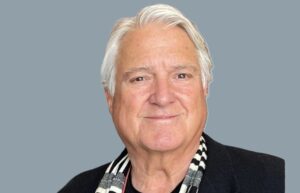 Tim Love is former Vice-Chairman of Omnicom Group, a leading global advertising and marketing services company. Throughout Tim’s career in the advertising industry he helped clients be more globally sensitive, collaborative and effective. His extensive global brand-building experience involved residing in Brussels, Tokyo, Singapore and New York City. He worked with some of the world’s most sophisticated marketers: P&G, Nissan and Infiniti automobiles, PepsiCo, Unilever, Gillette, Mars, UBS, Kraft, Philips and J&J.
Since retiring from Omnicom in 2013, Tim has returned to artistic beginnings. He also co-taught at Oxford University’s Said School of Business MBA program on “Branding and Communication,” he was on the faculty of the US Marketing Communications College, a pro-bono initiative at the Foreign Service Institute of the US State Department. He has also lectured on “Discovering Truth” an initiative he started 8 years to discern how people discern truth in a post-digital world. He has lectured at numerous universities across the country and a the National Voice of America Museum of Broadcasting. His 2024 podcast interview with PBS station WGCU won a regional Edward R. Murrow Award and will compete for a national award in August.
He is author of two award-winning books available on Amazon- “Discovering Truth: How to Navigate Between Fact & Fiction in an Overwhelming Social Media World” (Internationalist Press) and “The Book that Gets Better with Age” (LID London). Recent work is also available on Substack@timloveideas.com- “The Elephant in the Room” and “The Cost of Not Pursuing Truth.” and “The Medium is the Mirror.” His podcast series, Tim Love’s Discovering Truth includes 58 episodes of interviews with leading communication experts including Jane Goodall.
Tim was a founding member and first chairman of the 4A’s Multicultural Advertising Internship program, now in its 52nd year and a founding member for Business for Diplomatic Action (BDA), focused on improving international business cooperation.
He recently was invited to be on the Council for Responsible Social Media (CRSM) a cross-partisan initiative of Issue One in Washington DC.
Tim is a James Webb Young Fellow with a Masters in Communication from the University of Illinois and he has a Bachelor of Science in Business Administration with a minor in Fine Arts from Miami University in Ohio. Tim Love Ideas, LLC, is doing commissioned art and creating ideas. Also see www.timlovesworld.com.
 Richard. A Gephardt, President and CEO of Gephardt Group
Mr. Gephardt served for 28 years in the United States House of Representatives from 1976 to 2004, representing Missouri’s 3rd Congressional District, home to his birthplace St. Louis. In his role as Leader, Mr. Gephardt emerged as one of the leading strategists of the Democratic Party’s platform and chief architect to landmark reforms ranging from healthcare, pensions, education, energy independence and trade policy. In his first year in Congress, he was appointed to both the House Ways & Means and Budget Committees. He was elected to serve as House Democratic Leader for more than 14 years, as House Majority Leader from 1989 to 1995 and Minority Leader from 1995 to 2003. Mr. Gephardt ran for the Democratic nomination for U.S. President twice, in 1988 and 2004. Mr. Gephardt retired from the U.S. Congress in 2005 to found Gephardt Group, a privately held labor relations consulting and government affairs firm. He was Chair of the Board of Trustees of the Scripps Research Institute, a private, non profit research organization engaged in biomedical science. Most recently, Mr. Gephardt was a member of the Board of Directors at SpiritAerosystems, Centene Corporation, Ford Motor Company, CenturyLink and U.S. Steel Corporation. In addition, he is a member of the Board of Directors at The Washington Center for Internships and Academic Seminars, a member of the Council on Foreign Relations and is the Founder of the Gephardt Institute for Civic and Community Engagement at Washington University in St. Louis. Widely known for his advocacy for international human rights, Mr. Gephardt served as Chairman of the National Endowment for Democracy, a private, nonprofit organization that endeavors to strengthen democratic institutions around the world through nongovernmental efforts, from 2009 to 2013.
Mr. Gephardt began his career in public service in 1968 as a precinct captain to St. Louis’ 14th ward. From 1971 to 1976, he served as Alderman for the city’s 14th ward. In 1976, he was elected to the U.S. Congress, succeeding 24-year incumbent Leonor Sullivan.
Mr. Gephardt earned his Bachelor of Science from Northwestern University in 1962 and his juris doctorate from the University of Michigan Law School in 1965.